

I sat on both sides of the table. I have been the business owner desperate for more traffic, and I have been the consultant trying to explain why rankings dropped after a Google update. In my years of analyzing search data, I have seen millions of dollars wasted on bad contracts and “guaranteed rankings” that never happened.
Choosing a partner to manage your search visibility is one of the most stressful decisions a business owner makes. Hire the right team, and you build an asset that generates revenue while you sleep. Hire the wrong one, and you might wake up to a manual penalty that wipes your site off the map.
Most guides on this topic are full of jargon. They tell you to look for “backlink profiles” or “schema markup” without explaining why those things matter to your bank account. I want to strip all that away.
In this guide, I will walk you through exactly what to look for when hiring an SEO company. I will share the specific questions I ask, the red flags that make me run, and how to use your own data—tools like Google Search Console or my own platform, sneo.ai—to keep them honest.
You do not need to be a technical wizard to make a smart hire. You just need to know which questions to ask.
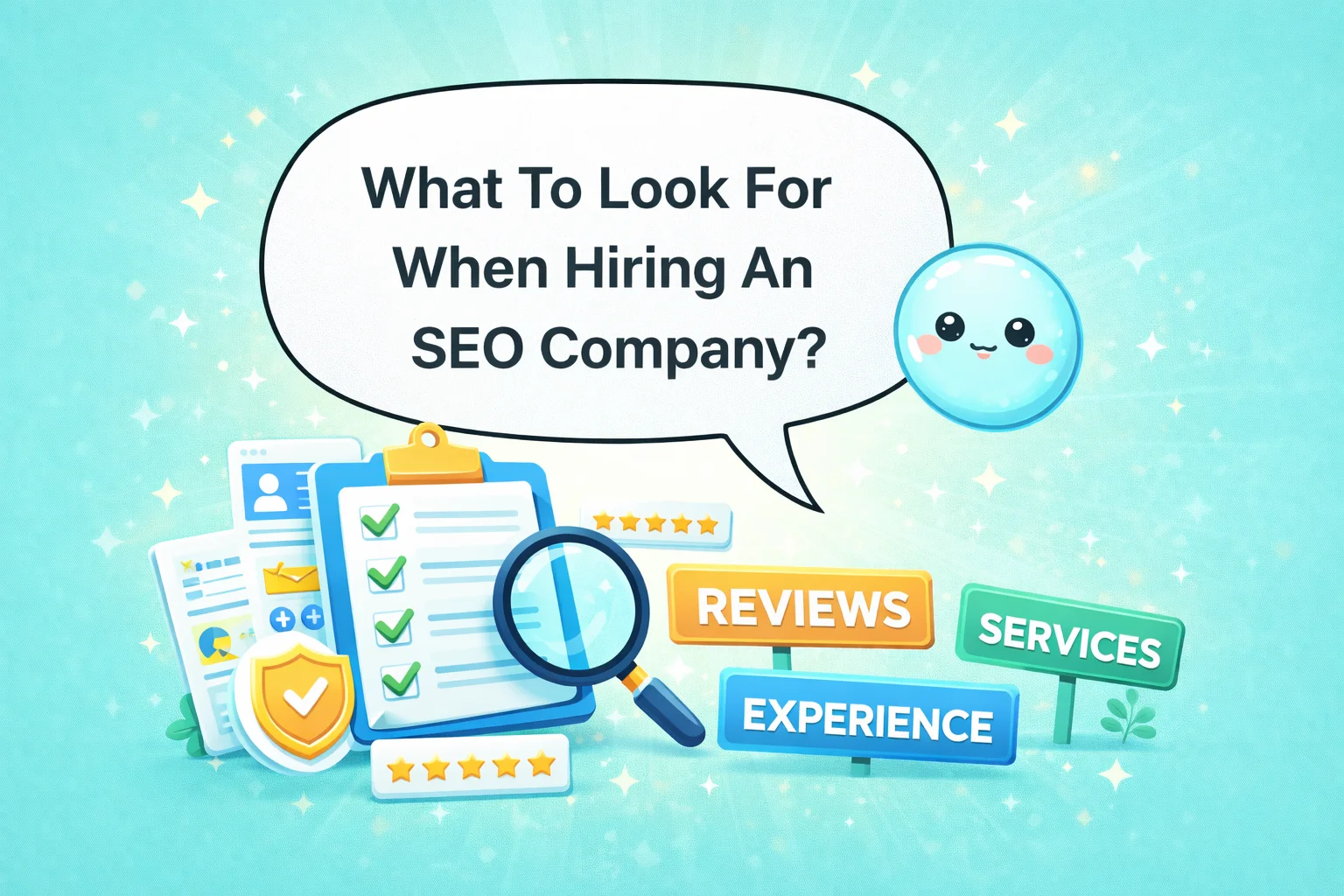
What To Look For When Hiring An SEO Company: The Direct Answer
Prioritize transparency, proven industry experience, and clear communication. Validate claims with specific case studies and independent reviews. Choose a partner focused on revenue and long-term growth, not cheap packages or guaranteed rankings.
Understand Your Own Goals Before You Hire
Before you even open Google to search for an agency, you need to look at your own business. I ask every potential client this question: “What does a win look like to you?”
You would be surprised how many people say, “I just want to rank number one.”

Ranking number one for a term nobody searches for is useless. Ranking number one for a term that brings in visitors who never buy anything is a waste of money.
Clarify What You Need
I break goals down into three categories. Knowing which one you fit into will help you filter agencies immediately.
- Traffic Goals: You have a blog or a news site. You make money from ads. You need sheer volume.
- Lead Generation: You are a lawyer, a plumber, or a SaaS company. You do not care if 10,000 people visit if zero people fill out your contact form. You need high-intent traffic.
- Ecommerce Sales: You sell shoes or software licenses. You need people ready to pull out their credit cards.
If you run a local bakery, hiring an agency famous for working with international software companies is a mistake. Their tactics won’t match your needs.
Use Your Data to Set Benchmarks
I always tell site owners to look at their current reality before asking for a quote. If you have Google Search Console set up, look at your performance for the last six months.
If you find that data confusing, this is exactly why I built sneo.ai. You can connect your account and simply ask, “Which pages have dropped in traffic lately?” or “What are my highest potential keywords?”
Having this baseline protects you. When an agency promises to “double your traffic,” you can look at your historical data and ask, “How? We have been flat for two years. What specific change will you make?”
If you skip this step, you are walking into a negotiation blind. Clear goals act as your shield against smooth sales talk.
Credentials Verification and Team Background
There is no “SEO University.” No governing body hands out licenses to practice search engine optimization. This lack of regulation means anyone with a laptop can call themselves an expert.
This makes knowing what to look for when hiring an SEO company tricky, because you can’t just ask for their license number. Instead, you have to play detective.
What Credentials Actually Matter
Ignore badges that say “Best SEO Agency 2025” from websites you have never heard of. Those are often “pay-to-play” awards.
Here is what I value instead:
- Google Analytics & Google Ads Certifications: While these don’t teach SEO directly, they show the team understands the data ecosystem.
- Published Case Studies: Real work is the best credential.
- Team Tenure: Does the person handling your account have five years of experience, or did they graduate last month? I often see agencies where the founder is a genius, but the person doing the actual work on your site is an intern.
How to Verify Properly
I suggest a simple test during your sales call. Ask them about a recent change in Google’s systems.
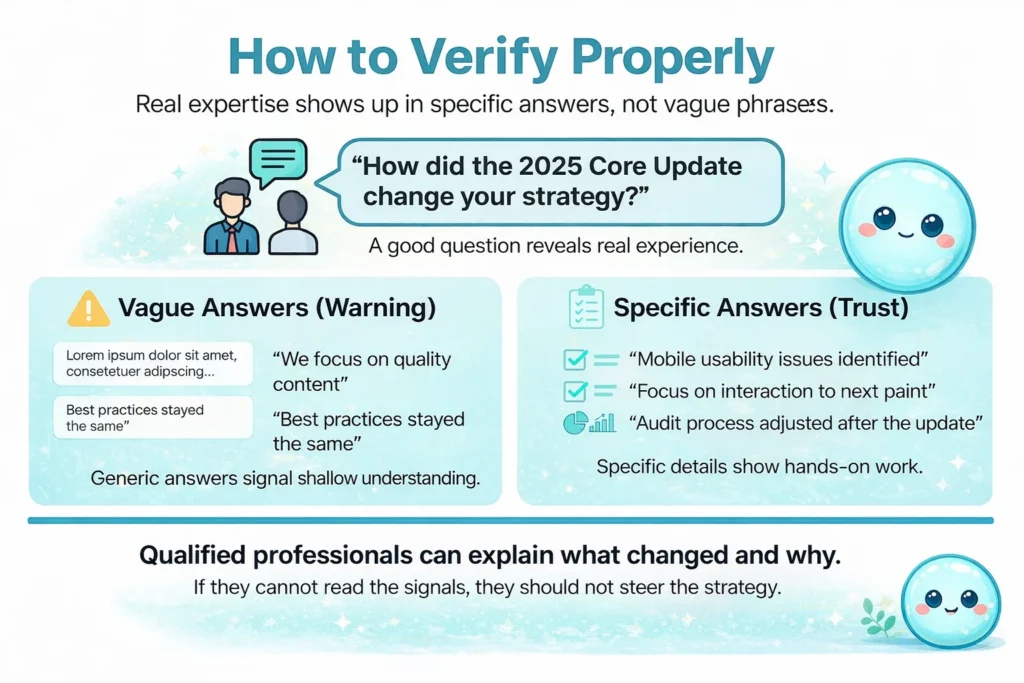
For example, you might ask, “How did the 2025 Core Update impact your strategy for clients?”
If they give you a vague answer about “quality content,” be wary. A qualified professional will get specific. They might say, “We noticed the update hit sites with poor mobile usability hard, so we adjusted our technical audits to focus on interaction to next paint metrics.”
When I analyze data through sneo.ai, I can see instantly if a site was hit by a specific update. Your agency should be able to see that too. If they can’t explain what is happening in the industry, they are not qualified to manage your greatest marketing asset.
Industry Experience That Matches Your Business
Search intent changes completely depending on the industry.

I once reviewed a strategy for a local dentist. The agency was building links from tech blogs and writing 3,000-word articles about the “history of dentistry.” It was a waste. When your tooth hurts, you do not want a history lesson; you want a phone number and an address.
Why Experience Changes Results
- Local Businesses: Need a focus on Google Maps, reviews, and local citations.
- Ecommerce: Needs a focus on product page structure, schema markup, and handling out-of-stock items.
- SaaS/B2B: Needs a focus on educational content and long sales cycles.
If an agency only has experience with ecommerce, they might struggle to rank your local law firm.
Judging Real Experience
Ask them to show you a client in a similar field. You do not need them to have worked with your direct competitor (in fact, that might be a conflict of interest), but they should understand your business model.
Ask this: “What is the biggest challenge for your industry right now?”
If you are in real estate, they should talk about how hard it is to compete with Zillow or Redfin. If you are in insurance, they should mention the high cost of ads and the difficulty of building trust.
I have found that generalist agencies often apply a “cookie-cutter” approach. They have a checklist they run for every client, regardless of whether you sell pizza or enterprise software. That does not work in 2026.
Case Studies That Show Real Work
Reviewing case studies is a vital part of what to look for when hiring an SEO company. However, you need to read them with a skeptical eye.
I see this all the time on agency websites: “We increased traffic by 500%!”
That sounds amazing. But if the site started with 10 visitors a month and went to 60, that is a 500% increase. It is also statistically meaningless for a real business.
Elements of a Strong Case Study
When I read a case study, I look for four things:
- The Starting Line: What was the site’s condition before they started? Was it penalized? Was it brand new?
- The Strategy: I want to know what they did. Did they fix technical errors? Did they rewrite content? If they can’t explain the “how,” they might have used spammy tactics.
- The Timeline: SEO takes time. Studies by Ahrefs show that only 5.7% of pages rank in the top 10 within a year. If a case study shows a massive spike in two weeks, I get suspicious. That usually implies a viral hit or paid traffic mixed in, not sustainable organic growth.
- Business Impact: Did that traffic turn into revenue?
Spotting Misleading Claims
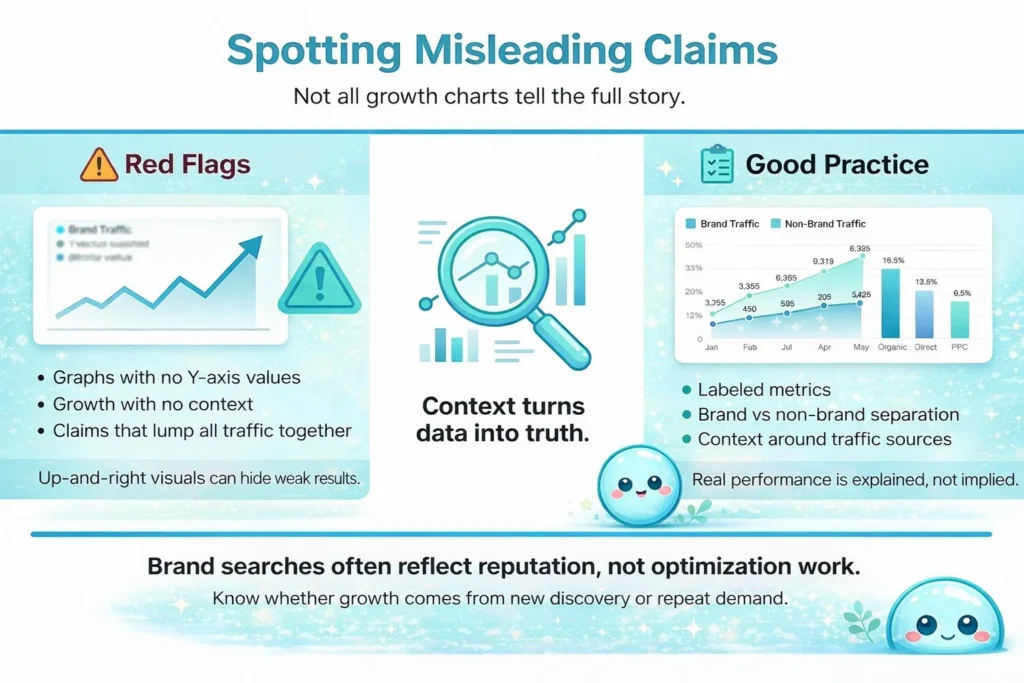
Watch out for graphs that have no Y-axis labels. If a chart goes up and to the right but doesn’t show the actual numbers, they are hiding something.
Also, ask for context. I worked with a client once who fired their previous agency because they claimed credit for “brand traffic.” Brand traffic comes from people searching for your company name. That is usually a result of your TV ads or reputation, not the SEO company’s work.
A good partner will separate “brand” vs. “non-brand” performance. This is something I emphasize when I help users interpret their sneo.ai reports—you need to know if new people are finding you, or if it is just your repeat customers coming back.
Client Testimonials and Independent Reviews
Testimonials on a company’s homepage will always be glowing. No business puts a one-star review on their front door. To find the truth, you have to dig deeper.
Reading Critically
When looking at testimonials, look for specifics.
- Weak: “Great guys, loved working with them.”
- Strong: “We struggled with a technical indexing issue for months. The team identified the JavaScript conflict in week one and our traffic recovered by month three.”
The second review tells you they have technical chops and solve hard problems.
Where to Find the Real Story
Go to third-party platforms like Google Maps, Clutch, or even Reddit/LinkedIn.
I often search for the agency’s name plus the word “scam” or “complaint” just to see what comes up. Every business has unhappy clients, but you are looking for patterns. Do people consistently complain about communication? Do they complain about long contracts with no results?
I also suggest asking the agency for a reference you can call. Ask that reference: “What happens when things go wrong?”
Every project has bumps. You want to know how the team handles them. Do they hide, or do they communicate?
Transparent Pricing and Clear Scope of Work
Transparent pricing is often the hardest part of figuring out what to look for when hiring an SEO company. The industry is notorious for vague “packages.”
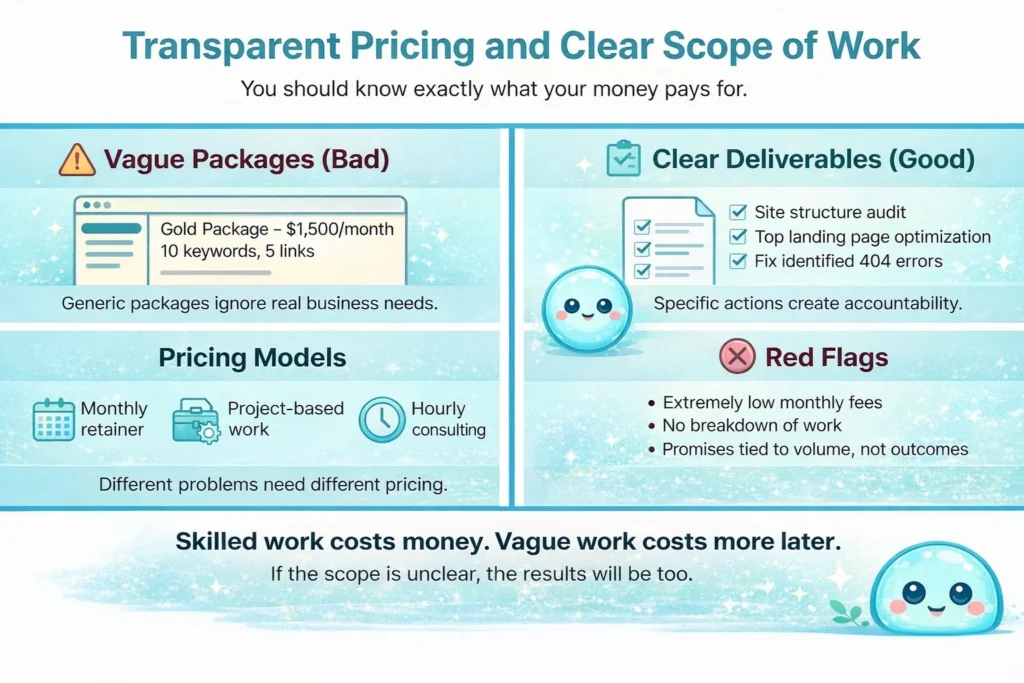
You might see: “Gold Package – $1,500/month – Includes 10 keywords and 5 links.”
I hate this model. It treats your business like a fast-food menu. Your business might not need links this month; it might need a site speed fix.
What Transparency Looks Like
A good proposal should outline deliverables, not just time.
- Bad: “10 hours of SEO work.”
- Good: “We will audit the site structure, optimize the top 20 landing pages, and fix the 404 errors identified in the technical crawl.”
You should know exactly where your money is going.
Pricing Models
- Monthly Retainer: Most common. You pay a flat fee for a set amount of resources.
- Project-Based: Good for specific audits or migrations.
- Hourly: Good for consulting calls, but hard to manage for long-term growth.
Red Flags
If a company offers you SEO for $300 a month, run. Good SEO requires skilled labor—writers, technical experts, strategists. You can’t hire three experts for $300. Cheap agencies often use automated bots to spam links to your site, which can get you banned from Google.
I always say: If you think a professional is expensive, wait until you hire an amateur.
Customized Strategies Instead of One-Size Plans
I mentioned “cookie-cutter” plans earlier. Let’s talk about why customization matters.
Every website has a different “bottleneck.”
- Site A has great content but is technically broken (Google can’t read it).
- Site B is technically perfect but has no content.
- Site C has content and tech, but no authority (backlinks).
If an agency applies the same strategy to all three, two of them will fail.
Discovery and Audit
A real strategy starts with an audit. When I start with a new project, or when a user connects to sneo.ai, the first step is always diagnosis.
During the sales process, ask them: “Based on your quick look at my site, what is our biggest weakness?”
They should be able to point out something specific. “I noticed your blog posts are very short,” or “I saw your site loads slowly on mobile.”
If their strategy is “we will just build links,” they haven’t looked at your site. They are selling a product, not a solution.

Technical Expertise That Goes Beyond Content
Technical skill is a non-negotiable factor in what to look for when hiring an SEO company.
In 2026, websites are complex. We use JavaScript frameworks, client-side rendering, and massive databases. If your SEO agency only knows how to write keywords in a title tag, they are obsolete.
Core Technical Skills
You need a team that understands:
- Crawlability: Can search engine bots access your content?
- Core Web Vitals: Is the site stable and fast?
- Schema Markup: Can they help you get those rich star ratings in search results?
- Index Management: Keeping low-quality pages out of Google is just as important as getting good pages in.
How to Test This
Ask a simple question: “How do you handle JavaScript rendering?”
Even if you do not understand the answer, watch how they explain it. Do they sound confident? Can they explain it simply?
I believe technical SEO is the foundation. You can build the most beautiful house in the world (great content), but if you build it on a swamp (bad technical setup), it will sink.
Communication Skills and Ongoing Support
You are hiring a partner, not a vending machine. You need to talk to them.
I have heard horror stories of clients who sign a contract and then don’t hear a word for three months. That is unacceptable.
What Good Communication Looks Like
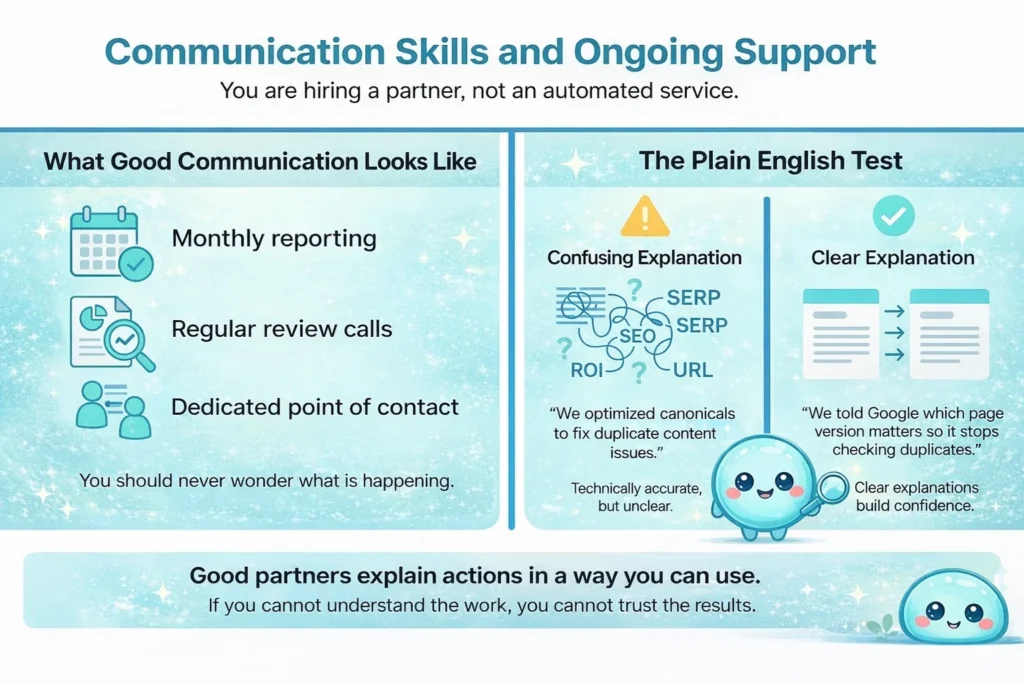
- Reporting Rhythm: You should get a report at least once a month.
- Meetings: A monthly call to review the data is standard.
- Point of Contact: You should have a dedicated account manager, not a generic “support@” email address.
The “Plain English” Test
Can they explain what they are doing without using acronyms? If they say, “We are optimizing the canonicals to fix the duplicate content budget,” that is gibberish to most business owners.
They should say: “We are telling Google which version of the page is the main one so it doesn’t waste time looking at copies.”
This drive for clarity is why I built the “Plain English” engine into sneo.ai. I wanted business owners to get answers they could actually use, not just a dump of data. Your agency should provide that same level of clarity.
Updated SEO Knowledge and Ongoing Learning
Because the rules change so fast, adaptability is what to look for when hiring an SEO company.
Google updates its systems thousands of times a year. Major updates happen every few months. What worked in 2024 might get you penalized in 2026.
AI and Search
With the rise of AI Overviews and generative search, the way people find information has shifted. Is your prospective agency talking about this?
Ask them: “How are you optimizing for AI-generated answers?”
If they say “we ignore that,” they are behind the curve. They should be talking about structure, direct answers, and brand authority.
Check their blog. Do they write about recent changes? Do they attend conferences? A stagnant SEO is a dangerous SEO.
Compliance With Search Engine Guidelines
You need to know if they play by the rules. Google has strict “Spam Policies”. If you violate them, your site can be removed from the index.
What Compliance Means
It means avoiding “black-hat” tactics like:
- Hiding text (white text on a white background).
- Cloaking (showing one thing to Google and another to users).
- Buying links.
Questions to Ask
Ask them directly: “Do you follow Google’s Webmaster Guidelines?”
Also ask: “What is your approach to link building?”
If they say they have a “private network” of sites, run away. That is a Private Blog Network (PBN), and it is a ticking time bomb for your site’s health.

White-Hat Techniques and Ethical SEO Practices
Safety and ethics are often overlooked when discussing what to look for when hiring an SEO company.
“White-hat” refers to strategies that target a human audience. It includes:
- Creating high-quality, helpful content.
- Improving site speed and security.
- Earning links through PR and outreach.
Why Ethics Matter
Unethical tactics work… for a little while. I have seen sites rocket to the top using spam, only to crash two months later and never recover.
If you are building a legitimate business, you can’t afford that risk. You want steady, sustainable growth.
I always tell my clients: “If it feels like cheating, it probably is.” Google employs some of the smartest engineers in the world. You are not going to outsmart them with a cheap trick.
Performance Tracking and Reporting
What gets measured gets managed. But are they measuring the right things?
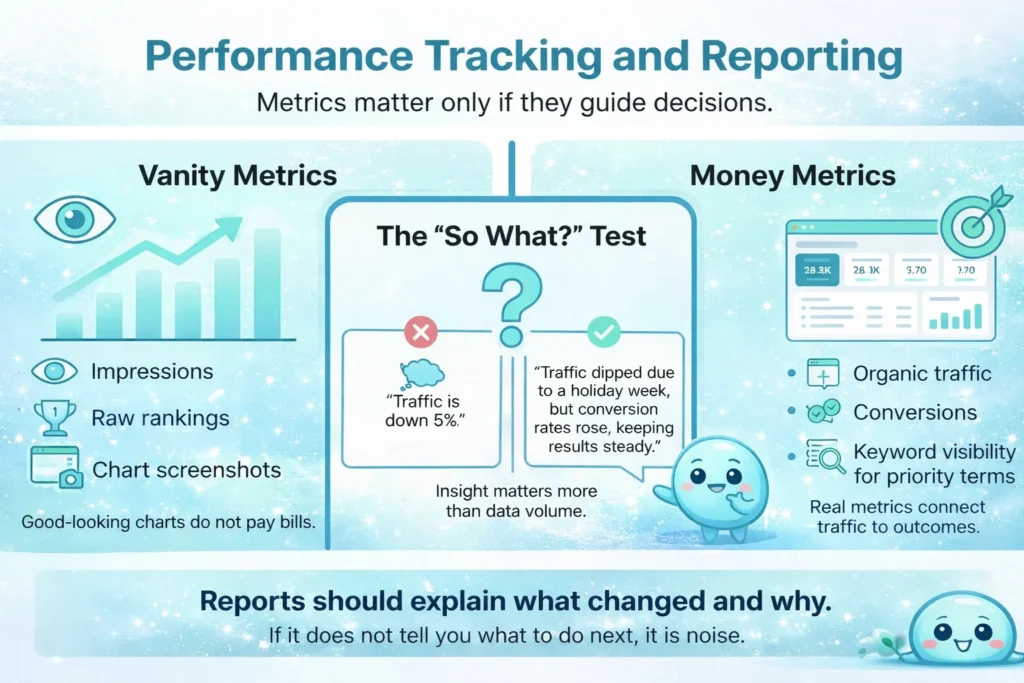
Vanity Metrics vs. Money Metrics
“Impressions” look good on a chart. But you can’t pay rent with impressions. Industry research shows that organic search drives 53% of all site traffic, so tracking how that traffic converts is vital.
A good report should track:
- Organic Traffic: Visitors from search.
- Conversions: Leads, sales, signups.
- Keyword Visibility: Are you moving up for terms that matter?
The “So What?” Factor
A report should not just be a screenshot of a graph. It needs commentary.
“Traffic is down 5% this month.” Okay, why?
“Traffic is down 5% because of a seasonal holiday drop, but conversion rates are up, so revenue is actually flat.” That is a useful insight.
This is the core philosophy behind sneo.ai. I wanted to move away from static dashboards and move toward actionable answers. When you look at an agency report, ask yourself: “Does this tell me what to do next?”
Value for Investment, Not Just Low Fees
True value is the ultimate goal of what to look for when hiring an SEO company.
Do not shop for SEO like you shop for office supplies. You are not buying paper clips; you are buying expertise.
The Cost of Cheap SEO
If you pay $500/month, you are likely getting:
- Automated reporting.
- No real strategy.
- Risky links.
If you pay $3,000/month, you should be getting:
- A dedicated strategist.
- Content production.
- Technical audits.
- Safe, long-term growth.
Calculate the ROI. If the $3,000 agency brings in $30,000 in new sales, they are effectively free. If the $500 agency brings in $0, they are an expense.
Long-Term Growth Focus vs Short-Term Wins
SEO is not a sprint. It is not even a marathon. It is a lifestyle choice for your website.
Compounding Returns
The work you do today might not pay off for six months. But once it kicks in, it compounds. A great article written in 2025 can still bring you traffic in 2030.
Planning for the Future
A good agency will have a 6-month or 12-month roadmap. They should be thinking about:
- Expanding your content library.
- Building authority over time.
- Keeping technical health high.
If they promise “instant rankings,” they are lying. The only way to get instant visibility is to pay for ads (Google Ads). SEO is about building equity.

How to Compare Multiple SEO Companies Side by Side
Use this checklist to finalize what to look for when hiring an SEO company. Create a spreadsheet and grade them.
- Goals: Did they ask about my revenue goals?
- Credentials: Do they have case studies in my industry?
- Transparency: Is the scope of work clear?
- Technicals: Can they explain technical issues simply?
- Ethics: Do they stick to white-hat methods?
- Reporting: Do they track conversions, not just clicks?
- Chemistry: Do I actually like talking to them?
The “Chemistry” part is underrated. You will be working with these people for a long time. If you dread their phone calls, it won’t work.
Final Hiring Checklist Before You Sign a Contract
We are at the finish line. Before you sign, check the fine print.
- Exit Clauses: Can you leave if they don’t perform? A 30-day notice period is standard. Avoid 12-month “lock-in” contracts unless you trust them implicitly.
- Ownership: Who owns the content and the analytics? You must own everything. I have seen agencies hold websites hostage because the client didn’t own the hosting or the Google Analytics account.
- Access: Ensure you have administrative access to all tools.
Conclusion
Hiring an SEO company is a big step. It means you are ready to take your business growth seriously.
To recap, finding the right partner comes down to transparency, realistic expectations, and technical competence. Ignore the flash, ignore the guarantees, and look for a team that wants to understand your business mechanics.
Ask the hard questions. Demand clear answers. And most importantly, keep an eye on your own data.
I built sneo.ai because I believe every business owner deserves to understand their own website. You can use it to audit your agency’s work, or just to get a second opinion on your performance. Whether you hire an agency or do it yourself, the data is there waiting for you.
Take your time, choose wisely, and watch your business grow.
FAQ Section
1) What should I ask first when speaking with an SEO company?
Ask them, “Have you worked with a business like mine before, and what were the specific challenges you faced?” This tests their relevant experience immediately.
2) How long does it usually take to see results from SEO?
Typically 4 to 6 months to see significant movement. If it is a brand new site, it can take up to a year. Anyone promising results in 30 days is likely using risky tactics or confusing SEO with paid ads.
3) Is it safe to hire a low-cost SEO provider?
Usually, no. Low-cost providers often cut corners by using automated tools or spammy link-building networks that can lead to Google penalties. Good labor costs money.
4) How can I tell if an SEO company is using white-hat techniques?
Ask them for their link-building strategy. If they talk about “content,” “outreach,” and “PR,” that is white-hat. If they mention “PBNs,” “link exchanges,” or “submission services,” that is risky.
5) What type of reporting should I expect each month?
You should expect a report that covers traffic, rankings, and conversions (leads/sales). Crucially, it should include an overview or breakdown of work completed and a plan for the next month.
6) Do small businesses need a different SEO approach than large brands?
Yes. Small businesses usually need to focus on “Local SEO” (Google Maps, local terms) and niche authority. Large brands focus more on broad technical architecture and massive content libraries.
7) Can an SEO company guarantee rankings?
No. Google explicitly warns against companies that guarantee rankings. The algorithm is secret and changes constantly. No third party can control it.
8) How often should strategies be reviewed and adjusted?
At least quarterly. The web changes fast. A strategy set in January might need to shift by April based on performance data and search updates.