

I’ve reviewed hundreds of Google Search Console accounts, and one question comes up constantly: what is a good average position in google search console? While there isn’t one single answer, a good average position in Google Search Console (GSC) is generally considered to be 1-3. It depends on your site’s age, your niche’s competitiveness, and what you’re optimizing for. In this article, I’ll walk you through exactly how to read your average position data, what benchmarks actually matter, and how to move the needle.
TL;DR
- Positions 1–10 sit on page one; positions 1–3 capture the majority of organic clicks.
- Average position is a mean across all queries, so a site-wide number of 20–35 is normal and not alarming.
- New sites realistically land between 30–60 at first; don’t panic.
- What matters more than the raw number: the trend direction and your CTR at each position.
What Does Average Position Mean in Search Console?
Average position in Google Search Console is the mean ranking of your URLs across every search query that triggered an impression during your selected date range. Google calculates it by averaging your highest-ranking URL for each query, then averaging those across all queries in your report.
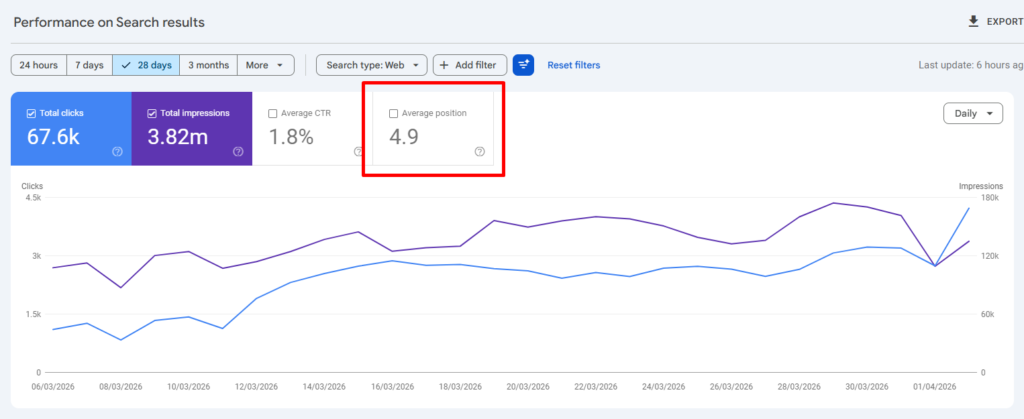
This sounds straightforward, but there’s a nuance most people miss. Marco Giordano highlighted on LinkedIn that average position is calculated before filters are applied, which means your filtered view can show slightly different numbers than you’d expect. Google’s own documentation confirms the metric reflects the topmost position your site appeared for a given query, not an average across multiple URLs for the same query.
What this means practically: if one page ranks at position 2 for a high-volume keyword and another page sits at position 45 for a niche query, your account-level average might read somewhere around 23. That number alone tells you almost nothing useful.
The search performance report shows average position alongside impressions, clicks, and CTR. I always recommend filtering by individual pages or query clusters rather than reading the site-wide average. A branded query pulling you to position 1 inflates the number; a newly indexed page buried at position 80 drags it down.
Key things average position does NOT tell you:
- Whether you appeared in a featured snippet, image pack, or local pack
- How many people actually saw your result (that’s impressions)
- Whether position improved or declined week-over-week without date comparison
- The difference between desktop and mobile rankings
Use the average position as a directional signal, not a verdict. Pair it with CTR benchmarks and impressions for the full picture. For a deeper dive into interpreting these metrics, our sneo.ai Google Search Console alternative overview shows how AI-assisted analysis surfaces the patterns that manual reading misses.
What Is a Good Average Position in Google Search Console?
This is the core question, and I’ll give you a real answer. What is a good average position in google search console depends entirely on context, but here’s a practical framework:
| Position Range | What It Means | Priority Action |
| 1–3 | Prime real estate, high CTR | Protect and expand to related queries |
| 4–10 | Page one, solid visibility | Optimize CTR via title/meta improvements |
| 11–20 | Page 2, opportunity zone | Content depth and internal linking push |
| 21–50 | Indexed but low visibility | Content refresh, E-E-A-T improvements |
| 51+ | Minimal organic value | Audit: is this page worth keeping? |
Research from Advanced Web Ranking, 2025 shows the top 3 organic results capture roughly 50–60% of all clicks for a given query, with position 1 alone drawing above 25% CTR on average.
A site-wide average position of 20–35 is common for established sites with a mix of competitive and long-tail keywords. If you’re running an SEO agency with hundreds of client pages indexed across varied niches, you might comfortably sit at 28 site-wide while having excellent individual performers.
The question to ask isn’t “is my average position good?” It’s “which queries are sitting at position 8–15 that I can push to the top five?” That’s where the real organic traffic growth lives. A page at position 8 converting to position 3 can triple its clicks without a single new backlink if the content is right.
Understanding what is a good average position in google search console also means accepting that averages obscure performance. Segment your data by page, device, and country before drawing conclusions.
Is Position 10 Good in Google Search Console?
Yes, position 10 is still page one, but it sits at the bottom of above the fold results on most desktop screens, and often below the fold on mobile. Its CTR reflects that reality.
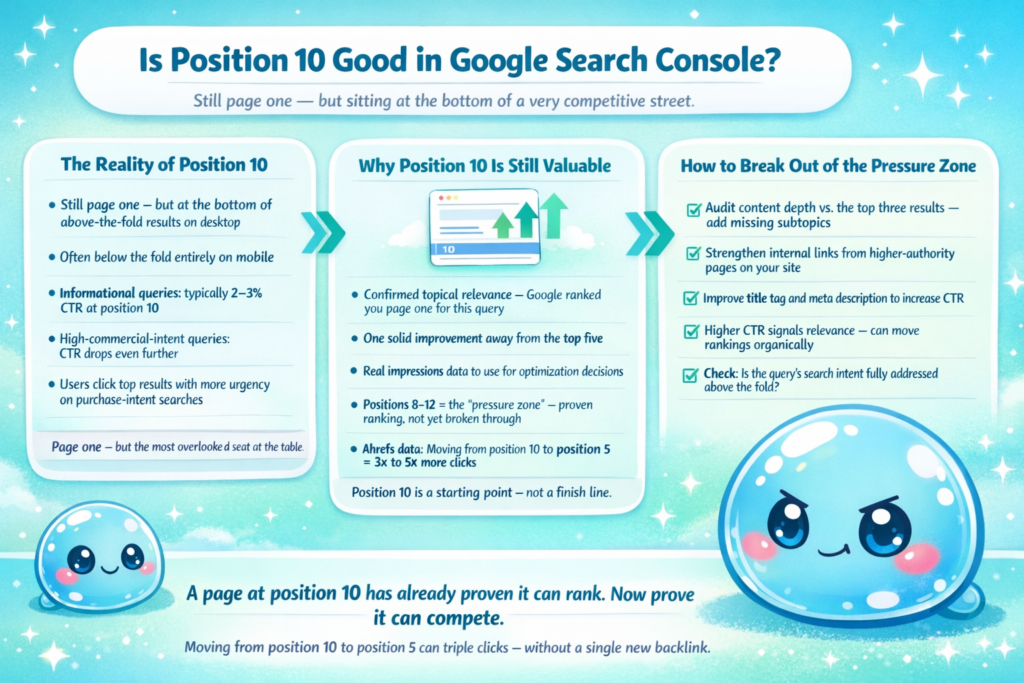
For informational queries, position 10 typically earns 2–3% CTR. For navigational or high-commercial-intent queries, that figure drops further because users click the top results with more urgency.
That said, position 10 is genuinely valuable for a few reasons:
- You have confirmed topical relevance: Google ranks you page one for this query.
- You are one solid content or authority improvement away from the top five.
- Impressions at position 10 are still real data you can use for optimization.
Positions 8–12 are what I call the “pressure zone.” These pages have proven they can rank but haven’t broken through. In my experience working with site owners through sneo, these are almost always fixable with targeted interventions:
- Audit the page’s content depth versus the top three results.
- Strengthen internal linking from higher-authority pages on your site.
- Improve the title tag and meta description to increase CTR, which can signal relevance to Google.
- Check whether the query’s search intent is fully addressed above the fold.
Position 10 is not a finish line. It’s a starting point for a more targeted push. Ahrefs’ CTR study, 2025 consistently shows that moving from position 10 to position 5 can increase organic clicks by 3x to 5x for the same query. That’s a compelling reason to focus your efforts here.
What Is a Realistic Average Position for a New Website?
New sites face the Google sandbox effect, a period where Google withholds significant ranking power while it builds trust in a domain. Realistically, a brand new site should expect:
- Months 1–3: Most pages at position 50–100 or not ranking at all.
- Months 3–6: Long-tail, low-competition queries beginning to surface at position 20–50.
- Months 6–12: Consistent positions in the 15–35 range for targeted keywords if content and technical SEO are solid.
According to Ahrefs, 2025, the average page in the top 10 results is over 2 years old, meaning new sites are competing against an entrenched time advantage.
This is why ongoing SEO matters so much for newer domains. Consistency compounds. A site that publishes quality content and earns even modest links monthly will see its average position improve steadily over 12–18 months.
For new site owners, here’s what I recommend watching instead of the average position number:
- Are impressions growing month-over-month? That signals Google is indexing and surfacing more of your content.
- Are any pages breaking into the top 30 for target queries?
- Is position tracking showing a downward trend (lower number = better rank) over time?
Don’t benchmark yourself against established competitors at the 6-month mark. Benchmark yourself against your own last month. That’s what progress looks like early on.
How to Improve Average Position in Google Search Console
Improving average position isn’t about chasing the number. It’s about systematically moving specific pages up in the SERP. Here’s the process I use:
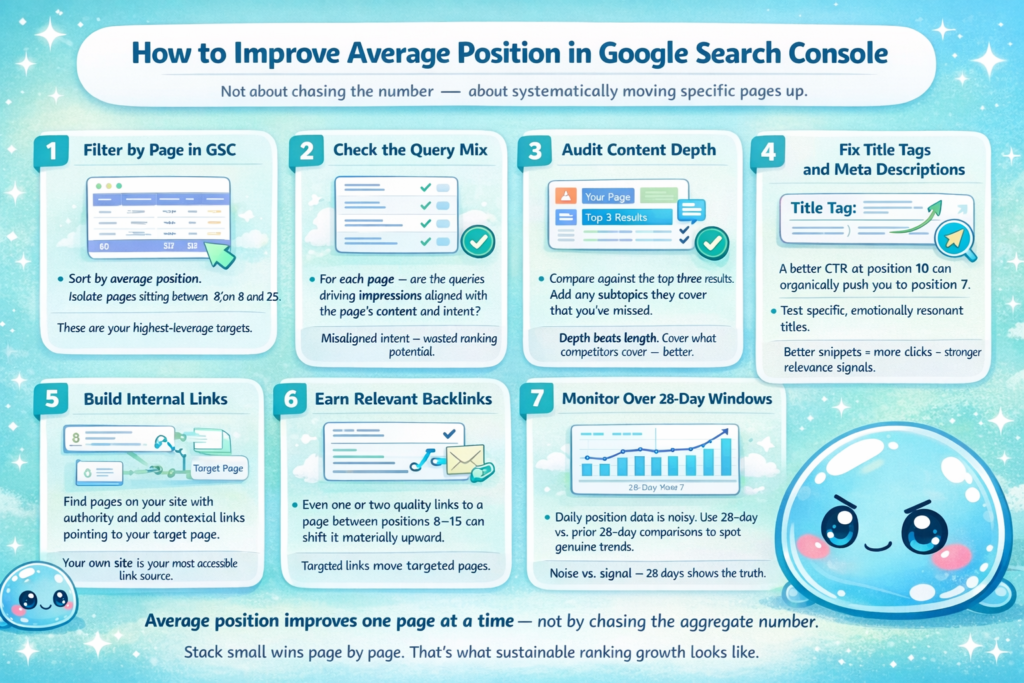
- Filter by page in GSC. Sort by average position, then isolate pages sitting between position 8 and 25. These are your highest-leverage targets.
- Check the query mix. For each page, look at which queries drive impressions. Are they aligned with the page’s actual content and search intent?
- Audit content depth. Compare your page against the top three results. Are they covering subtopics you’ve missed? Add them.
- Fix title tags and meta descriptions. A better CTR at position 10 can push you to position 7 organically. Test emotionally resonant, specific titles.
- Build internal links. Find pages on your site with authority and add contextual links pointing to your target page. This is consistently underused.
- Earn or build relevant backlinks. Even one or two quality links to a page in the pressure zone can shift it materially.
- Monitor over 28-day windows. Position data fluctuates daily. Use 28-day comparisons to spot genuine trends versus noise.
For a broader framework, understanding why SEO takes so long helps set client and stakeholder expectations during this process.
What is a good average position in google search console improves not by focusing on the aggregate metric but by stacking small wins page by page.
What Does It Mean When Average Position Drops in Google Search Console?
A drop in average position is one of the most stressful signals in the search performance report. Before reacting, diagnose accurately.
Common causes of average position drops:
- Algorithm update: Google rolls out core updates that reshuffle rankings broadly. Check Google’s update history and whether competitors moved similarly.
- New pages indexed: If you published a batch of new content that starts at position 60+, it pulls your average down even if existing pages held steady.
- Competitor improvements: A competitor refreshed their content, earned links, or launched new pages targeting your keywords.
- Technical issues: Crawl blocks, noindex tags added accidentally, or canonical errors can suppress pages. Run a technical SEO audit immediately.
- Seasonality: Certain query volumes spike seasonally, bringing lower-ranked pages more impressions, which skews the average.
My first step with any average position drop is to filter by page and date-compare a 28-day window versus the prior 28 days. Then I look at which specific pages dropped versus held. A sitewide average drop caused by one or two pages is a very different problem from a sitewide algorithmic hit.
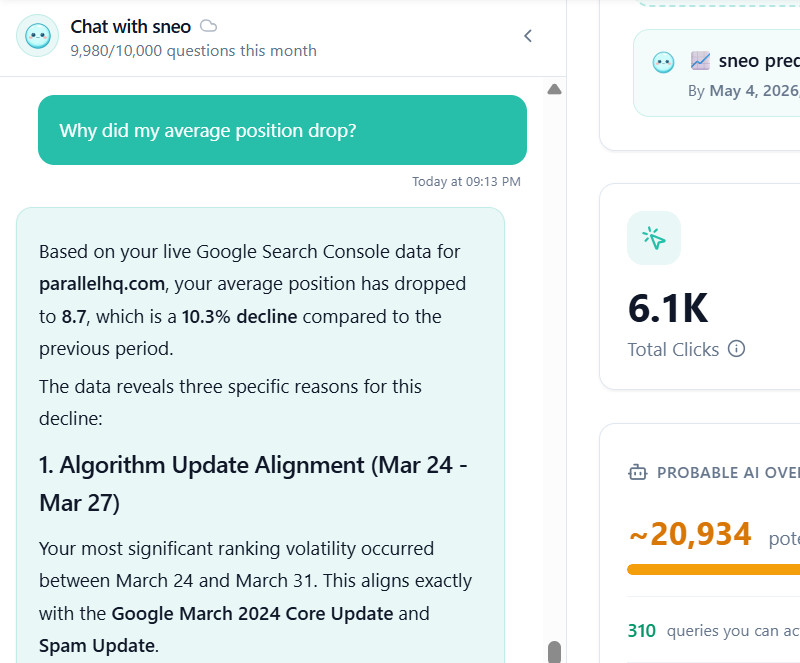
Sneo AI does this diagnostic automatically when you connect your Google Search Console account. Ask it “why did my average position drop?” and it surfaces the page-level breakdown immediately rather than you having to dig through filters manually. That’s what makes AI-powered SEO analysis genuinely useful here.
What is a good average position in google search console after a drop? The same answer as before: one that trends back downward over the following weeks with targeted intervention.
Conclusion
Average position is a useful directional signal, not a pass/fail grade.
- Positions 1–10 are your goal; positions 8–15 are your opportunity zone.
- A site-wide average of 20–35 is normal for established sites; new sites should focus on impression growth first.
- Drops in average position require page-level diagnosis before any action.
- Improvement comes from stacking targeted, page-by-page wins, not chasing the aggregate number.
Connect your GSC to sneo and ask it directly what your data is telling you.
Frequently Asked Questions
1) What is a good average position in Google Search Console for an ecommerce site?
For ecommerce, positions 1–5 for commercial and transactional queries matter most since CTR drops sharply below position 5 on high-intent searches. A site-wide average of 15–25 is healthy for an established store with a broad product catalog and mix of informational content.
2) Does the average position include Google Ads results?
No. Average position in Search Console reflects only organic search rankings. Paid ads are tracked separately in Google Ads. The two systems don’t share position data.
3) How often does Google Search Console update average position data?
GSC typically updates data with a 2–3 day delay. Daily fluctuations are normal and noisy. Use 28-day date ranges for meaningful trend analysis rather than reacting to day-to-day changes.
4) Is an average position of 20 bad?
Not inherently. A site-wide average of 20 often means you have strong page-one performers mixed with newer or lower-authority pages. Segment by page to find which URLs need attention rather than treating 20 as a failure.
5) Can improving CTR improve my average position?
Yes, indirectly. Higher CTR signals relevance to Google and can support ranking improvements over time. Optimizing title tags and meta descriptions for pages in positions 8–15 is one of the fastest ways to move the needle.
6) What’s the difference between average position and keyword ranking in third-party tools?
GSC average position is a mean across all queries triggering impressions on your site. Third-party rank tracking tools show position for specific, pre-selected keywords. Both are useful; GSC captures queries you didn’t know you rank for, while rank trackers give precise tracking for priority terms.