

I get a version of this question every week. A client shares a screenshot of a number between 0 and 100, tells me it’s their “SEO score,” and asks if it’s good. My honest answer is always the same: that number is probably telling you something useful, but it is not measuring what you think it is, and chasing it higher will not automatically improve your rankings. Understanding what is a good SEO score starts with a critical truth that most SEO tools would rather you didn’t think too hard about: almost every “SEO score” you’ve ever been shown is a third-party estimate built on data Google doesn’t share, using algorithms Google doesn’t endorse, measuring signals Google may not even use in the way the tool implies.
What’s a Good SEO Score: TL;DR
The most meaningful SEO score is one built from your own real data: actual rankings, CTR, technical health, and traffic trends from Google Search Console (currently you can track in sneo.ai). A site health score of 80 & above is generally considered good. Though there is no universally “good” SEO score because no single third-party tool has access to Google’s actual ranking algorithm. Domain Rating, Domain Authority, and Authority Score are useful competitive proxies, but a higher score does not directly produce better rankings.
The Uncomfortable Truth About Third-Party SEO Scores
Let me say this clearly before we go any further, because I think the SEO industry does a poor job of communicating it: Google does not use Domain Authority, Domain Rating, or Authority Score to rank websites. Not one of them. Google’s John Mueller has stated this explicitly on multiple occasions. None of these scores appear in Google’s ranking algorithm. None of them are inputs to how Google’s search index works.
This doesn’t mean they’re useless. It means they’re proxies, and understanding what a proxy is will change how you use these scores entirely.
A proxy is an indirect measure. It estimates something you can’t directly observe by measuring something correlated with it. Domain Rating measures backlink profile strength. Moz Domain Authority measures the predicted likelihood of ranking based on link data. SEMrush Authority Score blends backlinks, organic traffic estimates, and spam signals. These things do correlate with ranking performance, because sites that rank well tend to have strong backlink profiles and generate real traffic. But correlation is not causation, and a higher proxy score does not guarantee better rankings.
I’ve audited sites with a Domain Rating of 65 that were hemorrhaging traffic because of technical SEO issues Google couldn’t crawl around. I’ve helped sites with a DR of 18 outrank DR 50 competitors by publishing significantly better content on low-competition topics. The score wasn’t the determining factor in either case. The actual on-site signals were.
The danger of over-indexing on third-party SEO scores is that it sends effort in the wrong direction. Teams spend months on link building to move a DA from 32 to 38, celebrating the jump as a win, while their Core Web Vitals are failing, their meta descriptions are missing on 40% of pages, and their highest-traffic content is declining in CTR. The score went up. The rankings went nowhere.
What Third-Party Scores Actually Measure (And What They Don’t)
With that foundation established, here’s how to read each of the major third-party scores correctly: as directional signals within their specific domain, not as verdicts on your SEO health.
Ahrefs Domain Rating: Backlink Strength Only
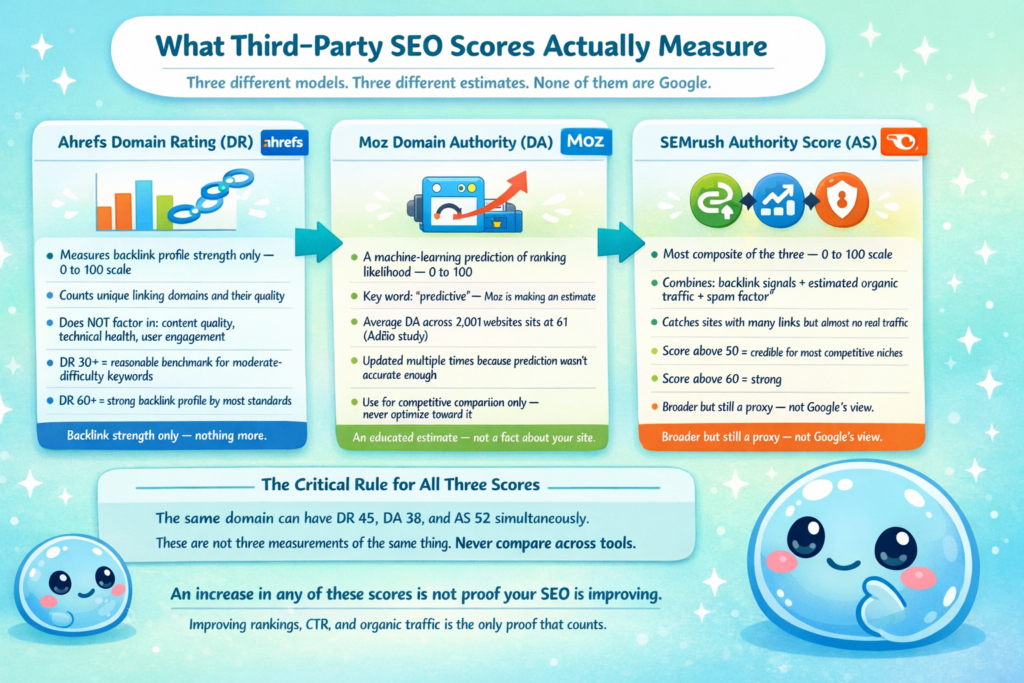
Domain Rating (DR) measures the strength of your backlink profile on a scale from 0 to 100. It looks at the number of unique domains linking to you and the quality of those domains. It does not factor in content quality, technical health, organic traffic, or user engagement.
A DR of 30 or above is a reasonable benchmark for a growing site to start competing for moderate-difficulty keywords. DR above 60 indicates a strong backlink profile by most standards. But DR tells you nothing about whether your site is technically sound, whether your content is satisfying search intent, or whether your rankings are moving in the right direction. It is one input among many, and it’s an indirect input at that.
Moz Domain Authority: A Predictive Estimate, Not a Fact
Moz Domain Authority (DA) is a machine-learning model that predicts how likely a domain is to rank. Like DR, it runs from 0 to 100 on a logarithmic scale. A study by Adilo found the average DA sits at 61 across 2,001 websites and 16,008 data points, but that figure tells you very little about what’s competitive in your specific niche.
The key word in the DA’s description is “predictive.” Moz is making an educated estimate. It is not reading from Google’s index. The model has been updated many times over the years because the prediction wasn’t accurate enough, and it will be updated again. Treat DA as a rough comparative benchmark when evaluating link opportunities or sizing up competitors, not as a score to optimize toward.
SEMrush Authority Score: Broader but Still a Proxy
SEMrush’s Authority Score (AS) is the most composite of the three, combining backlink signals, estimated organic traffic, and spam factor analysis into a single 0 to 100 score. Because it incorporates organic traffic estimates, it catches cases that pure backlink metrics miss, such as a site with many links but almost no real traffic, which is a common sign of link manipulation.
A score above 50 is credible for most competitive niches. Above 60 is strong. But the same caveat applies: Authority Score is SEMrush’s model, built on SEMrush’s data, reflecting SEMrush’s interpretation of quality signals. It is not Google’s verdict on your site.
The Critical Rule for All Three Scores
The three major authority tools each use unique algorithms that prioritize different signals, which is why the same domain can have a DR of 45, a DA of 38, and an AS of 52 simultaneously. These are not three measurements of the same thing. They are three different estimates from three different models. Never compare your Ahrefs DR to a competitor’s Moz DA and conclude anything meaningful from the difference.
More importantly: never treat an increase in any of these scores as proof that your SEO is improving. The only proof of improving SEO is improving rankings, improving CTR, improving organic traffic, and improving the engagement signals that tell Google your content is serving users well. Those outcomes come from your actual site data, not from a third-party model.
Site Audit Scores: More Useful, Still Incomplete
Site audit health scores from tools like SEMrush, Ahrefs, Screaming Frog, and Moz are a different and more directly actionable category of SEO score. Instead of estimating authority from backlink data, they crawl your actual site and report on the presence or absence of specific technical SEO signals: missing meta tags, broken links, duplicate content, slow page speeds, indexing errors, and more.
These scores are more useful than authority scores because they’re based on real data from your own site. Understanding what is a good SEO score in this context is clearer: a site audit score of 80 or above indicates a technically healthy site. Below 70 indicates meaningful issues affecting crawlability and indexing. Below 50 is a structural problem that is almost certainly suppressing rankings regardless of your content quality.
The limitation of standalone site audit scores is that they measure inputs without measuring outcomes. A site can pass every technical check and still rank poorly because the content doesn’t match search intent, because the pages aren’t earning clicks, or because the traffic it’s getting isn’t converting into engagement signals that reinforce rankings. Technical health is necessary but not sufficient.
The technical benchmarks that matter most in 2026 are Google’s Core Web Vitals: Largest Contentful Paint (LCP) under 2.5 seconds, Interaction to Next Paint (INP) under 200 milliseconds, and Cumulative Layout Shift (CLS) under 0.1. These are confirmed page experience signals. Missing meta descriptions, absent schema markup, and crawl errors compound the problem. Fixing these doesn’t guarantee ranking improvements, but failing them reliably suppresses them.
Why a Better Score Doesn’t Automatically Mean Better SEO
This is the point I want to press hardest, because I see it cause real damage to real budgets.
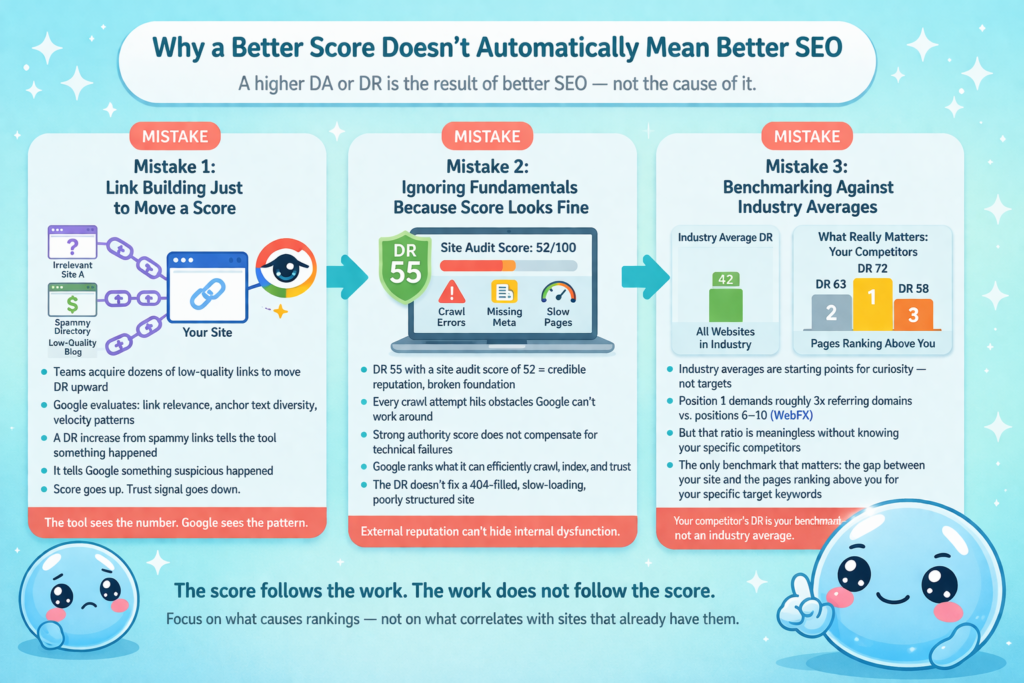
A higher DA or DR is the result of better SEO, not the cause of it. When you publish excellent content that earns natural backlinks, your DR rises. When you build topical authority through a strong content ecosystem, your DA reflects that over time. The score follows the work. The work does not follow the score.
I’ve watched teams make three specific mistakes because they confused the proxy for the outcome.
The first is link building purely to move a score. Teams acquire dozens of low-quality links from irrelevant sites because the DR transfer makes their number go up. Google’s algorithm evaluates link relevance, anchor text diversity, and link velocity patterns. A DR increase from spammy links tells the tool something happened. It tells Google something suspicious happened.
The second is ignoring content and technical fundamentals because the authority score looks fine. A site with a DR of 55 and a site audit score of 52 is a site with a credible external reputation and a broken internal foundation. Every time Google tries to crawl and index that site efficiently, it runs into obstacles. The DR doesn’t fix that.
The third is benchmarking against industry averages rather than direct competitors. According to WebFX’s 2026 benchmark research, position one demands roughly 3x the referring domains of pages ranking in positions 6 to 10. But that ratio is meaningless without knowing the specific referring domain counts of the pages you’re competing against on your specific keywords. Industry averages are starting points for curiosity, not targets for strategy.
The only benchmark that matters is the gap between your site and the pages currently ranking above you for the terms your audience is actually searching.
What a Legitimate SEO Score Actually Looks Like
Given all of this, what would a genuinely useful answer to what a good SEO score actually look like? It would need to be built from your own real performance data, not estimated from a third-party model. It would need to measure the signals that actually affect rankings, not just the signals that correlate with sites that already rank well. And it would need to be specific enough to tell you what to fix, not just whether to be worried.
That’s exactly what we built with the sneo.ai Site Health Score.
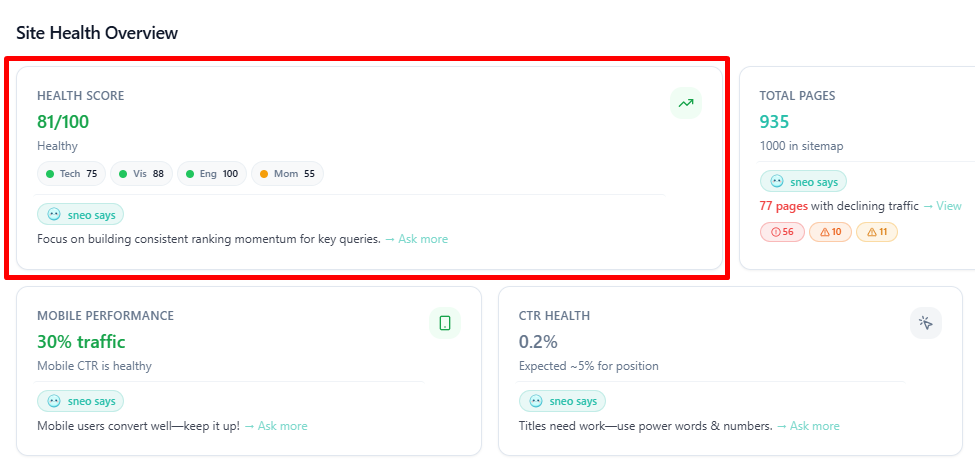
The Site Health Score in sneo.ai is different from every other SEO score you’ve used because it is sourced entirely from your Google Search Console data and your own site’s content audit. Google is the one telling us what’s happening with your site. Not a third-party model estimating from a backlink index. Not an algorithm that has never seen the inside of Google’s search infrastructure. Your actual search performance, measured against real benchmarks, on your real pages.
The score is built across four parameters that individually diagnose different dimensions of SEO health and collectively give you the most honest picture of where your site actually stands.
Parameter 1: Technical Health
The technical parameter measures the foundational on-site signals that determine whether Google can efficiently crawl, understand, and index your content. This includes Core Web Vitals performance (LCP, INP, CLS), missing or duplicate meta descriptions, missing title tags, absent schema markup, pages with indexing errors, and mobile usability failures.
Unlike a generic site audit score that simply checks whether elements are present, sneo.ai’s technical health parameter is weighted by the pages that actually matter for your traffic. A missing meta description on a page Google has never crawled is a low-priority issue. A missing meta description on a page generating 50,000 impressions per month is urgent. The weighting reflects reality, not a uniform checklist.
Parameter 2: Visibility
The visibility parameter measures your average organic ranking positions across your keyword portfolio as reported directly by Google Search Console. This is the most honest measure of where your content actually sits in search results, because it comes from Google’s own data on how often and at what positions your pages appear.
Rather than estimating your ranking potential from backlink data (what third-party tools do), sneo.ai measures your actual ranking performance directly. A page ranking at an average position of 8 on a high-volume query is close to the first-page threshold and represents a specific optimization opportunity. A page stuck at position 35 on the same query needs a different intervention entirely. The visibility score surfaces these distinctions at scale, across your entire site, in one place.
Parameter 3: Engagement
The engagement parameter measures CTR performance against expected benchmarks for your ranking positions. This is the dimension that most SEO tools miss entirely, and it’s one of the most actionable signals available.
At any given ranking position, there is a benchmark CTR range that reflects typical user behavior. If your page ranks at position 3 but is generating a CTR of 1.2% when the benchmark for position 3 is closer to 8 to 10%, that gap tells you something specific: users are seeing your result and choosing not to click. The content visible in the SERP (your title tag and meta description) is not compelling enough relative to the alternatives. That’s a precise, fixable problem.
sneo.ai calculates your CTR performance relative to position-adjusted benchmarks for every page on your site, flagging the pages where engagement is most below expectation. These are your highest-return optimization opportunities because the ranking work is already done. You just need to convert visibility into clicks.
Parameter 4: Traffic Momentum
The traffic momentum parameter tracks the direction and rate of change in your organic traffic over time. A site with solid technical health, good visibility scores, and reasonable CTR can still be in trouble if its traffic trend is declining. Equally, a newer site with lower absolute scores but an accelerating traffic trend is on a fundamentally healthier trajectory than a more established site with flat or declining traffic.
Momentum matters because Google’s algorithm is not static. A site that was ranking well six months ago but has seen consistent month-over-month declines may have been affected by an algorithm update, a competitive shift, or content decay. Catching that trend early, before it becomes a significant traffic loss, is one of the most valuable things an SEO monitoring system can do. sneo.ai surfaces momentum signals from your Search Console data weekly, so declines are caught before they compound.
How the Site Health Score Translates to Action
The four parameters combine into a single Site Health Score that tells you not just what is a good SEO score for your site in abstract terms, but specifically which dimension is your biggest current constraint. That distinction is what converts a score into a priority.
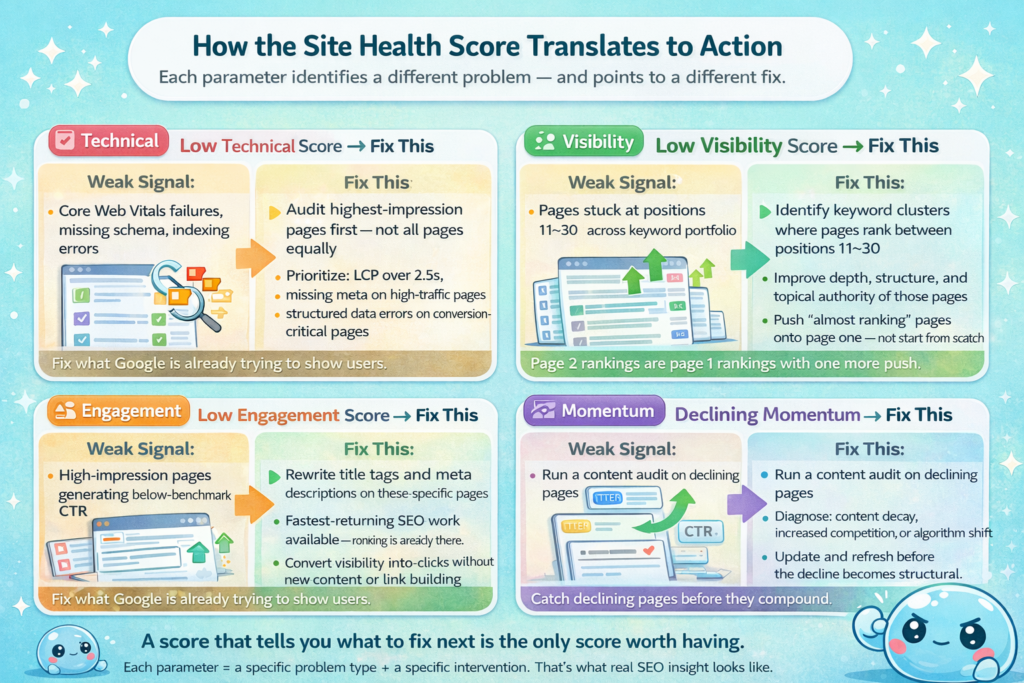
- If your technical score is pulling the composite down, the immediate action is a technical audit of your highest-impression pages, prioritizing Core Web Vitals failures, missing schema, and indexing errors on pages Google is already trying to show users.
- If your visibility score is weak, the priority is content strategy: identifying the keyword clusters where your pages are ranking between positions 11 and 30 (the “almost ranking” opportunities), and improving the depth, structure, and topical authority of those pages to push them onto page one.
- If your engagement score is the lowest component, the priority is SERP snippet optimization: rewriting title tags and meta descriptions on pages with high impressions but below-benchmark CTR. This is often the fastest-returning SEO work available because it converts existing rankings into more traffic without requiring any new content or link building.
- If your momentum score is declining, the priority is content audit: identifying which previously-ranking pages are losing ground, diagnosing whether the cause is content decay, increased competition, or algorithm signal changes, and intervening with updates before the decline becomes structural.
Where Third-Party Scores Still Add Value
I don’t want to leave you with the impression that DA, DR, and AS are worthless in the broader question of what is a good SEO score for competitive positioning. They’re not. They’re just being used incorrectly when treated as primary SEO performance indicators.
The legitimate uses for third-party authority scores are competitive and comparative. Before targeting a keyword, I check the DR of the pages ranking in the top 5. If they’re all DR 60 to 70 and my site is DR 25, I need a lower-competition entry point. If they’re DR 25 to 35 and my site is DR 40, the keyword is realistically targetable. This is backlink competitiveness analysis, not SEO health monitoring, and for that specific purpose, DR and DA are genuinely useful.
Third-party scores are also useful during link prospecting. When evaluating a potential guest posting opportunity or a site to pitch for a backlink, checking DA or DR gives you a rough sense of whether the site has any backlink equity to pass. A DA of 5 on a site that’s been live for three years is a signal the site has no meaningful authority. A DA of 45 suggests it might be worth pursuing.
Use these scores for competitive benchmarking and link prospecting. Do not use them as the primary measure of your SEO health. For that, you need data from the only source that actually knows how your site is performing in Google: Google itself.
Conclusion
The question of what is a good SEO score has a longer answer than most tools are willing to give you. Third-party scores are estimates built on incomplete data, using algorithms that have no connection to Google’s search index. A DR of 50 does not mean you rank well. A DA of 60 does not mean your content is serving users effectively. An Authority Score increase does not mean your organic traffic will grow. If you’ve ever been told what a good SEO score is “above 50” without any qualification of which score or which niche, you’ve been given an incomplete picture. A DR of 50 does not mean you rank well. A DA of 60 does not mean your content is serving users effectively. An Authority Score increase does not mean your organic traffic will grow. These scores tell you something about your backlink profile and domain reputation. They tell you almost nothing about the dimensions of SEO that are most directly affecting your rankings right now.
The most honest SEO score is one that comes from your own data. Actual positions from Google Search Console. Actual CTR performance against real benchmarks. Actual technical health on the pages users are finding. Actual traffic momentum telling you whether things are getting better or worse over time. That’s what sneo.ai’s Site Health Score measures, and it’s the score I’d trust over any third-party proxy.
Connect your Google Search Console to sneo.ai and see your real Site Health Score across all four parameters. No estimates. No third-party models. Just your actual data, telling you exactly what to fix next.
Frequently Asked Questions (FAQ)
1) What is a good SEO score?
A “good” SEO score depends entirely on which score you’re looking at and what it’s measuring. For third-party authority scores like Ahrefs Domain Rating or Moz Domain Authority, scores above 30 to 50 are competitive for most growing sites, but these are proxies, not actual measures of ranking performance. For site audit health scores, 80 or above is the target. The most meaningful SEO score is one built from your own Google Search Console data, measuring actual rankings, CTR, technical health, and traffic momentum.
2) Do Domain Authority and Domain Rating affect Google rankings?
No. Google does not use Moz’s Domain Authority, Ahrefs’ Domain Rating, or SEMrush’s Authority Score as ranking factors. Google’s John Mueller has confirmed this directly. These metrics correlate with sites that tend to rank well because strong backlink profiles are a genuine ranking signal, but the score itself is a third-party estimate. Improving your DA or DR does not directly cause ranking improvements. What causes ranking improvements are the underlying signals those scores try to estimate: quality backlinks, strong content, and good technical health.
3) Can a site with a low Domain Rating outrank a site with a high Domain Rating?
Yes, regularly. A site with a DR of 20 can outrank a site with a DR of 55 if it produces significantly better content on a topic with lower keyword difficulty, has strong on-page optimization, and earns genuine engagement signals from users. Domain Rating measures backlink profile strength, which is one ranking input among many. Content relevance, search intent match, technical health, and user engagement signals all contribute to actual rankings. I’ve seen this happen consistently with well-executed content strategies on newer sites.
4) What does sneo.ai’s Site Health Score measure?
sneo.ai’s Site Health Score is built from your actual Google Search Console data and content audit across four parameters. Technical health measures Core Web Vitals performance, missing meta tags, schema markup, and indexing errors. Visibility measures your average organic ranking positions across your keyword portfolio. Engagement measures your CTR performance relative to position-adjusted benchmarks. Traffic momentum tracks the direction and rate of change in your organic traffic over time. Each parameter identifies a specific type of SEO problem and points toward a specific type of fix.
5) Why is CTR performance included in an SEO health score?
CTR (Click-Through Rate) is one of the most actionable SEO signals available because it measures whether your rankings are converting to actual visits. A page ranking at position 3 with a CTR of 1% when the position-3 benchmark is 8 to 10% has a specific, fixable problem: the title tag and meta description visible in search results are not compelling enough. Improving SERP snippets on high-impression, low-CTR pages is often the highest-return SEO work available, because the ranking is already there. You just need to convert visibility into clicks.
6) What is keyword difficulty and how does it relate to SEO scores?
Keyword Difficulty (KD) is a score from tools like Ahrefs, SEMrush, and Moz that estimates how hard it is to rank on page one for a given keyword. A KD below 20 is generally achievable for most sites regardless of domain authority. A KD between 20 and 49 is moderate. A KD of 50 or above is highly competitive and typically requires meaningful domain authority to be realistic. KD is a useful planning tool for prioritizing which keywords to target based on your current authority level, but like all third-party scores, it’s an estimate, not a guarantee.
7) How often should I check my SEO score?
For third-party authority scores like DA and DR, monthly is sufficient because they change slowly and meaningful movement takes sustained effort over weeks or months. For site audit health scores, run a full audit quarterly and after any major site change. For real performance metrics including CTR, rankings, and traffic momentum from Google Search Console, weekly monitoring is the right cadence because these can shift quickly and early detection of declines is where the most value sits. sneo.ai surfaces these changes from your live Search Console data continuously, without manual report-pulling.
8) What should I do if my SEO score is low?
The answer depends on which score is low. If your site audit health score is below 70, prioritize technical fixes before any content or link building work. If your third-party authority score is significantly lower than the domains ranking above you on your target keywords, a targeted link building strategy focused on quality over volume is the right investment. If your sneo.ai Site Health Score is low on the engagement parameter, rewrite SERP snippets on high-impression, low-CTR pages. If momentum is declining, run a content audit to identify pages losing ground and update them before the decline compounds.