

I remember the first time a client called me convinced their website had been penalized. They had done everything right — clean site structure, well-researched content, no shady backlinks. Their pages were indexed. Their on-page SEO was solid. And yet, six weeks after launch, they were ranking nowhere on Google. Meanwhile, the same content was appearing on Bing and Yahoo without a problem. That disconnect is what most people experience when they encounter the Google Sandbox. It’s one of the most frustrating — and most misunderstood — phenomena in SEO, and explaining it properly is something I’ve done dozens of times in client calls. So let me break it down for you here, clearly and honestly.
Quick Answer
The Google Sandbox is a widely observed SEO phenomenon where new websites experience a temporary period of ranking suppression in Google Search, typically lasting 3 to 6 months, despite having quality content and proper optimization. Google has never officially confirmed its existence, but the effect is consistently reported across the SEO community.
What Is the Google Sandbox? The Core Concept Explained
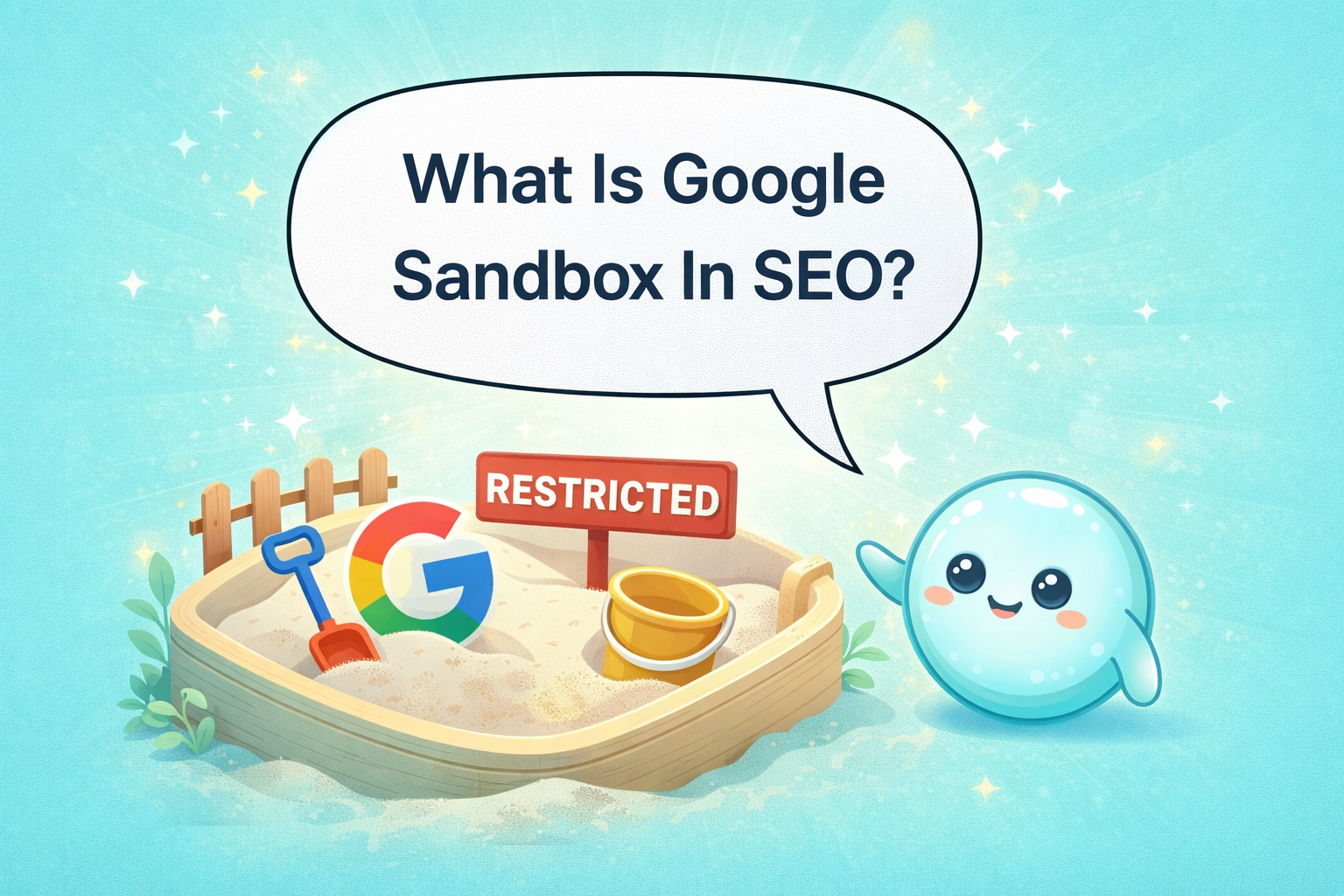
At its simplest, the Google Sandbox refers to a temporary holding period that new websites appear to go through — a phase where they struggle to rank competitively in Google’s search results, even when they’re well-optimized and properly indexed.

The Google Sandbox is described as a filter that prevents new websites from appearing at the top of Google search results, acting as a probationary evaluation phase for newly created domains. The term itself is borrowed from software development and cybersecurity, where a “sandbox” is an isolated environment used to test and observe behavior safely — before anything is allowed into the live system. Apply that metaphor to Google’s treatment of new websites, and you have a vivid picture of what site owners experience.
Here’s what makes the Google Sandbox so uniquely frustrating: it’s not a penalty. Your site hasn’t done anything wrong. Your pages are indexed — you can confirm that in Google Search Console. But when you search for your target keywords, your site is nowhere to be found on page one, page two, or even page five. Pages are indexed normally, but rankings and traffic are systematically suppressed, especially for competitive head terms. That gap between being indexed and actually ranking is the hallmark of the sandbox experience.
The reason I find this topic so important to address is that it affects almost every new website — and most site owners have no idea it’s coming. They launch with high expectations, invest in content and SEO, and then stare at flat traffic charts wondering what they did wrong. The answer, most of the time, is nothing. You’re just new.
A Brief History: Where the Google Sandbox Theory Came From
The Google Sandbox concept has been around for two decades. It was March of 2004 when SEO experts and web administrators first noticed that new websites were not appearing on the first pages of Google searches — even when they were keyword-optimized and properly indexed. What made the observation particularly compelling was that the same websites ranked perfectly well on competing search engines like Yahoo and Bing. The problem was specific to Google.
SEO professionals began comparing notes across forums, and a consensus emerged: Google appeared to be placing new domains through a period of deliberate ranking suppression before allowing them to compete normally. The community named this phenomenon “The Google Sandbox” — and it stuck.
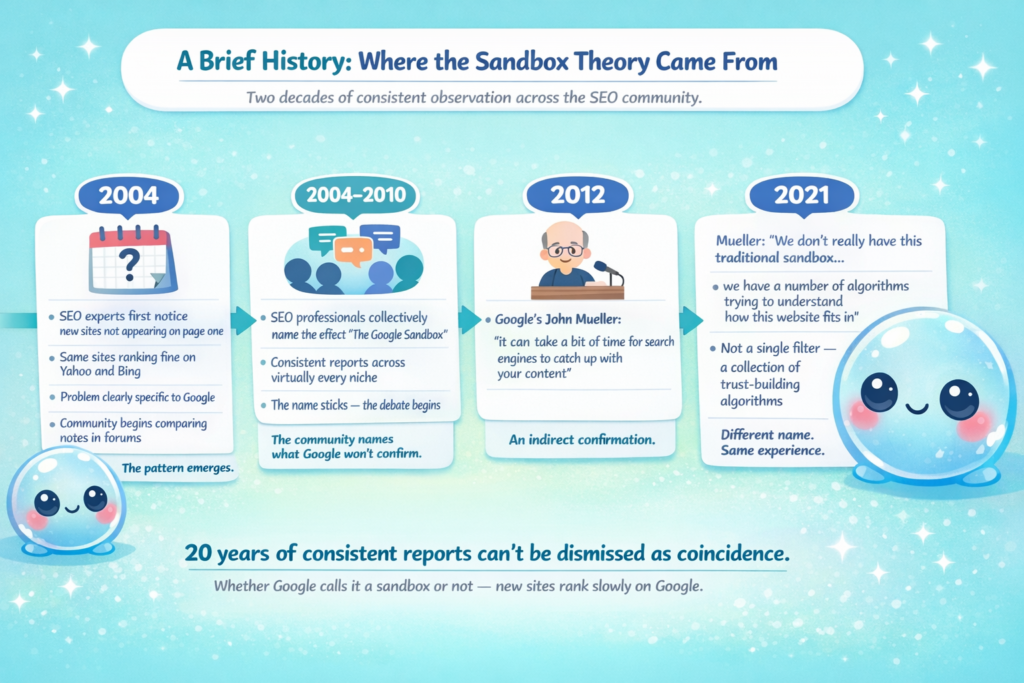
The debate has never fully settled. In 2012, Google’s John Mueller acknowledged that “it can take a bit of time for search engines to catch up with your content, and to learn to treat it appropriately.” Then in 2021, Mueller commented more directly on the sandbox, stating: “We don’t really have this traditional sandbox that a lot of SEOs used to be talking about in the years past. We have a number of algorithms that might look similar, but these are essentially just algorithms trying to understand how this website fits in with the rest of the websites”.
That quote is telling. Google isn’t saying new sites rank normally from day one. They’re saying the delay isn’t a deliberate sandbox filter — it’s a collection of algorithms all simultaneously trying to evaluate where a new site belongs. For the site owner on the receiving end, the practical experience is identical.
One of the most famous case studies supporting the sandbox’s existence involves Rand Fishkin and Moz. Fishkin believed that SEOmoz had been sandboxed for 9 months, despite having over 12,000 entirely natural backlinks pointing to it. The site was receiving only 10 to 20 visitors per day during that period — then traffic jumped to 100 visitors per day the moment it appeared to exit the sandbox. That kind of sudden, dramatic shift in traffic is one of the clearest signals that something systematic was suppressing rankings before releasing them.
Does the Google Sandbox Actually Exist?
This is the question I get asked most often on this topic, so I want to answer it directly: nobody knows for certain, including Google.
Google has consistently denied the existence of a formal sandbox mechanism. However, in the same breath, they’ve confirmed that new websites take time to accumulate the trust and authority signals needed to rank competitively. That nuance matters. Although Google denies the existence of a formal sandbox, ranking delays occur due to algorithms assessing content quality, topical relevance, and user signals.
What the SEO community has observed consistently since 2004 is this: new websites, across virtually every niche, experience a period of ranking difficulty on Google that doesn’t appear on other search engines. That pattern is too consistent and too widespread to be dismissed as coincidence or bad SEO.
My personal position after years of working with new sites: the effect is real, even if the exact mechanism isn’t a single named filter. Whether Google calls it a “sandbox” or “trust-building algorithms evaluating domain credibility” — the result for new website owners is the same. You will likely experience a period of suppressed rankings. Understanding that reality is the first step toward navigating it productively.
How Long Does the Google Sandbox Last?
This is the second question I hear every time I explain the sandbox to a new client. And the honest answer is: it varies. But the data we have is helpful for setting realistic expectations.
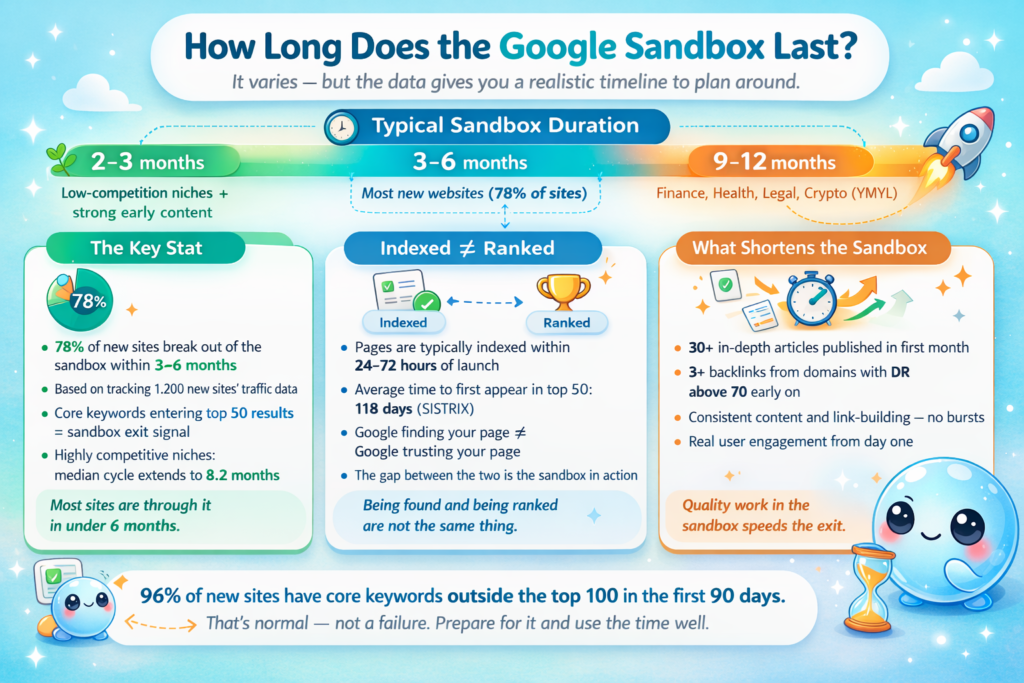
Industry data shows the sandbox averages 3 to 6 months for most new sites. For sites in less competitive niches with strong early content and quality backlinks, the period can be as short as 2 to 3 months. For highly competitive industries — finance, health, legal, cryptocurrency — the sandbox period can extend to 9 to 12 months.
What accelerates the exit? The data points to a clear pattern: sites that published 30 or more in-depth articles in their first month and acquired 3 or more backlinks from domains with a Domain Rating above 70 showed short sandbox cycles of under 3 months. In other words, the quality and consistency of what you do during the sandbox period is the most significant factor in how quickly you exit it.
One important clarification I always make to clients: being indexed does not mean being ranked. After Google’s 2022 algorithm updates, the average time for a new site to first hit the top 50 search results rose to 118 days, according to SISTRIX data. New site pages are typically indexed within 24 to 72 hours — but indexing and meaningful ranking are two entirely different things. Google finding your page is not the same as Google trusting it enough to show it to searchers.
Why Does the Google Sandbox Exist? The Real Reason Behind the Delay
Whether Google has a formal sandbox or not, the reasoning behind why new sites rank slowly is actually logical — and understanding it helps you work with it rather than against it.
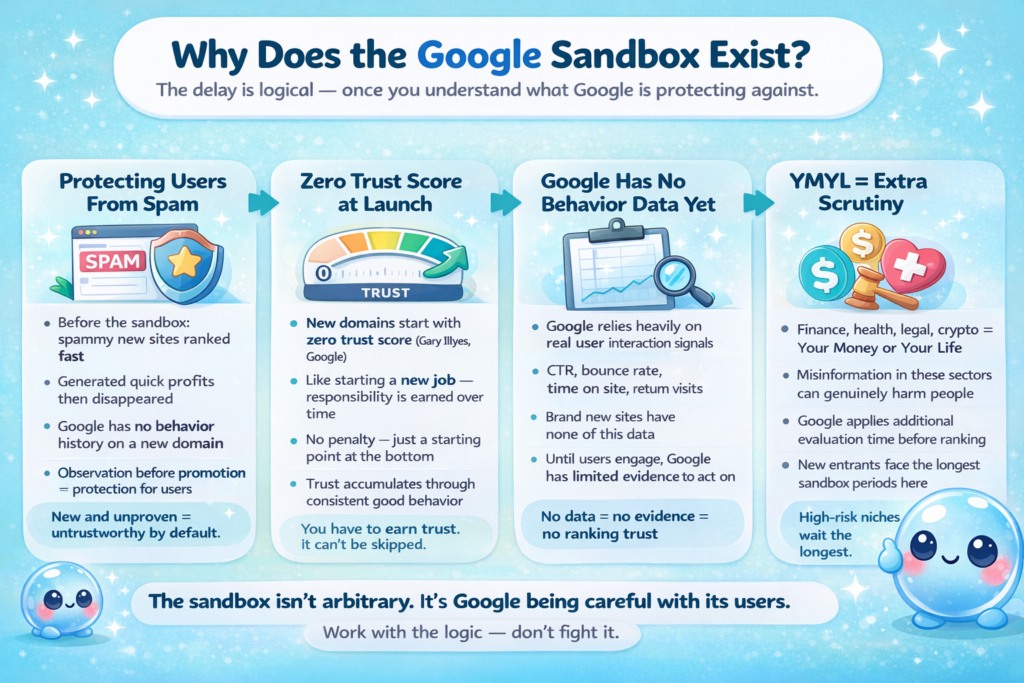
1) Google is protecting its users from spam: Before the sandbox concept emerged, new spam websites could quickly achieve high rankings using unethical SEO techniques, generate quick profits, and disappear before Google could catch them. A site with no history and no established behavior is fundamentally untrustworthy from Google’s perspective. The safest thing Google can do for its users is observe new sites over time before promoting them in results.
2) New domains have zero trust score: Former Google Search engineer Gary Illyes has stated multiple times that the sandbox isn’t a penalty tool — new domains simply start with zero trust score. Think of it like starting a new job. Even if you’re talented and qualified, your employer doesn’t give you full responsibility on day one. You have to earn it through demonstrated behavior over time. Google treats new websites the same way.
3) Google needs behavioral signals it simply doesn’t have yet: Google’s ranking algorithms rely heavily on user behavior data — how long users stay on your pages, whether they bounce back to search results, how many people click your listing. A brand new site has none of this data. Until Google can observe real users interacting with your site, it has limited evidence that your content actually satisfies search intent. Google analyses click-through rate, bounce rate, and user behavior data — and if user signals are unresponsive or scarce, there’s a high chance rankings will stay suppressed.
4) Competitive industries trigger longer evaluation periods: Websites in sectors seen as risky — such as crypto, finance, health, and legal — often face longer sandbox periods. These are Google’s YMYL (Your Money or Your Life) categories, where misinformation can genuinely harm people. Google’s algorithm applies extra scrutiny to new entrants in these spaces before granting competitive ranking positions.
How to Tell If Your Site Is in the Google Sandbox
One of the most common frustrations I hear from site owners is not knowing whether they’re in the sandbox or whether their SEO strategy simply isn’t working. Here are the specific signals I look for when diagnosing this with clients.
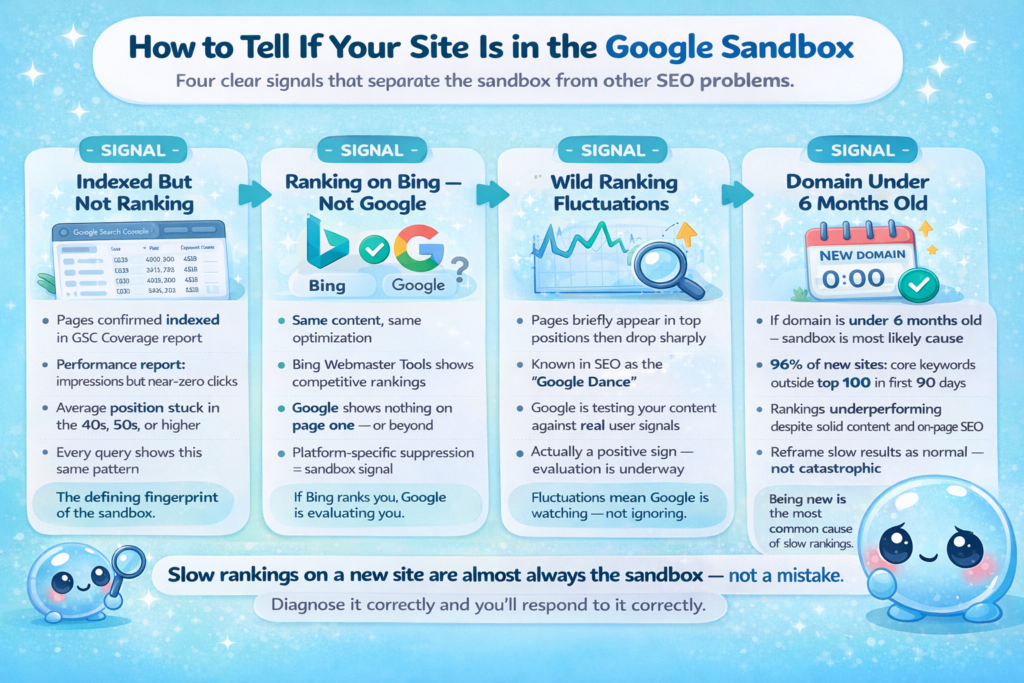
Your pages are indexed but not ranking. This is the clearest indicator. Open Google Search Console and confirm your pages are appearing in the Coverage report as indexed. Then check your Performance report — if you have impressions but near-zero clicks, and your average position is in the 40s, 50s, or higher for every query, you’re likely in the sandbox. The disconnect between indexed status and ranking performance is the defining fingerprint.
You’re ranking on other search engines but not Google. New website pages might have already ranked in other search engines such as Bing and Yahoo, but are not yet easily discovered in Google. If you check Bing Webmaster Tools and find your site appearing competitively while Google shows nothing, that differential is a strong signal of the sandbox effect.
Your rankings fluctuate wildly. Some sites experience what the SEO community calls the “Google Dance” — pages appearing briefly in top positions before dropping dramatically. Some websites experience initial traffic spikes followed by temporary ranking drops. This is Google testing your content against actual user signals. It’s actually a positive sign — it means the algorithm is evaluating you.
You’re a brand new domain. If your domain is less than 6 months old and your rankings are underperforming relative to your content quality and on-page optimization, the sandbox is the most likely explanation. 96% of new sites show core keywords ranking outside the top 100 in the first 90 days. Knowing this benchmark can reframe slow early results as normal, not catastrophic.
How to Escape the Google Sandbox Faster: Proven Strategies
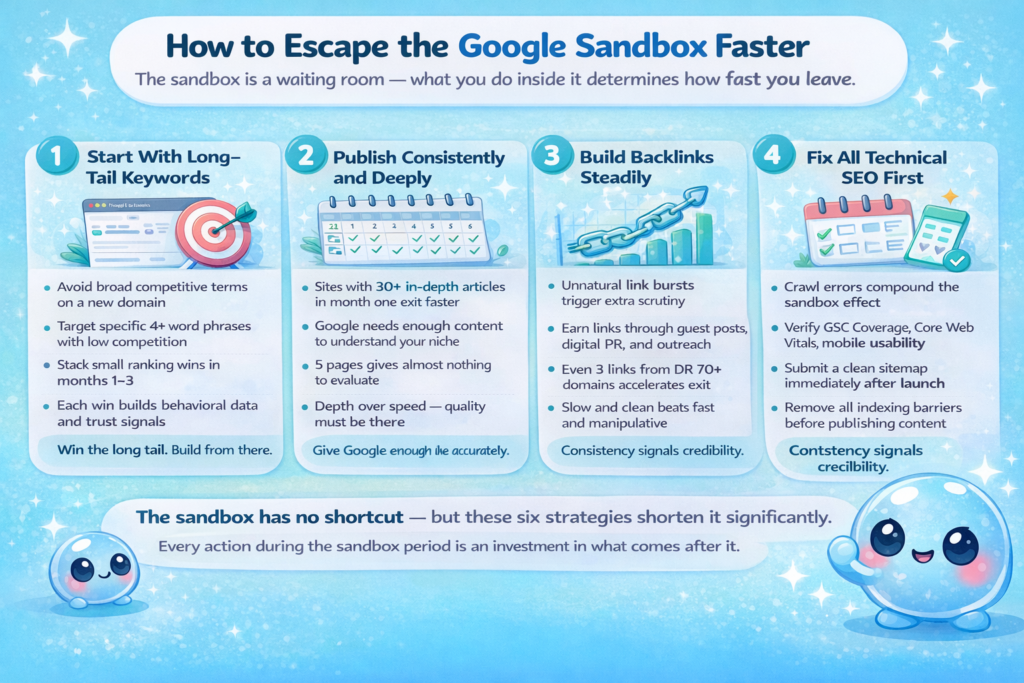
The sandbox is not a sentence. It’s a waiting room — and the quality of what you do while you’re in it directly determines how quickly you exit. Here are the strategies I use with every new site client to compress the sandbox period.
1. Start With Long-Tail, Low-Competition Keywords
This is the single most impactful early-stage decision you can make. Starting with long-tail keywords can be highly effective for new websites — these keywords are less competitive and more specific, which means they can attract targeted traffic with higher conversion potential. Trying to rank for “best running shoes” on a new domain is an exercise in frustration. Trying to rank for “best trail running shoes for wide feet under $100” is achievable within weeks, and every small ranking win builds the behavioral and authority signals Google needs to start trusting you more broadly.
I always build a long-tail content plan before a new site launches. The goal in months one through three is to stack up ranking wins on low-competition terms. Those wins generate real users, real engagement data, and the trust signals that help you emerge from the sandbox and eventually compete for more valuable terms.
2. Publish Consistently and Comprehensively
Volume and consistency matter in the early months — but only if the quality is there. Sites that published 30 or more in-depth articles in the first month showed dramatically shorter sandbox cycles. Google needs enough content to accurately understand what your site is about and how it fits within its niche. A site with 5 pages gives Google almost nothing to evaluate. A site with 30 substantive, well-structured articles gives it a clear topical picture to work with.
Focus on depth over speed. Every article should comprehensively address its topic, use proper header structure, include internal links to related content, and be written with genuine expertise. This is what builds the E-E-A-T signals — Experience, Expertise, Authoritativeness, Trustworthiness — that Google’s algorithms are actively looking for.
3. Build Backlinks Steadily — Not in Bursts
Off-page authority is critical for exiting the sandbox, but the pattern of how you acquire it matters just as much as the volume. An unusual pattern in link creation — a sudden surge of backlinks — can trigger extra scrutiny and delay improvements in rankings. Google sees unnatural link growth as a potential spam signal, which is exactly the opposite of what you want when you’re already under evaluation.
Build backlinks steadily and naturally: through guest posts on relevant publications, digital PR, link-worthy content like original research or comprehensive guides, and outreach to genuinely relevant sites in your niche. Even a handful of high-quality links from authoritative domains in your first three months sends a powerful trust signal. Sites that acquired even 3 backlinks from domains with a Domain Rating above 70 in their first month showed significantly faster sandbox exits.
4. Fix Every Technical SEO Issue Before and After Launch
Technical problems compound the sandbox effect. If Google’s crawlers encounter indexing errors, slow page loads, missing sitemaps, or mobile usability issues on a brand new site, it has even fewer reasons to trust what you’re publishing. Optimizing on-page SEO elements like titles, meta descriptions, header tags, and images — and ensuring a clean, crawlable site structure with a properly submitted sitemap — helps search engines understand your website better and speeds up the ranking process.
I always run a technical audit immediately after a site launches: checking for crawl errors in Google Search Console, verifying Core Web Vitals scores in PageSpeed Insights, confirming mobile usability, and ensuring every published page is indexable. These checks take less than an hour, but they remove barriers that could otherwise extend the sandbox period unnecessarily.
5. Generate Real User Engagement Signals
Google needs behavioral data, and the only way to give it that data is to drive real users to your site through channels other than organic search. Social media, email newsletters, community platforms like Reddit or Quora, and even modest paid advertising can all bring real visitors to your new site — creating the click, engagement, and return-visit signals that tell Google your content is genuinely useful.
I’ve seen new sites exit the sandbox noticeably faster when they had active social media channels driving real traffic from day one. Every user who lands on your site, reads three pages, and returns next week is a piece of evidence that Google can see and weigh. Google monitors user signals including click-through rate, bounce rate, and time on site as part of its evaluation process for new sites.
6. Consider an Aged Domain (With Care)
If you haven’t yet purchased your domain, an aged domain with a clean history is worth considering. The best way to avoid the Google sandbox effect entirely is by purchasing an expired domain with established authority and trust history — rather than registering a new one. An expired domain that previously operated in your niche may come with existing backlinks, established trust signals, and a head start on the evaluation period.
The critical caveat: verify the domain’s history thoroughly before buying. Use tools like Ahrefs, SEMrush, or the Wayback Machine to confirm the domain was used legitimately in your niche, has no history of Google penalties, and isn’t carrying toxic backlinks. A domain with a problematic history will create problems far worse than the sandbox.
What the Google Sandbox Is Not
Before I close, I want to address a few misconceptions that come up regularly — because conflating the sandbox with other issues leads to the wrong fixes.
The sandbox is not a Google penalty: A penalty is a deliberate action Google takes against sites that violate its guidelines — for buying links, keyword stuffing, cloaking, or other manipulative tactics. There is no permanent SEO damage from being in the sandbox. It doesn’t tarnish your reputation with Google. Once you’re out, you rank as your SEO efforts deserve. If you’ve been penalized, that requires a different response — specifically a manual review process and a reconsideration request

The sandbox is not caused by poor content alone: I’ve seen excellent content sandboxed and mediocre content escape quickly. The sandbox is primarily a trust and authority issue, not a content quality issue in isolation. Great content is necessary but not sufficient — you also need backlinks, user signals, and time.
The sandbox is not permanent: Every site that follows best practices and builds authority consistently exits the sandbox. The question is only when, not if. Patience combined with consistent, high-quality work is the only reliable path through it.
Using Google Search Console to Navigate the Sandbox
One of the most productive things you can do during the sandbox period is treat it as a data-gathering phase. Google Search Console shows you exactly which queries your site is starting to appear for — even if you’re ranking in positions 40, 50, or 80. Those early impressions tell you which topics Google is beginning to associate with your site, and they reveal which long-tail opportunities are starting to gain traction.
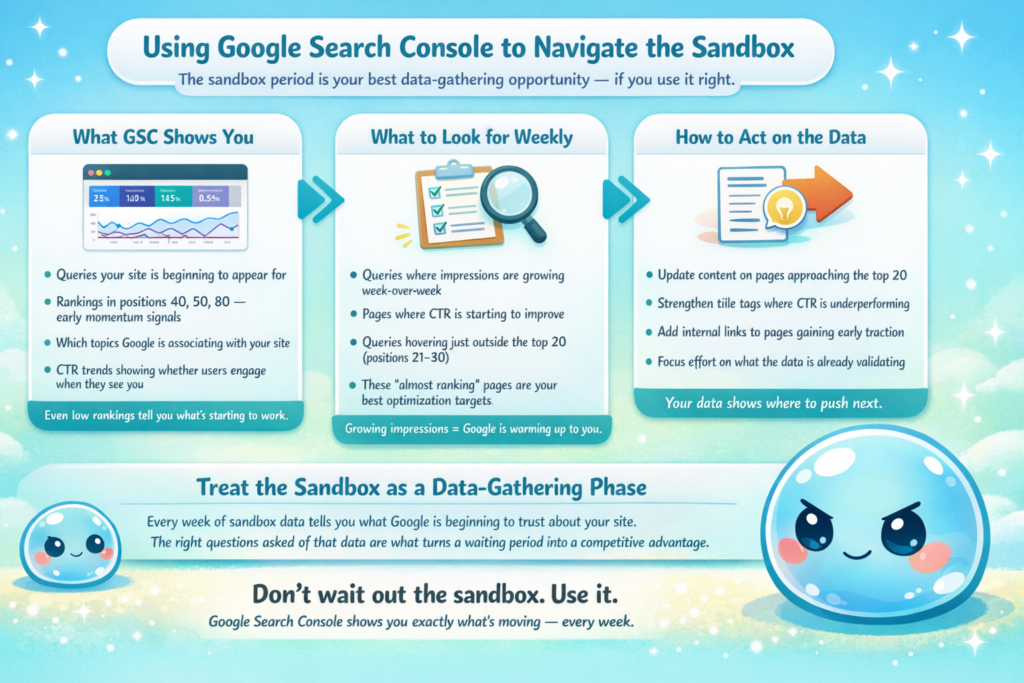
I review Search Console data weekly for new site clients, looking specifically for: queries where impressions are growing (a signal that rankings are moving in the right direction), pages where CTR is improving (a signal that users are engaging), and queries where we’re hovering just outside the top 20 (the best candidates for content improvements that can accelerate ranking progress).
This is exactly the kind of pattern recognition that sneo.ai makes dramatically faster. Rather than manually filtering through hundreds of queries in your Search Console performance report, you can simply ask me: “Which queries are gaining impressions on my new site right now?” or “Which pages are closest to breaking into the top 20?” I’ll draw on your actual data and give you specific, prioritized answers — so you spend your sandbox period doing the work that moves the needle, not sorting through spreadsheets.
Conclusion
The Google Sandbox is one of SEO’s most debated phenomena — but for new website owners, the debate is academic. What matters is the practical reality: new sites consistently face a period of ranking suppression on Google that lasts anywhere from 3 to 9 months, depending on niche competitiveness and the quality of your SEO work during that time.
Understanding what is happening and why is the first step toward navigating it calmly. The sandbox isn’t a punishment — it’s Google’s trust-building process. And the sites that emerge from it strongest are the ones that use the waiting period productively: building topical content, earning quality backlinks, fixing technical issues, and generating genuine user engagement.
Your Google Search Console is the most valuable tool you have during this period. It shows you exactly what Google sees, what’s starting to move, and where your opportunities are emerging. Connect your Search Console to sneo.ai and let me help you read those signals clearly — so every week of your sandbox period is an investment in the authority that will drive your rankings for years to come.
Frequently Asked Questions (FAQ)
Q1: What is the Google Sandbox in SEO?
The Google Sandbox is a widely observed phenomenon where new websites experience a temporary period of ranking suppression in Google’s search results — even when they’re properly optimized and indexed. It’s believed to reflect Google’s trust-building evaluation process for new domains. While Google has never officially confirmed a “sandbox” mechanism, consistent SEO industry data and observation strongly support the effect’s existence.
Q2: How long does the Google Sandbox last?
For most websites, the sandbox period lasts between 3 and 6 months. In highly competitive niches like finance, health, legal, or cryptocurrency, it can extend to 9 to 12 months. Sites in less competitive markets with strong early content and quality backlinks can sometimes exit in as little as 2 to 3 months. The most important factor influencing duration is the quality and consistency of SEO work done during the period itself.
Q3: Has Google officially confirmed the Google Sandbox exists?
No. Google has consistently denied the existence of a specific sandbox mechanism. However, Google’s John Mueller has acknowledged that new sites may take time to rank due to a lack of established trust and authority signals. The practical effect — ranking suppression for new domains — is widely observed and well-documented in the SEO community, regardless of what Google calls the underlying process.
Q4: How do I know if my site is in the Google Sandbox?
The clearest signs are: your pages are indexed in Google but rank poorly for all keywords; your site ranks on Bing and Yahoo but not Google; your Google Search Console shows impressions but near-zero clicks; and your domain is less than 6 months old. The defining characteristic is the gap between being fully indexed and being ranked competitively — which distinguishes the sandbox from a penalty or a technical issue.
Q5: Can I avoid the Google Sandbox entirely?
For brand new domains, the sandbox effect is effectively unavoidable. The only reliable way to bypass it is to purchase an aged domain with an established, clean backlink history in your niche. If you’re starting with a new domain, the best approach is to accept the sandbox period and focus on doing the right SEO work consistently throughout it.
Q6: What’s the fastest way to exit the Google Sandbox?
The fastest exits happen when sites combine three things simultaneously: publishing comprehensive, topic-clustered content consistently from day one; earning quality backlinks from relevant, authoritative domains early; and driving real user engagement through social media, email, and community channels. Each of these supplies Google with the trust signals it needs to move a site out of evaluation and into competitive ranking.
Q7: Is the Google Sandbox the same as a Google penalty?
No — and the distinction matters. A Google penalty is a deliberate action taken against sites that violate Google’s guidelines, such as purchasing links or using manipulative tactics. The sandbox is a natural evaluation period for new domains with no wrongdoing involved. Penalties require a remediation process and a reconsideration request. The sandbox simply requires time, quality content, and consistent SEO effort.
Q8: How does sneo.ai help during the Google Sandbox period?
sneo.ai connects directly to your Google Search Console, giving you plain-English insights into exactly what’s happening with your new site’s search performance. During the sandbox period, this means you can ask questions like: “Which queries is my site starting to gain impressions for?” or “Which of my pages are closest to breaking into the top 20 for their target keywords?” Instead of manually analyzing hundreds of data points each week, you get clear, site-specific answers that help you focus your SEO efforts where they’ll have the most impact.