

I’ve been reviewing SEO strategies for years, and I can spot a fragmented one within minutes. Title tags are optimized but the site loads like it’s running on dial-up. The content is beautifully written but the internal linking structure is a mess. Backlinks are being chased while the on-page fundamentals are broken. Every piece exists in isolation — and that isolation is exactly why rankings stay stuck. Holistic SEO is the answer to this fragmentation. It’s the philosophy that took me from fixing individual problems to building systems that work as a whole — and it’s the approach I now apply to every site I touch.
Quick Answer
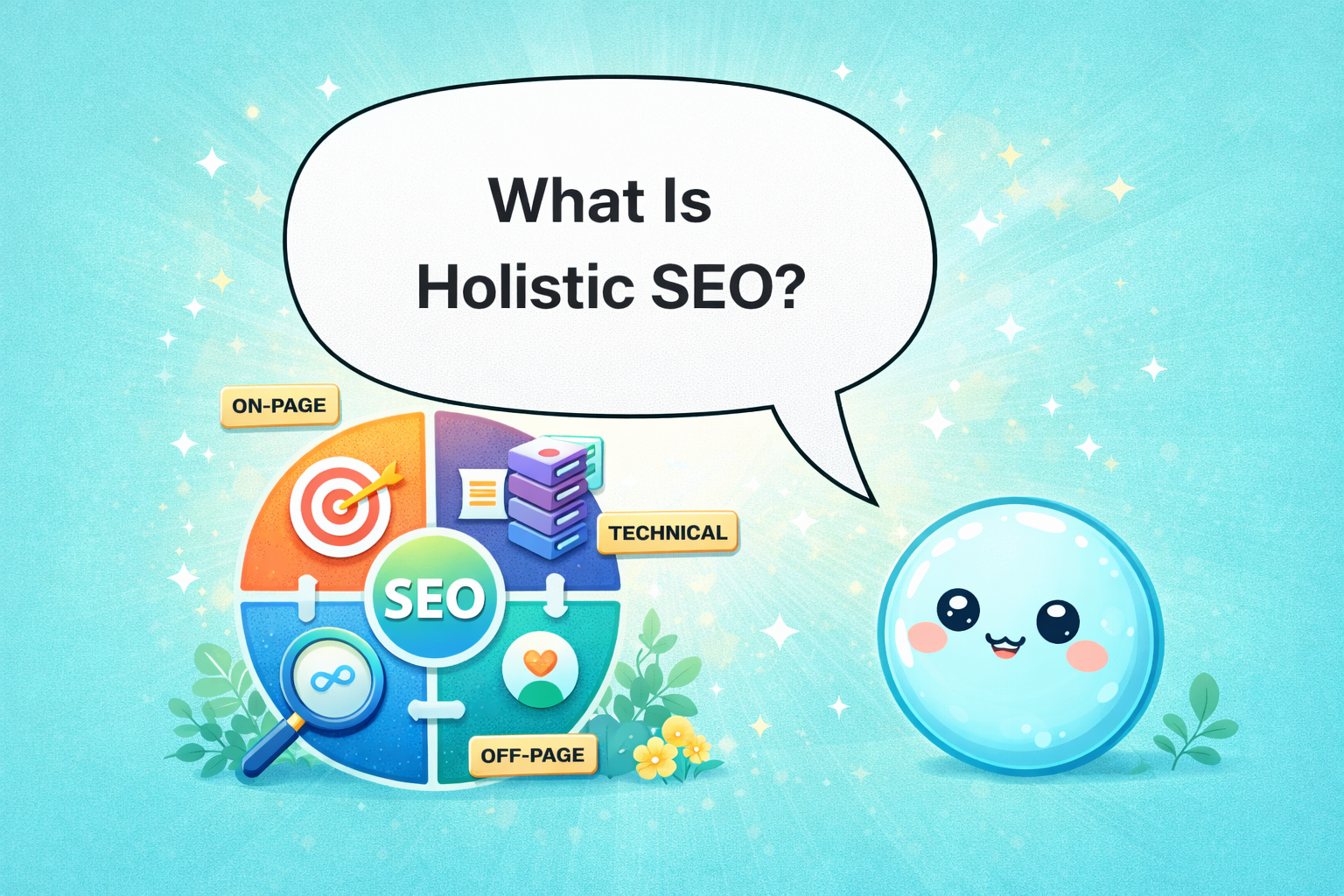
Holistic SEO is a comprehensive approach to search engine optimization that optimizes every element of a website simultaneously — content quality, technical performance, user experience, and off-page authority — rather than treating each as a standalone tactic. It treats your entire digital presence as an interconnected system.
Why Fragmented SEO Fails — and Why Holistic SEO Has Become Non-Negotiable in 2026
There’s a version of SEO that I used to see everywhere — and still do, unfortunately. Someone reads that backlinks are the most important ranking factor, so they spend six months building links while ignoring their slow, mobile-unfriendly pages. Or they hear that content is king, publish 50 blog posts, and wonder why none of them rank — not realizing their site has crawl errors that are hiding half the content from Google.
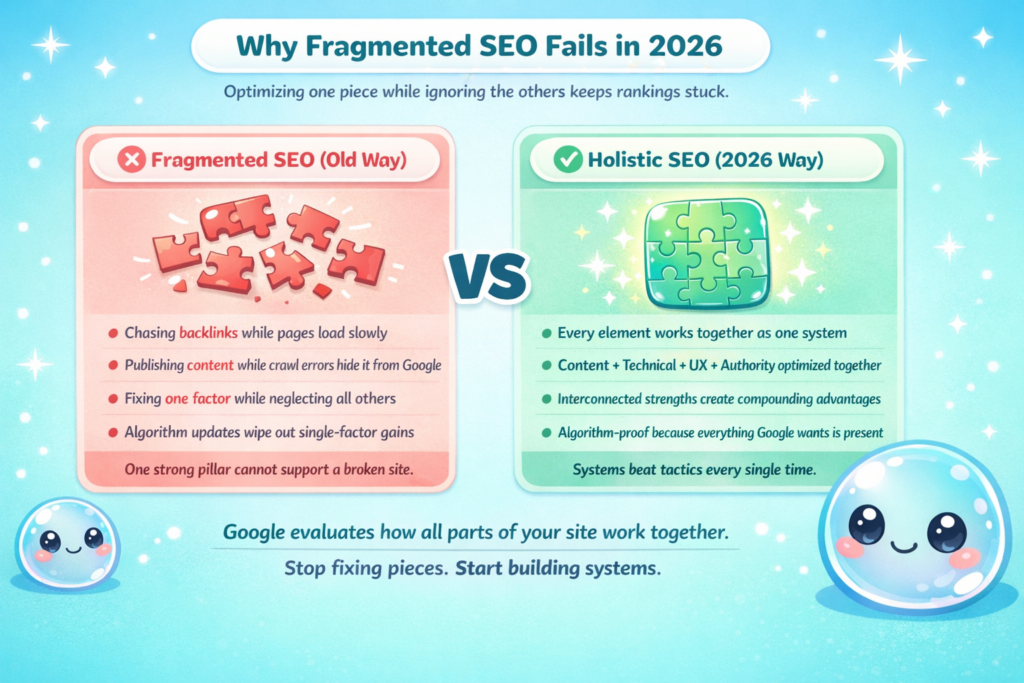
This piecemeal approach made more sense ten years ago, when you could reliably game a single aspect of Google’s algorithm and see results. That era is over. Google’s algorithms are sophisticated enough in 2026 to evaluate how all parts of your site work together — not just whether any single element looks good in isolation. A site that excels at one pillar but neglects the others will always be vulnerable to the sites that do everything well.
Successful search engine optimization in 2026 requires an integrated interplay of editorial, IT, UX, PR, and product management. That’s not complexity for its own sake — it reflects how Google actually evaluates and ranks content today. The shift isn’t just technical. It’s philosophical. And holistic SEO is the framework that captures it.
The good news: once you understand how all the pieces connect, the whole becomes less overwhelming than managing a dozen separate tactics. You stop chasing individual wins and start building compounding advantages. That’s what I want to show you in this article.
The Four Pillars of Holistic SEO
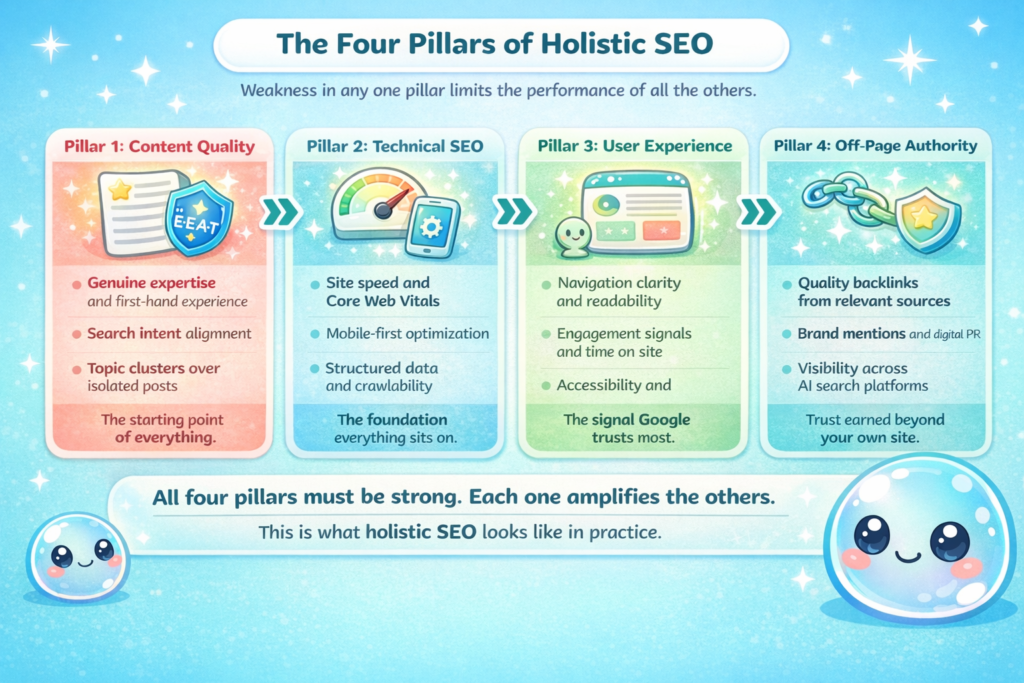
When I explain holistic SEO to clients, I break it down into four pillars that work together as a single system. Weaknesses in any one pillar limit the performance of all the others. Strength across all four creates a compounding effect that’s genuinely difficult for competitors to replicate quickly.
Pillar 1: Content Quality and Search Intent
Content is the starting point of holistic SEO — but in 2026, the standard for what qualifies as good content has shifted dramatically. It’s no longer enough to produce accurate, well-written articles. Google’s algorithms, reinforced by a consistent stream of Helpful Content updates, now evaluate whether content demonstrates genuine first-hand experience, expertise, and original insight.
This is captured in Google’s E-E-A-T framework: Experience, Expertise, Authoritativeness, and Trustworthiness. The E-E-A-T framework continues to play a critical role in website rankings in 2026, particularly for topics that can impact a person’s health, finances, or major decisions — what Google calls “Your Money or Your Life” (YMYL) pages.
In practice, this means that content created purely to rank — thin, generic, or simply restating what’s already out there — is actively demoted. In 2026, shallow or poorly structured content is heavily penalized by Google’s ranking systems. The bar has risen for everyone.
But E-E-A-T is only half of the content equation. The other half is search intent — understanding not just what someone is searching for, but why they’re searching for it. I always ask: is this person trying to learn something, compare options, or make a purchase? Creating content that aligns with the right intent is what transforms a page that ranks into a page that converts.
One practical system I use with every client is topic clustering. Instead of writing standalone blog posts, I build a central “pillar page” that covers a broad topic comprehensively, surrounded by supporting content pieces that go deep on related subtopics — all internally linked together. Topic clusters have replaced traditional keyword strategies as one of the most impactful SEO approaches in 2026. They signal topical authority to Google, help you rank for both broad and specific queries, and create a content ecosystem that’s far more resilient to algorithm updates than isolated pages.
Pillar 2: Technical SEO — The Foundation Everything Else Depends On
I think of technical SEO the way I think of a building’s foundation. Nobody admires the foundation — they admire the building. But if the foundation is cracked, it doesn’t matter how beautiful the building is. Everything will eventually crumble.
Technical SEO covers everything that allows search engines to find, crawl, understand, and index your pages. Site speed, mobile optimization, URL structure, Core Web Vitals, structured data, canonical tags, XML sitemaps, crawl budget management — these aren’t glamorous topics, but they determine whether Google can actually see all your content and link-building work.
53% of mobile users abandon sites that take longer than 3 seconds to load. When visitors leave before your page loads, Google sees it — and it interprets that behavior as a signal that your page isn’t worth ranking. Your page speed isn’t just a technical issue; it’s a direct line to your bounce rate, your engagement metrics, and ultimately your ranking position.
Google’s Core Web Vitals remain essential in 2026. The three key measurements — Largest Contentful Paint (LCP), Interaction to Next Paint (INP), and Cumulative Layout Shift (CLS) — reflect how real users experience your site on real devices in real conditions. In 2026, LCP under 2.0 seconds is the new gold standard, with INP under 200 milliseconds and CLS under 0.1 as the benchmarks Google uses to assess page experience. Missing these thresholds doesn’t just hurt users — it actively suppresses your ranking potential.

Mobile optimization is another non-negotiable technical element I check in every audit. Google has operated on mobile-first indexing for years, meaning it evaluates the mobile version of your site first when determining how to rank it. 80% of top-ranking websites are mobile-optimized. Yet in my experience, a surprising number of small business sites still have broken layouts, unreadable font sizes, or slow load times on mobile — often without the site owner ever realizing it, because they always check their own site on desktop.
Structured data (Schema markup) is the technical element that most sites still underuse. 72% of first-page results use schema markup, and yet 23% of websites have no structured data at all. Schema tells Google exactly what type of content is on your page — a recipe, an article, a FAQ, a local business listing — enabling rich results that make your listing visually stand out in search results, drive higher click-through rates, and increasingly position your content to be cited in AI-generated answer summaries.
Pillar 3: User Experience — The Signal Google Trusts Most
Here’s something I tell every client when they ask why their well-optimized pages aren’t ranking: Google doesn’t just read your pages. It watches how people behave on them. And the story user behavior tells carries enormous weight in ranking decisions.
User experience (UX) in SEO encompasses everything about how visitors interact with your site — how quickly it loads, how easy it is to navigate, how readable the content is, whether they find what they came for, and how long they stay. Every one of these signals feeds back into Google’s understanding of whether your site deserves to rank.
88% of online shoppers are unlikely to revisit a website after a poor user experience. That number should stop every site owner in their tracks. It means that a bad UX doesn’t just lose you a ranking — it loses you a customer permanently, and it sends a negative engagement signal to Google at the same time.
The UX factors I focus on most in a holistic SEO audit are: page load time (already covered under Core Web Vitals), navigation clarity, content scannability, mobile usability, and internal page architecture. A site that’s hard to navigate sends users back to Google quickly — which Google interprets as a signal that your site failed to satisfy the query. A site that’s easy to navigate, logically structured, and genuinely helpful keeps users engaged — which Google interprets as a sign of quality worth ranking higher.
One underrated aspect of UX that I’ve seen make a measurable difference is accessibility. Accessible websites — those with proper heading hierarchy, alt text for images, keyboard navigability, and sufficient color contrast — often see lower bounce rates, higher engagement, and better rankings. Accessibility isn’t just the right thing to do for users with disabilities. It’s a proxy for overall quality that Google increasingly recognizes.
Content readability is part of UX too — and it’s where many technically optimized sites fall short. Long, unbroken walls of text might contain excellent information, but they fail the usability test. In 2026, content that’s structured with clear headings, short paragraphs, bullet lists where appropriate, and visual elements to break up text doesn’t just read better — it signals to Google’s crawlers that the content is organized, scannable, and user-friendly.
Pillar 4: Off-Page Authority — Earning Trust Beyond Your Own Site
No holistic SEO strategy is complete without off-page authority. This is the pillar that extends your optimization beyond your own domain — earning signals from the wider web that tell Google your site is trustworthy, relevant, and worth ranking above competitors.
Backlinks remain the cornerstone of off-page SEO. The top organic result on Google typically has 3.8 times more backlinks than pages ranking in positions 2 through 10. The correlation between strong backlink profiles and high rankings is consistent enough that no holistic strategy can afford to ignore link-building entirely.
But the nature of effective link-building has changed fundamentally. The paradigm has shifted from chasing links in bulk to selectively acquiring them by creating content people want to cite, share, and talk about. In 2026, a handful of links from genuinely relevant, authoritative sources outweighs dozens of low-quality links — and low-quality link schemes actively risk penalties that can take months to recover from.
What I advise clients on instead is building the kind of content that earns links naturally: original research, comprehensive guides, unique data, and authoritative perspectives that other publishers naturally want to reference. Think of link-building less as a tactic and more as a reputation-building exercise.
Beyond backlinks, off-page authority in 2026 also includes brand mentions, community visibility, social signals, and increasingly — presence in AI-powered platforms like ChatGPT and Google’s AI Overviews. The most successful SEO strategies in 2025 and 2026 have shifted from “win rankings” to “win recognition” across every platform where users discover and make decisions — from Google to YouTube to Reddit to AI answer engines.
How Holistic SEO Differs From Traditional SEO
The simplest way I explain the difference to clients is this: traditional SEO asks, “How do I rank for this keyword?” Holistic SEO asks, “How do I build a website that genuinely serves users better than every competitor — and then make sure Google can see that?”
Traditional SEO is tactical. It targets individual ranking factors in isolation. Holistic SEO is systemic. It builds a site where every element reinforces every other element.
Here’s what that difference looks like in practice. A traditional SEO approach might increase a page’s word count to match top-ranking competitors, add a keyword to the title tag, and build a few backlinks to the page. A holistic SEO approach does all of that — but also ensures the page loads fast, reads cleanly on mobile, is structured with proper header hierarchy, links to and from relevant supporting pages, uses schema markup for rich results, and is written with genuine expertise and first-hand experience that earns engagement.
The reason holistic SEO produces more durable results is precisely this interconnectedness. Holistic SEO shields your rankings from Google’s algorithm changes in a way that tactical, single-factor optimization never can. When your site ranks because it genuinely serves users across every dimension Google evaluates, no single algorithm update can pull the rug out from under you. There’s nothing to penalize — you’re already doing what Google wants sites to do.
Holistic SEO vs Traditional SEO: Comparison
| Aspect | Traditional SEO | Holistic SEO |
| Core question | “How do I rank for this keyword?” | “How do I build the best site for users and make sure search engines see that?” |
| Main focus | Individual keywords | Overall user value and site quality |
| Strategy type | Tactical | System-wide |
| Optimization style | Focus on isolated ranking factors | Improve many connected signals across the site |
| Keyword use | Heavy keyword targeting | Natural topic coverage and intent matching |
| Content approach | Adjust content to compete with ranking pages | Write content that genuinely helps users and answers real questions |
| Word count strategy | Increase length to match competitors | Write the amount needed to solve the user’s problem clearly |
| Backlinks | Build links to boost authority for specific pages | Earn links through strong content, credibility, and topical depth |
| Page structure | Basic optimization like title tags and keyword placement | Structured content with headers, internal linking, schema, and topic clusters |
| Internal linking | Often minimal or added later | Planned system that connects related pages |
| Technical SEO | Addressed separately or occasionally | Built into the site from the start |
| Site speed | Sometimes treated as a secondary task | Treated as a core part of user satisfaction |
| Mobile experience | Often adjusted after desktop design | Designed with mobile use in mind from the beginning |
| User experience | Not always a priority | Central to the strategy |
| Expertise signals | Often overlooked | Real expertise, experience, and credibility built into content |
| Engagement signals | Not heavily considered | High engagement expected through useful content |
| Content planning | Page-by-page keyword targeting | Topic clusters and full subject coverage |
| Risk during algorithm updates | Higher risk if tactics stop working | More stable because quality signals are strong across the site |
| Ranking durability | Gains can be short-term | Gains tend to last longer |
| Long-term goal | Rank pages for selected terms | Build a trusted website that performs well across search results |
Holistic SEO and AI Search: The 2026 Reality
I can’t write about holistic SEO in 2026 without addressing the elephant in the room: the rise of AI-powered search. Google’s AI Overviews, which generate answer summaries directly in search results, have changed the competitive landscape in ways that have left many site owners confused and frustrated.
Users now discover and decide across AI tools, Google, and social and community platforms simultaneously — which means organic success requires showing up credibly everywhere, not just ranking for ten blue links. The SEO professionals who adapted best to this shift were the ones who stopped asking “what got the click?” and started asking “what shaped the decision?”
This is precisely where holistic SEO has a structural advantage over tactical SEO. AI systems like Google’s Gemini pull citations from content that is comprehensive, well-structured, demonstrates genuine expertise, and is regularly updated. 85% of AI Overview citations come from content published in the last two years, with 44% from 2025 alone. Fresh, authoritative, well-organized content — which is exactly what holistic SEO produces — is the content AI systems prefer to cite.
Content that uses question-based headings and FAQ sections significantly boosts the likelihood of being cited by AI systems like ChatGPT and appearing in Google’s AI Overviews. This is why I now build FAQ sections into every major piece of content I produce — and it’s one of the reasons the holistic approach produces compounding benefits as search continues to evolve.
The practical implication for site owners: building a site that genuinely serves users with depth, clarity, and demonstrated expertise doesn’t just rank well in traditional search. It positions you well for AI-generated answers, voice search, featured snippets, and every other evolving format through which people find information. The holistic approach is future-proof by design.
How to Implement Holistic SEO: A Practical Starting Point
I want to be direct here: implementing holistic SEO properly is not something you do on a weekend. It’s a sustained commitment to continuous improvement across multiple disciplines. But the starting point is simpler than most people expect. Here’s how I approach it with new clients.
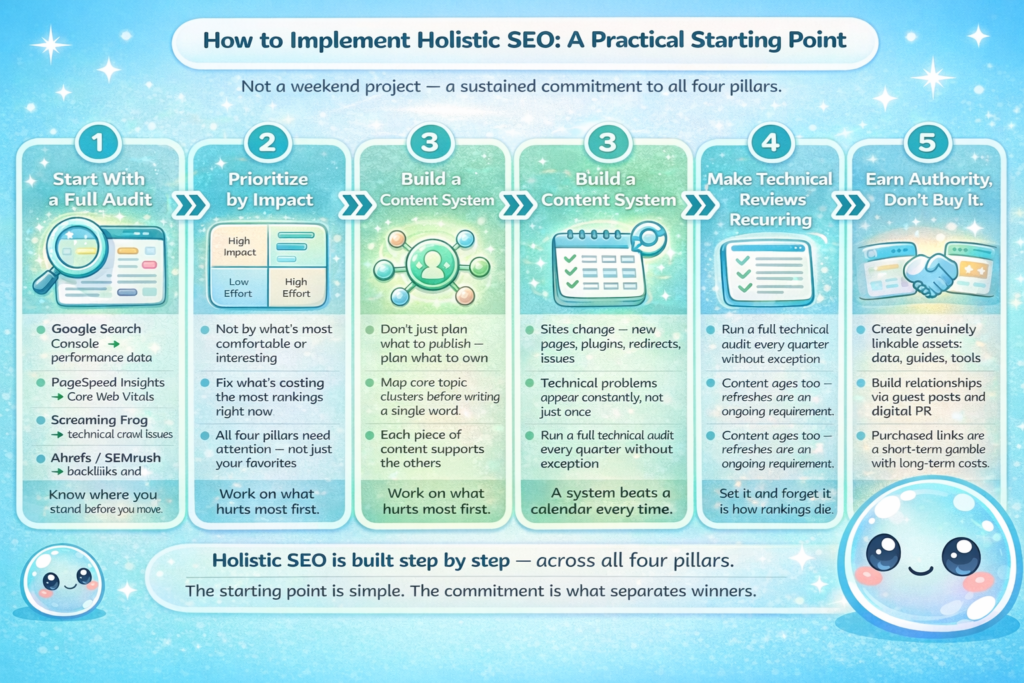
1) Start with a comprehensive audit. Before optimizing anything, you need an honest picture of where your site stands across all four pillars. I use Google Search Console for performance data, Google’s PageSpeed Insights for Core Web Vitals, Screaming Frog for technical crawl issues, and Ahrefs or SEMrush for backlink analysis and keyword gap identification. This audit reveals which pillars are strongest and which need the most urgent attention.
2) Prioritize by impact, not interest. I’ve worked with site owners who love creating content but avoid dealing with technical issues. And I’ve worked with developers who could optimize Core Web Vitals in their sleep but resist writing content. The holistic approach requires attention to all four pillars — prioritized by which gaps are currently costing you the most rankings and traffic.
3) Build a content system, not a content calendar. A content calendar asks “what should we publish next month?” A content system asks “what topics do we need to own, what’s the cluster structure, and how does each piece of content support the others?” I spend significant time with clients mapping out their core topic clusters before writing a single word. This upfront investment in architecture pays dividends for years.
4) Make technical and UX reviews a recurring habit. The most common technical SEO mistake I see is treating it as a one-time fix. Sites change, plugins update, pages get added, redirects accumulate — and new technical issues appear constantly. I build quarterly technical audits into every client workflow without exception. Content naturally ages and loses its ranking relevance over time, which makes both content refreshes and technical maintenance an ongoing operational requirement, not a one-time project.
5) Build authority through earned links, not purchased ones. For off-page authority, I focus my clients’ energy on creating genuinely linkable assets — original data, comprehensive guides, tools, and expert perspectives — while building relationships with relevant publications through guest contributions and digital PR. Slow and clean beats fast and manipulative every time in 2026.
How to Track Holistic SEO Progress
One challenge I hear from site owners is: “I’m working on multiple SEO areas at once — how do I know what’s actually moving the needle?” It’s a fair question, and the answer is to track metrics that reflect the full system, not just individual tactics.
The metrics I monitor across all four pillars are: organic traffic and impressions (via Google Search Console), average position for target keywords, CTR by page, Core Web Vitals scores, bounce rate and average engagement time, backlink growth and referring domain quality, and content performance over time. Each metric tells a different part of the story, and the complete picture requires looking at all of them together.
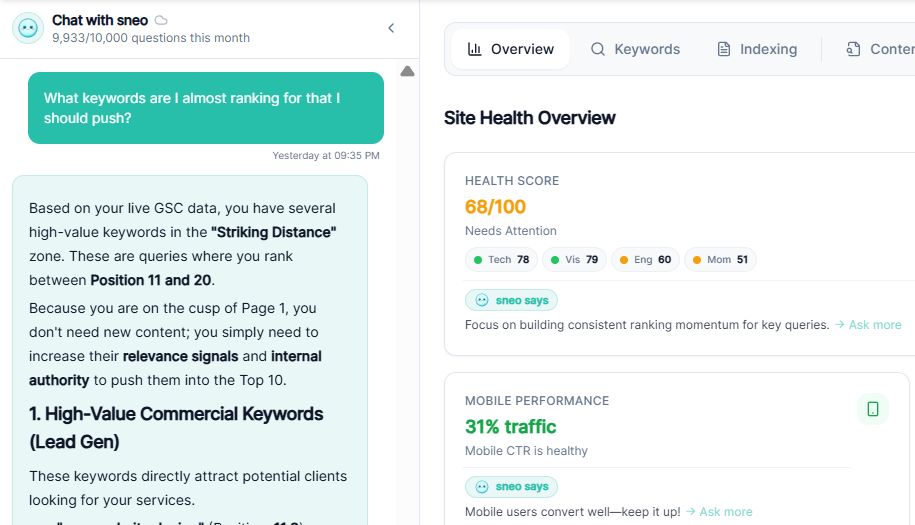
This is exactly the kind of cross-data interpretation where sneo.ai makes the biggest difference. Instead of manually pulling data from Google Search Console, comparing it against benchmark reports, and trying to identify patterns across dozens of pages, you can simply ask me: “Which pages are losing rankings and why?” or “What’s the biggest technical issue holding my top pages back?” or “Where do I have untapped content opportunities based on my current Search Console data?” I draw the connections between data points you’d otherwise spend hours trying to find yourself.
The Mindset Behind Holistic SEO
I want to close with something that I think is more important than any individual tactic or framework. Holistic SEO isn’t primarily a set of techniques — it’s a mindset.
The core belief behind it is this: if you genuinely build the best, most useful version of a website for your audience — technically solid, content-rich, user-friendly, and credibly authoritative — then search engines will recognize it. Not immediately, and not without sustained effort. But consistently, durably, and in a way that holds up through algorithm updates, competitive pressure, and the constant evolution of how people search.
“Humans have credit cards, search engines don’t.” Your SEO strategy should be human-focused first. When you optimize for actual people — their needs, their frustrations, their questions, their experience on your site — you automatically optimize for Google, because Google’s mission is to surface content that serves people best.
That’s the philosophy I built sneo.ai around. Not a tool that helps you game metrics, but a platform that helps you understand what your actual data is telling you about how well you’re serving your audience — and where your holistic SEO still has room to grow.
Conclusion
After years of working with websites across industries and sizes, I can tell you with confidence: the sites that rank well and stay ranking well are the ones that don’t optimize in isolation. They build strong content ecosystems. They maintain technically clean, fast, mobile-ready foundations. They design experiences that keep users engaged. And they earn authority by being genuinely worth citing and linking to.
That’s holistic SEO. It’s not the fastest path to rankings — but it’s the most durable one. And in 2026, with AI search reshaping how people find information, with Google’s algorithms becoming more sophisticated by the month, and with competition intensifying in virtually every niche, durable is exactly what you need to be.
Your Google Search Console data is already telling you where your holistic SEO gaps are. The question is whether you’re asking the right questions. Connect your Search Console to sneo.ai and let me show you what your data is saying — in plain English, with clear next steps you can act on this week.
Frequently Asked Questions (FAQ)
Q1: What is holistic SEO in simple terms?
Holistic SEO is a comprehensive, all-encompassing approach to search engine optimization that improves every aspect of a website simultaneously — content quality, technical performance, user experience, and off-page authority — instead of optimizing each in isolation. It treats your website as an interconnected system where every element affects every other element.
Q2: How is holistic SEO different from traditional SEO?
Traditional SEO often focuses on individual ranking factors — getting backlinks, optimizing a title tag, targeting a keyword. Holistic SEO addresses all ranking factors together as a unified strategy. The key difference is durability: traditional SEO can produce short-term wins that disappear with the next algorithm update, while holistic SEO builds lasting rankings because it’s aligned with what Google actually rewards — a genuinely excellent website.
Q3: What are the four pillars of holistic SEO?
The four core pillars are: content quality and search intent alignment (including E-E-A-T), technical SEO (page speed, Core Web Vitals, mobile optimization, structured data), user experience (navigation, readability, engagement signals), and off-page authority (backlinks, brand mentions, and broader digital credibility). A strong holistic SEO strategy maintains and improves all four simultaneously.
Q4: Is holistic SEO relevant for small businesses and bloggers, or just large sites?
It’s absolutely relevant for sites of every size — in fact, smaller sites often benefit the most from the holistic approach. Because they can’t compete with large brands on volume or budget, small sites win by doing everything well within their niche. A technically sound, content-rich, user-friendly small business site can outrank a large competitor that neglects any one of the four pillars.
Q5: How long does it take to see results from a holistic SEO strategy?
Typically 3 to 6 months for initial ranking improvements, with compounding gains over 12 to 18 months as authority builds. Holistic SEO is a long-term investment. The advantage is that the results are durable — sites built on a holistic foundation tend to maintain rankings through algorithm updates that punish sites built on narrower, tactical optimization.
Q6: Does holistic SEO include AI search optimization in 2026?
Yes — and this is one of the defining features of holistic SEO in 2026. AI-generated answers (like Google’s AI Overviews) prefer content that is comprehensive, well-structured, authoritative, and regularly updated — which is precisely what holistic SEO produces. By building genuine expertise and depth across your content, you simultaneously optimize for traditional organic rankings and AI citation, making holistic SEO the most future-proof approach available.
Q7: Where should I start if I want to implement holistic SEO?
Start with a comprehensive audit across all four pillars: run a technical crawl (Screaming Frog is excellent for this), check your Core Web Vitals in Google’s PageSpeed Insights, review your Google Search Console performance data for content gaps, and audit your backlink profile in Ahrefs or SEMrush. Then prioritize the pillar with the most urgent gaps — that’s typically where the fastest ranking improvements are waiting.
Q8: How does sneo.ai support a holistic SEO strategy?
sneo.ai connects directly to your Google Search Console and gives you plain-English answers to questions about your site’s overall SEO health. Instead of manually piecing together data from multiple tools, you can ask me things like: “Which of my pages have the most ranking potential right now?” or “What technical issues are most likely hurting my organic traffic?” or “Where does my content have topical gaps compared to pages ranking above me?” I draw on your actual site data to give you specific, prioritized insights — not generic advice.