

If you’ve ever asked is https better for SEO, you’re not alone — and the answer matters more than most site owners realise. HTTPS isn’t just a padlock icon. It’s a confirmed Google ranking signal, a trust indicator that affects click-through rates, and a prerequisite for features that directly influence Core Web Vitals and crawl behaviour. In this guide, I’ll walk you through exactly what the data shows, what Google has confirmed, and how to migrate safely without losing rankings.
Is HTTPS Better for SEO? TL;DR
- HTTPS is a confirmed Google ranking factor, not a myth.
- HTTP sites face Chrome security warnings that damage user trust signals and increase bounce rates.
- A poorly executed HTTPS migration can temporarily hurt rankings — proper 301 redirects are non-negotiable.
- SSL alone won’t skyrocket rankings, but staying on HTTP actively holds you back.
Is HTTPS a Confirmed Google Ranking Factor or Just a Myth?
This question comes up constantly in SEO forums, and I want to settle it with facts rather than opinion.
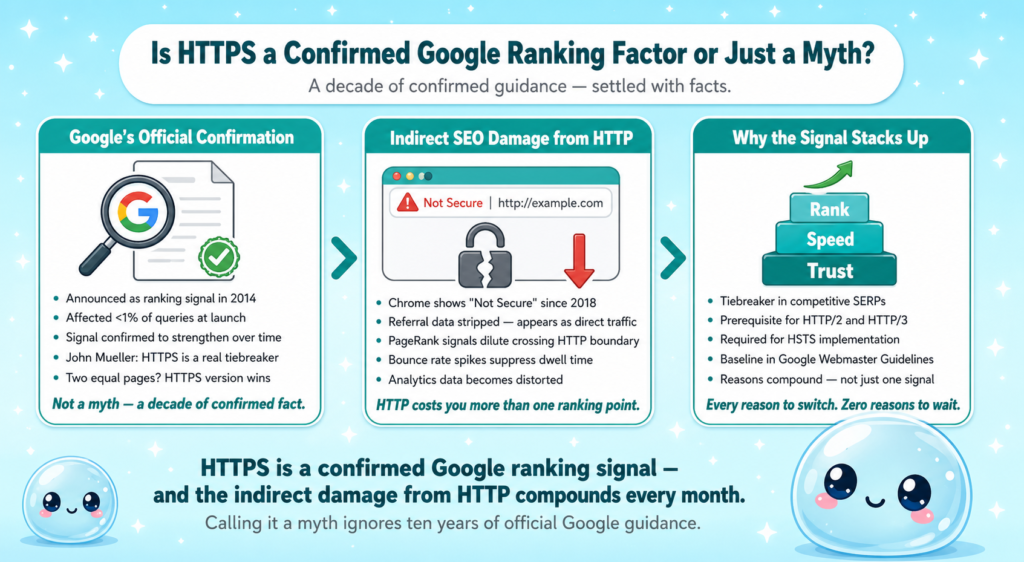
In 2014, Google officially announced HTTPS as a lightweight ranking signal in its Google Search ranking factors update. At launch, it affected fewer than 1% of queries. Google also stated it could strengthen the signal over time if webmasters adopted HTTPS widely — and they did exactly that.
John Mueller and the Google Search team have repeatedly confirmed that HTTPS remains a ranking factor, though they characterise it as a tiebreaker rather than a primary driver. That framing matters. If two pages are otherwise equal in relevance, authority, and content quality, the HTTPS version wins. That’s a real, measurable edge.
What’s often underestimated is the indirect SEO damage HTTP causes:
- Chrome browser security warnings: Since 2018, Chrome labels all HTTP pages as “Not Secure.” Users see this warning before they engage with your content.
- Referral data stripping: Traffic passing from an HTTPS site to an HTTP site loses its referral header — it shows up as direct traffic in Google Search Console, distorting your analytics.
- PageRank signal dilution: Links from HTTPS sources to HTTP destinations can pass fewer signals cleanly.
The Google Webmaster Guidelines have long recommended HTTPS as a baseline. Calling it a “myth” at this point ignores a decade of confirmed guidance. Is https better for SEO? Yes — and the reasons stack up well beyond a single ranking point.
Does Not Having SSL Hurt Your SEO Performance?
Skipping SSL isn’t neutral. It actively degrades your SEO in ways that compound over time.
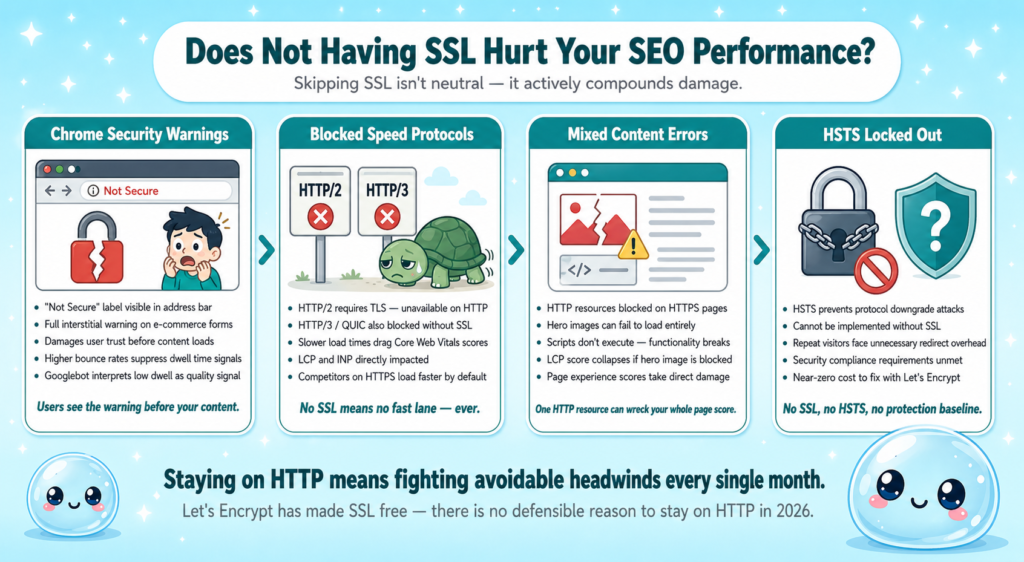
The most visible damage happens at the Chrome browser security layer. When a visitor lands on an HTTP page, Chrome surfaces a “Not Secure” label in the address bar. For e-commerce or any site collecting form data, Chrome escalates this to a full interstitial warning. The impact on conversion rates and bounce rates is real and documented.
Bounce rate increases directly suppress dwell time signals, which influence how Googlebot crawling interprets page quality over time.
Beyond user behaviour, missing SSL affects technical SEO in three concrete ways:
- HTTP/2 and HTTP/3 are unavailable: These protocols require TLS. Without them, your page load speeds are slower, which drags Core Web Vitals scores.
- Mixed content errors: If you migrate partially, or if third-party scripts load over HTTP on an HTTPS page, browsers block those resources. Images fail to load. Scripts don’t execute. This wrecks page experience scores.
- HTTP Strict Transport Security (HSTS) cannot be implemented: HSTS tells browsers to always use HTTPS, preventing protocol downgrade attacks. Without SSL, you can’t set it.
From an ongoing SEO perspective, staying on HTTP means you’re fighting these headwinds every single month. The gap between HTTP and HTTPS sites widens as secure protocols become more embedded in Google’s infrastructure and browser defaults.
I’ve reviewed sites where HTTP was the single most fixable issue dragging down an otherwise solid content strategy. The SSL certificate cost has dropped to near zero with providers like Let’s Encrypt. There’s no defensible reason to stay on HTTP in 2026.
How to Migrate from HTTP to HTTPS Without Losing SEO Rankings
Migration risk is real, but it’s manageable with the right process. I’ve seen sites lose 30–40% of traffic from a botched migration and recover fully — it just takes longer than doing it right the first time.
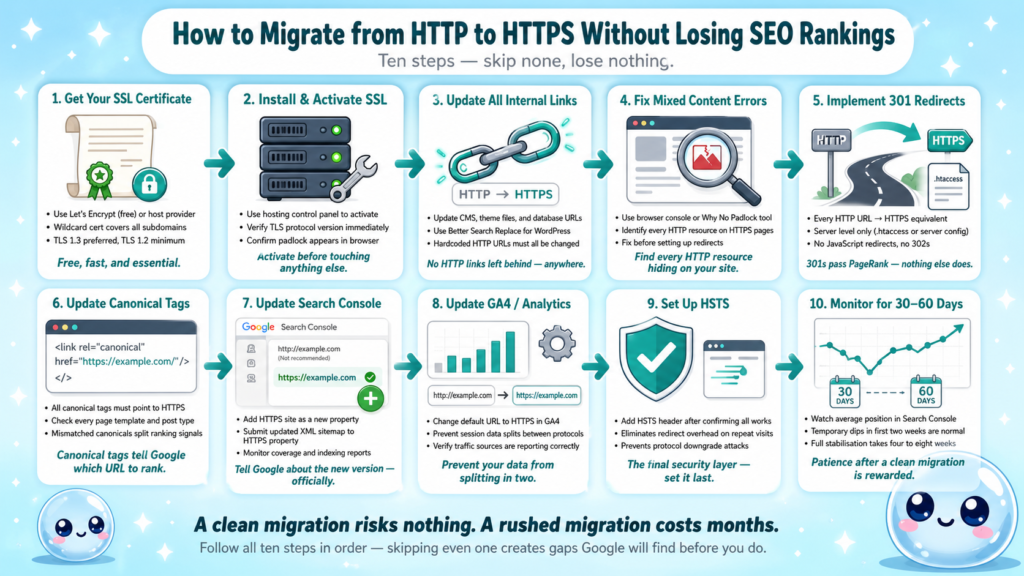
Follow this sequence without skipping steps:
- Purchase or obtain your SSL certificate: Use Let’s Encrypt (free), or your hosting provider’s certificate. Wildcard certificates cover all subdomains if you need them.
- Install and activate SSL on your server: Your host’s control panel typically handles this. Verify the TLS protocol version — TLS 1.2 minimum, TLS 1.3 preferred.
- Update all internal links to HTTPS: Hardcoded HTTP URLs in your CMS, theme files, and database must be updated. Tools like Better Search Replace (WordPress) handle this at scale.
- Fix all mixed content errors: Use a browser console or a tool like Why No Padlock to identify HTTP resources loading on HTTPS pages.
- Implement 301 redirects at the server level: Every HTTP URL must 301 redirect to its HTTPS equivalent. Do not use JavaScript redirects. Do not use 302s. A 301 redirect passes PageRank signals correctly.
- Update your canonical URL tags: All canonical tags must point to HTTPS versions.
- Update Google Search Console: Add the HTTPS version as a new property. Submit your updated XML sitemap to the HTTPS property.
- Update Google Analytics / GA4: Change your default URL to HTTPS to prevent data splits.
- Set up HSTS: Add the HTTP Strict Transport Security header after confirming everything works.
- Monitor for 30–60 days: Watch average position in Google Search Console for any ranking fluctuations. Temporary dips within two weeks are normal.
This is where a tool like sneo AI helps — I built it specifically so you can connect your Google Search Console data and ask directly whether your migration is causing ranking shifts, which pages are losing visibility, and what to fix next.
Does HTTPS Affect Core Web Vitals and SEO Scores?
This connection is underappreciated, and it’s where https better for SEO becomes a layered answer rather than a simple yes.
Core Web Vitals (LCP, INP, CLS) are direct Google Search ranking factors. HTTPS enables the protocols that make achieving good Core Web Vitals scores significantly easier:
| Factor | HTTP | HTTPS |
| HTTP/2 multiplexing | Not available | Available |
| HTTP/3 / QUIC | Not available | Available |
| Browser resource prioritisation | Limited | Full |
| Service workers / PWA | Blocked | Available |
| Preload headers | Limited browser support | Full support |
HTTP/2 allows multiple requests to load in parallel over a single connection. For pages with many assets — images, scripts, fonts — this can cut load time measurably. LCP, which measures how fast the largest visible element loads, benefits directly.
Mixed content errors compound this. An HTTPS page with a single HTTP image or script will see that resource blocked by the browser. If that image is your hero image, it becomes your LCP element and it fails to load — your LCP score collapses.
From a holistic SEO standpoint, HTTPS isn’t a standalone checkbox. It’s the foundation that enables the technical performance layer your rankings depend on. Skipping it means you’re building on a cracked base.
Domain authority signals also concentrate better under HTTPS. When inbound links point to your HTTPS URLs, PageRank flows without the protocol mismatch friction that occurs when an external HTTPS site links to your HTTP page.
Is Switching from HTTP to HTTPS Worth It for SEO in 2026?
At this point in 2026, the question isn’t really whether switching is worth it — it’s whether you can afford not to. Let me be direct about what you’re weighing.
What you gain:
- Ranking signal: Small but real, and it breaks ties in competitive SERPs.
- User trust signals: The padlock (or absence of a warning) affects click-through rates. Users are trained to notice security indicators.
- Technical SEO headroom: HTTP/2, HTTP/3, HSTS, service workers — none accessible without SSL.
- Cleaner analytics: Referral data passes correctly between HTTPS origins.
- Cybersecurity compliance: Industries handling personal data face regulatory requirements that HTTP simply doesn’t satisfy.
What you risk (only with poor execution):
- Temporary ranking fluctuations from incomplete 301 redirects.
- Traffic loss from missing canonical URL updates.
- Mixed content errors breaking page functionality.
All of these risks are process failures, not inherent costs of migration. Follow the ten-step process above and you avoid them.
The why an SEO audit matters is never more obvious than in a migration context — auditing before and after is how you catch gaps before Google does. With sneo AI, you can ask your own data directly: “Did my rankings drop after the HTTPS migration?” and get an answer grounded in your actual Search Console metrics, not generic advice.
Is https better for SEO? In 2026, it’s the baseline. The real question is whether your migration is executed cleanly enough to capture the full benefit.
Conclusion
- HTTPS is a confirmed Google ranking signal — lightweight but real, and it breaks competitive ties.
- HTTP actively hurts SEO through Chrome warnings, blocked protocols, and distorted analytics.
- Migration done correctly carries minimal risk; migration done poorly can cost months of recovery.
- In 2026, HTTPS isn’t an upgrade — it’s table stakes for any serious Search Engine Optimisation strategy.
Connect your site to sneo AI and ask it directly whether your HTTPS setup is working for or against your rankings.
Frequently Asked Questions
Q1: Is https better for SEO than http in every case?
Yes. HTTPS provides a confirmed ranking signal, enables faster protocols like HTTP/2, and prevents Chrome security warnings that increase bounce rates. There is no scenario in 2026 where HTTP is the better choice for SEO.
Q2: How long does it take for Google to recognise an HTTPS migration?
Googlebot crawling typically re-indexes updated URLs within two to four weeks for actively crawled sites. Rankings may fluctuate in the first two weeks — this is normal. Full stabilisation usually takes four to eight weeks.
Q3: Will getting an SSL certificate alone improve my Google rankings?
Not significantly on its own. SSL removes a negative signal and enables technical improvements, but content quality, backlinks, and Core Web Vitals carry far more ranking weight. Think of HTTPS as removing a ceiling, not as a rankings accelerator.
Q4: Do 301 redirects from HTTP to HTTPS pass full PageRank?
Google has confirmed that 301 redirects pass PageRank without meaningful loss. The key is implementing them at the server level (via .htaccess or server config), not via JavaScript or meta-refresh tags.
Q5: Can mixed content errors cancel out the SEO benefit of HTTPS?
Yes. Mixed content errors cause browsers to block HTTP resources on HTTPS pages, breaking page functionality and Core Web Vitals scores. Always audit for mixed content immediately after migration using browser dev tools or a dedicated checker.
Q6: Does HTTP Strict Transport Security (HSTS) affect SEO directly?
HSTS doesn’t directly influence rankings, but it eliminates protocol redirect overhead on repeat visits, marginally improving load speed. More importantly, it prevents downgrade attacks that could compromise your site’s security signals and user trust.