

I’ve analyzed hundreds of websites over the last few years, and I see the same pattern repeat itself. A business builds a fantastic website in English, sees great success in the US or UK, and decides it’s time to expand. They hire a translator, swap the English text for Spanish or French, and wait for the traffic to roll in.
And they wait. And wait.
The traffic never comes.

Why? Because they treated a new market like a simple copy-paste job. They didn’t account for the fact that a user in Mumbai searches differently than a user in New York, even if they are searching for the exact same product.
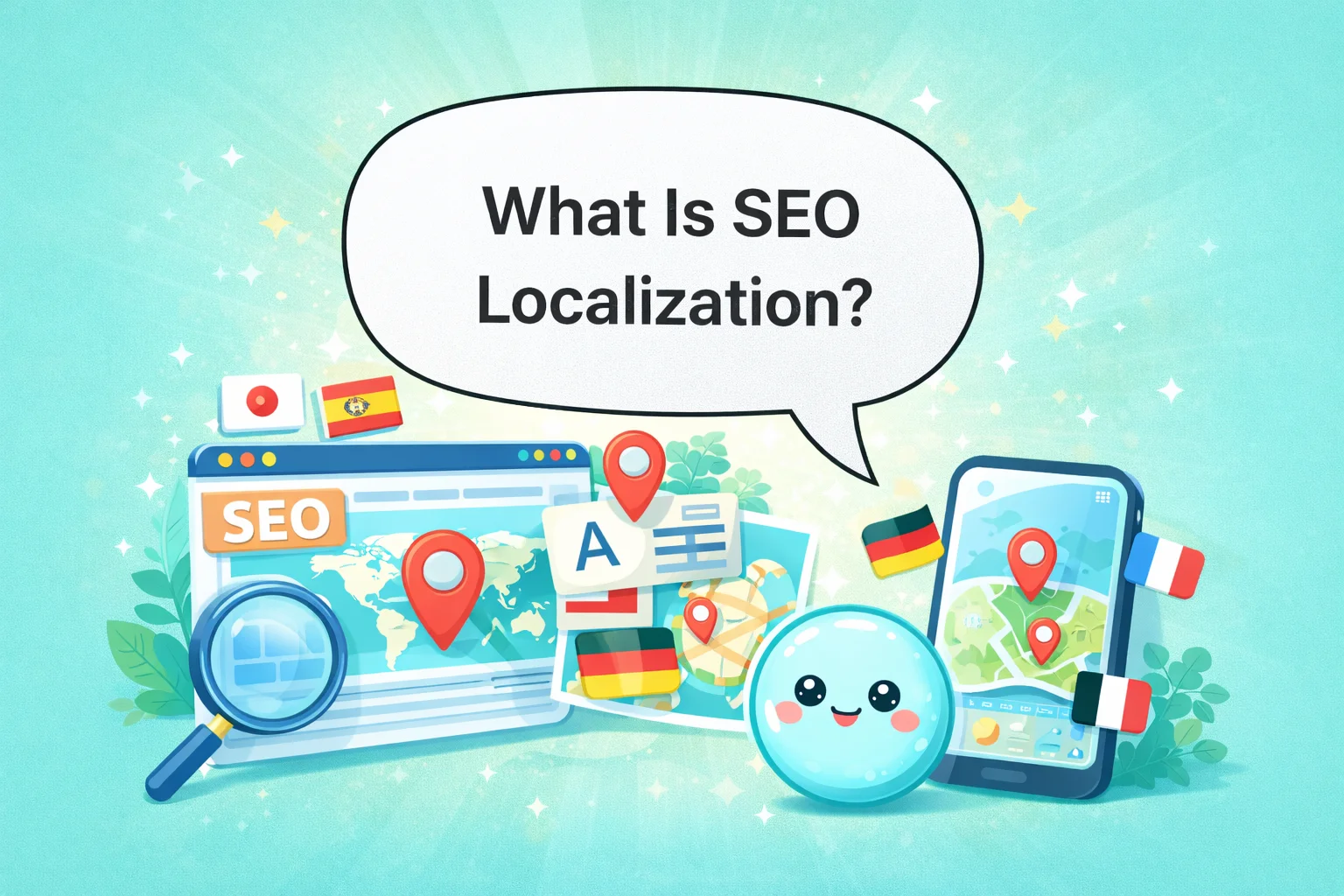
This brings us to the most critical question for any growing business: what is SEO localization?
It isn’t just about translating words. It is about translating intent, context, and technical signals so that search engines trust your site in a specific region. In 2026, Google’s algorithms are incredibly sophisticated. They know that a direct translation often misses the mark on user intent.
If you are a website owner, a marketer, or a small business owner looking to expand beyond your borders, this guide is for you. I’m going to walk you through exactly how I approach this process, moving away from generic advice and into the specific strategies that actually impact your bottom line.
TL;DR: SEO Localization
SEO localization is the process of adapting a website’s content, technical setup, and search signals to rank for users in a specific geographic location or language, moving beyond simple translation to match local search intent.
What Is SEO Localization?
SEO localization is the process of adapting your website’s content and technical setup to rank high in search results for a specific location or language.
It combines standard search engine optimization with language adaptation and regional targeting. While translation focuses on changing words from one language to another, localization focuses on how people actually use those words to find answers.
For example, I once worked with a SaaS company that offered “vacation tracking software.” In the US, that keyword volume is huge. In the UK, however, people search for “holiday leave booking.” Direct translation would have kept them invisible in the UK market. Localization bridged that gap.
Why It Matters Today
Search behavior varies wildly by country, region, and language.
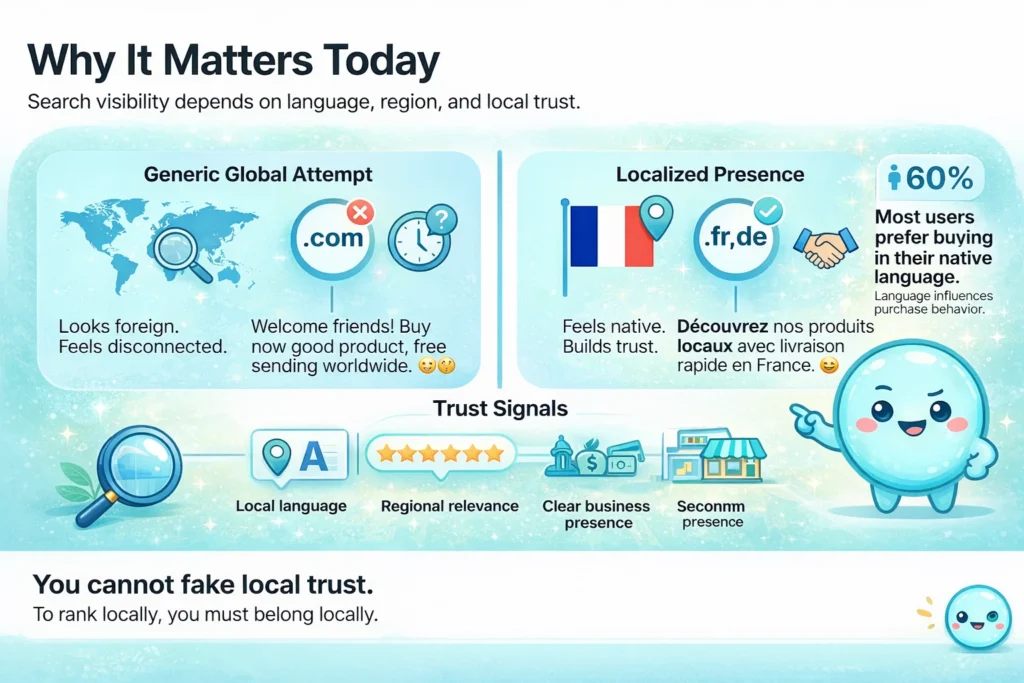
According to long-standing data validated by CSA Research, over 75% of internet users prefer to buy products in their native language. But more importantly, Google gives preference to sites that look and feel local.
If you are trying to rank in Germany with a .com domain, no German address, and content that reads like it was written by an American using Google Translate, you are fighting a losing battle. Local visibility depends on building trust. You need to show both the search engine and the user that you are part of their local ecosystem, not just an outsider looking in.
SEO Localization vs Traditional SEO
Understanding the difference here is crucial. I often see people apply general SEO rules to international markets and wonder why they fail.
Traditional Search Engine Optimization
When I run a traditional SEO campaign, I typically focus on:
- General Keyword Research: Finding terms with high volume globally or nationally.
- Broad Audience Targeting: Trying to reach the widest possible group of interested users.
- Global Visibility: Focusing on domain authority that lifts all pages, regardless of where the user sits.
SEO Localization
Localization requires a sharper focus. When I shift gears to localization, I look at:
- Regional Targeting: I care less about global volume and more about volume in a specific city or country.
- Cultural Context: Does the messaging fit the local norms?
- Search Engine Specifics: Google is king in many places, but if we are looking at South Korea (Naver) or China (Baidu), the rules change completely.
Quick Comparison Table
Here is a breakdown of how I view the two approaches side-by-side:
| Feature | Global SEO | Localized SEO |
| Target Audience | Broad, often English-first | Specific, defined by region/language |
| Keywords | High volume, direct translation | High intent, culturally specific terms |
| Content Strategy | One size fits many | Adapted for local customs and trends |
| Technical Setup | Generic domains (.com) | ccTLDs (.fr, .de) or subdirectories |
The Core Elements of SEO Localization
To answer what SEO localization is fully, we need to look at its component parts. It is not one single action; it is a collection of signals you send to Google.
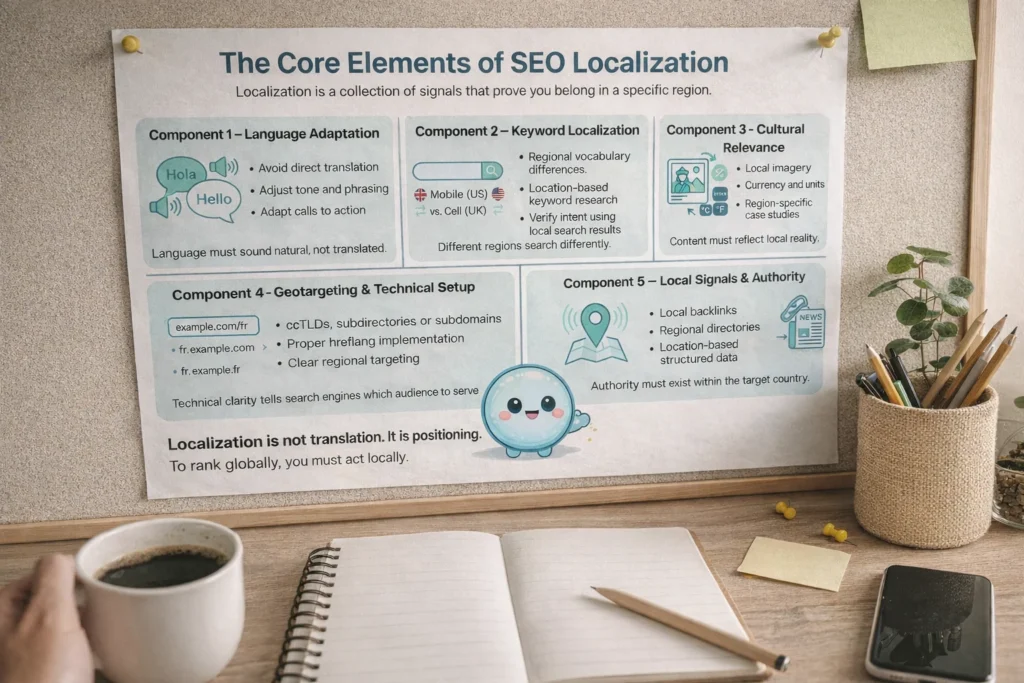
1. Language Adaptation
I cannot stress this enough: direct translation is the enemy of context.
I recall reviewing a fashion e-commerce site expanding into Mexico. They used an automated translator for their “winter jackets.” The translator used a word that, in that specific region of Mexico, was slang for something entirely different. Not only did they not rank, but they also offended the few visitors they actually got.
Language adaptation involves native speakers ensuring the tone, idioms, and phrasing sound natural. It means checking your Call to Actions (CTAs). “Buy Now” might work in the US, but in some Asian markets, a softer “Learn More” or “View Details” often yields higher conversion rates because the buying culture is less aggressive.
2. Keyword Localization
This is where I spend most of my time in sneo.ai.
Search terms differ by region. A “jumper” in the UK is a “sweater” in the US. A “biscuit” in the UK is a “cookie” in the US. If you optimize for the wrong term, you miss the audience entirely.
I always suggest website owners conduct fresh keyword research for every single region. Never assume.
- Tools I use: I rely heavily on Google Keyword Planner filtering by specific location, and I verify intent using local SERP (Search Engine Results Page) analysis.
- Intent Alignment: I verify that the keyword actually means what I think it means in that country.
3. Cultural Relevance
Visuals and references matter. If you are selling insurance and your landing page features a family standing in front of a typical American suburban house, that image will feel alien to a user in a dense neighborhood in Tokyo or Paris.
I advise clients to swap out images, currency symbols, units of measurement (metric vs. imperial), and even success stories. A case study from a local company carries ten times more weight than a case study from a recognizable global brand that has no local footprint.
4. Geotargeting and Technical Setup
This is the technical backbone. If you get this wrong, Google won’t know which version of your site to show.
- URL Structure: You have choices here.
- ccTLDs (example.fr): Best for ranking, hardest to maintain.
- Subdirectories (https://www.google.com/search?q=example.com/fr): My personal preference for most businesses because it consolidates domain authority.
- Subdomains (https://www.google.com/search?q=fr.example.com): Easier to host separately, but often treated as a separate site by Google.
- Hreflang Tags: These are code snippets that tell Google, “Hey, this page is for Spanish speakers in Spain, and this one is for Spanish speakers in Mexico.” I check my clients’ hreflang implementation religiously because a single error here can cause duplicate content issues. You can verify your setup using Google Search Central’s International Targeting report.
5. Local Signals and Authority
You need to prove you belong.
When I analyze a site’s authority profile, I look for backlinks from local domains. A link from a popular French news site is worth gold for your French rankings, far more than a generic link from a US blog.
I also encourage businesses to get listed in local directories and set up region-specific structured data (Schema markup) to help search engines parse the location details immediately.
How SEO Localization Improves Local Search Rankings
So, why go through all this trouble? Because generic optimization is hitting a ceiling.
Matching Local Search Intent
Search engines are obsessed with intent. When a user in Berlin types a query, Google wants to serve a result that matches their location, language, and immediate need.
By localizing, you align perfectly with that intent. You are no longer just “relevant” to the topic; you are relevant to the user. This relevance is the primary ranking factor in 2026.
Improving Click-Through Rates
I’ve run A/B tests on titles and meta descriptions for years.
- Version A: Translated directly from English.
- Version B: Written by a local copywriter using local slang and emotional triggers.

Version B almost always wins. Higher click-through rates (CTR) signal to Google that your result is valuable, which creates a positive feedback loop that pushes your rankings even higher.
Increasing Conversions
Ranking is vanity; conversion is sanity.
I built sneo.ai to help users look past vanity metrics. When I see high traffic but low conversions from a specific country, it’s almost always a localization issue. The user lands on the page, senses that “this isn’t really for me” (maybe the currency is wrong, or the shipping terms are unclear), and leaves.
Localized content reduces friction. It builds trust. And trust leads to sales.
Step-by-Step: How to Implement SEO Localization
If you are ready to start, here is the exact process I follow.
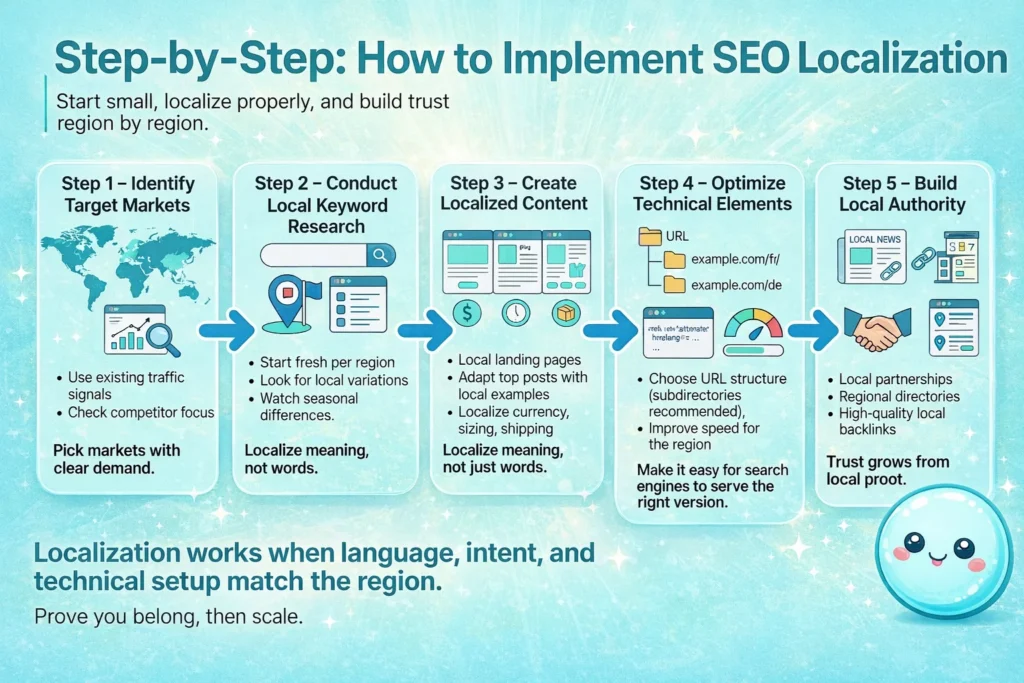
Step 1: Identify Target Markets
Don’t try to conquer the world all at once.
I suggest looking at your current Google Analytics (or asking me through sneo.ai). Where are you already getting a trickle of traffic? If you see organic visits from Brazil despite having no Portuguese content, that is a massive signal of market demand.
Check your competitors, too. If they are investing heavily in a specific region, there is likely a reason.
Step 2: Conduct Local Keyword Research
Start fresh.
- Select your target region in your keyword tool.
- Input your core service or product.
- Look for local variations.
- Analyze the search volume differences.
I often find seasonal trends here too. “Back to school” happens at completely different times of the year in Australia compared to the US. Your keyword strategy needs to match that calendar.
Step 3: Create Localized Content
This is the heavy lifting.
- Landing Pages: Create specific landing pages for your priority regions.
- Blog Posts: Adapt your top-performing posts. Don’t just translate them—add local examples.
- Product Pages: Ensure sizing, currency, and shipping info is localized.
Step 4: Optimize Technical Elements
Now, talk to the search engine.
Set up your URL structure (I usually suggest subdirectories for simplicity). Implement your hreflang tags.
I also check server location. While Content Delivery Networks (CDNs) have made this less critical, having your site hosted on a server near your target audience can still offer a slight speed advantage, which is a Core Web Vital.
Step 5: Build Local Authority
You need friends in the neighborhood.
Reach out to local influencers or complementary businesses for partnerships. Get listed in the local version of Yelp or industry-specific directories. Even a few high-quality local backlinks can move the needle significantly.
Common Mistakes in SEO Localization
I’ve cleaned up a lot of messes in my career. Here are the pitfalls I want you to avoid.
1) Relying Only on Website Translation
This is the most frequent error. I recently audited a site that used a plugin to auto-translate everything. It translated their brand name literally into other languages, making them the laughing stock of the industry in Spain.
Translation addresses the language barrier, but it doesn’t address the search barrier.
2) Ignoring Keyword Localization
I once saw a US athletic brand try to rank for “soccer cleats” in the UK. They spent thousands on content. They got zero traction. Why? Because the UK searches for “football boots.”
They were using the correct English words, but the wrong local words. Ignoring this distinction is expensive.
3) Overlooking Regional Relevance
Using a July 4th promotion in a country that doesn’t celebrate it is a waste of pixel space. Worse, it signals to the user that you don’t know who they are.
4) Incorrect Geotargeting Setup
Hreflang tags are tricky. A common mistake is self-referencing errors, where page A points to page B, but page B doesn’t point back to page A.
When this happens, Google gets confused and might just ignore your localized pages altogether, defaulting to your main English site (which won’t rank locally).
Who Needs SEO Localization?
You might be thinking, “Is this for me?”

If you fit any of these categories, the answer is yes:
- E-commerce stores: If you ship internationally, you need to rank internationally.
- SaaS companies: Software is borderless, but customer trust is local.
- Service-based businesses: If you have offices in different cities or countries.
- Small business owners: Even if you just target different language speakers within your own city (e.g., a Spanish landing page for a Miami law firm).
- Content creators: Bloggers wanting to expand their readership into new regions.
SEO Localization and Website Translation: What’s the Difference?
Let’s clarify this distinction one last time, as it confuses many people I speak with.
Website Translation
- Goal: Readability.
- Process: Converting text from Language A to Language B.
- Outcome: The user can read the words.
SEO Localization
- Goal: Findability and Conversion.
- Process: Adapting keywords, technical tags, cultural references, and user experience.
- Outcome: The user finds the site via search and feels comfortable buying.
What is SEO localization if not the bridge between “readable” and “rankable”? It includes translation, but it adds the layers of keyword strategy, regional targeting, and technical adjustments that actually drive business results.
Measuring the Success of SEO Localization
How do you know it is working? I live in the data, so here is what I track.
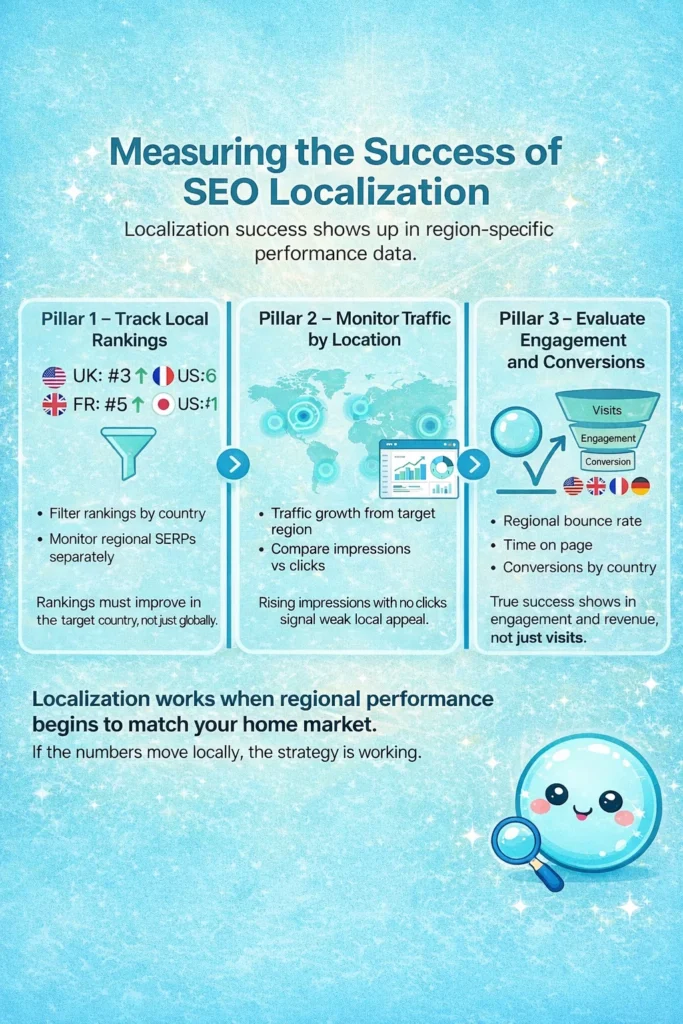
Tracking Local Search Rankings
I don’t just look at “rankings.” I filter by country. I want to see if my German keywords are rising in Google.de, regardless of what is happening in https://www.google.com/search?q=Google.com.
Monitoring Traffic by Location
In Google Analytics, I drill down into Audience > Geo > Location.
I look for trends. Is traffic from my target region growing? If I see impressions rising in Google Search Console but no clicks, I know my titles aren’t locally appealing, and I need to rewrite them.
Evaluating Engagement and Conversions
Are French users bouncing off the page faster than American users? That suggests a content disconnect or a slow loading time in that region.
I monitor sales and leads specifically by region. If localization is done right, your conversion rate in the new region should start to approach your conversion rate in your home market.
Conclusion
We have covered a lot of ground. From technical hreflang tags to the subtleties of cultural references, expanding a website globally is no small task.
So, what is SEO localization? It is the difference between showing up and fitting in. It is the respectful, intelligent way to enter a new market. It tells your future customers, “I see you, I understand you, and I value your business enough to speak your language—literally and figuratively.”
If you rely on generic search engine optimization, you will hit a wall. But if you take the steps to localize your strategy, you open up entirely new streams of traffic and revenue.
I know this can feel overwhelming. The data in Google Search Console can be dense, and figuring out why your Italian traffic dropped or why your Japanese rankings are stalled can be frustrating.
That is why I built sneo.ai. I wanted to create a way for you to simply ask, “How is my performance in France?” or “Why did my traffic drop in Brazil?” and get a plain English answer. You don’t need to be a data scientist to succeed at SEO; you just need to ask the right questions.
Connect your site, ask a question, and let’s get your content ranking where it belongs—everywhere.
FAQs
1. What is SEO localization in simple terms?
SEO localization is the process of adapting your website to rank in specific regions. It involves translating content, using local keywords, and setting up technical signals so search engines know which country you are targeting.
2. Is SEO localization the same as website translation?
No. Translation only changes the language of the text. Localization adapts the content for search intent, cultural nuance, and technical ranking factors. Translation makes it readable; localization makes it rankable.
3. How does keyword localization work?
It involves researching what specific terms people in a target region use to find your products. For example, optimizing for “flat” in the UK versus “apartment” in the US ensures you match the local search vocabulary.
4. Do small businesses need SEO localization?
Absolutely. If you serve a multicultural city or ship products to different countries, localization helps you compete. It allows you to target specific customer bases that larger, generic competitors might overlook.
5. How long does SEO localization take to show results?
Like all search engine optimization, it requires patience. Typically, you might see initial movement in 3 to 6 months. However, technical fixes (like hreflang tags) can sometimes yield faster corrections in indexing.
6. What is the role of geotargeting in SEO localization?
Geotargeting is how you tell search engines which country your content is for. This is done through URL structures (like .de or .fr domains), hreflang tags, and settings in Google Search Console. It ensures the right users see the right page.
7. Can I use the same content for multiple countries?
You should be careful. If you use the exact same English content for the US, UK, and Australia without localization, Google might view it as duplicate content. You need to “localize” it with regional spellings, currency, and references to make it distinct and relevant.