

I’ve analyzed hundreds of websites over the last few years, and I see the same pattern repeat itself almost every time. A business owner or marketing manager opens their analytics dashboard, sees a mix of red and green arrows, and feels a pit in their stomach. They see thousands of impressions in Google search results, but their click-through rate is stuck at 1% or 2%. They know people are seeing their brand, but those searchers aren’t becoming visitors.
The answer to “why” is almost always buried somewhere in the data. But finding it feels like searching for a needle in a haystack.

Most people treat Search Engine Optimization (SEO) as a one-time setup—something you “do” once when you launch a site and then forget. But Google updates its algorithms thousands of times a year, and your competitors are constantly publishing new content. If you aren’t actively managing your presence, you are falling behind.
That is why I built sneo.ai—to bridge the gap between having data and actually understanding it. But before you can use tools effectively, you need to understand the discipline itself. In this article, I will explain exactly what SEO management is, why it is the difference between a dead site and a thriving one, and how you can take control of your search performance without becoming a data scientist.
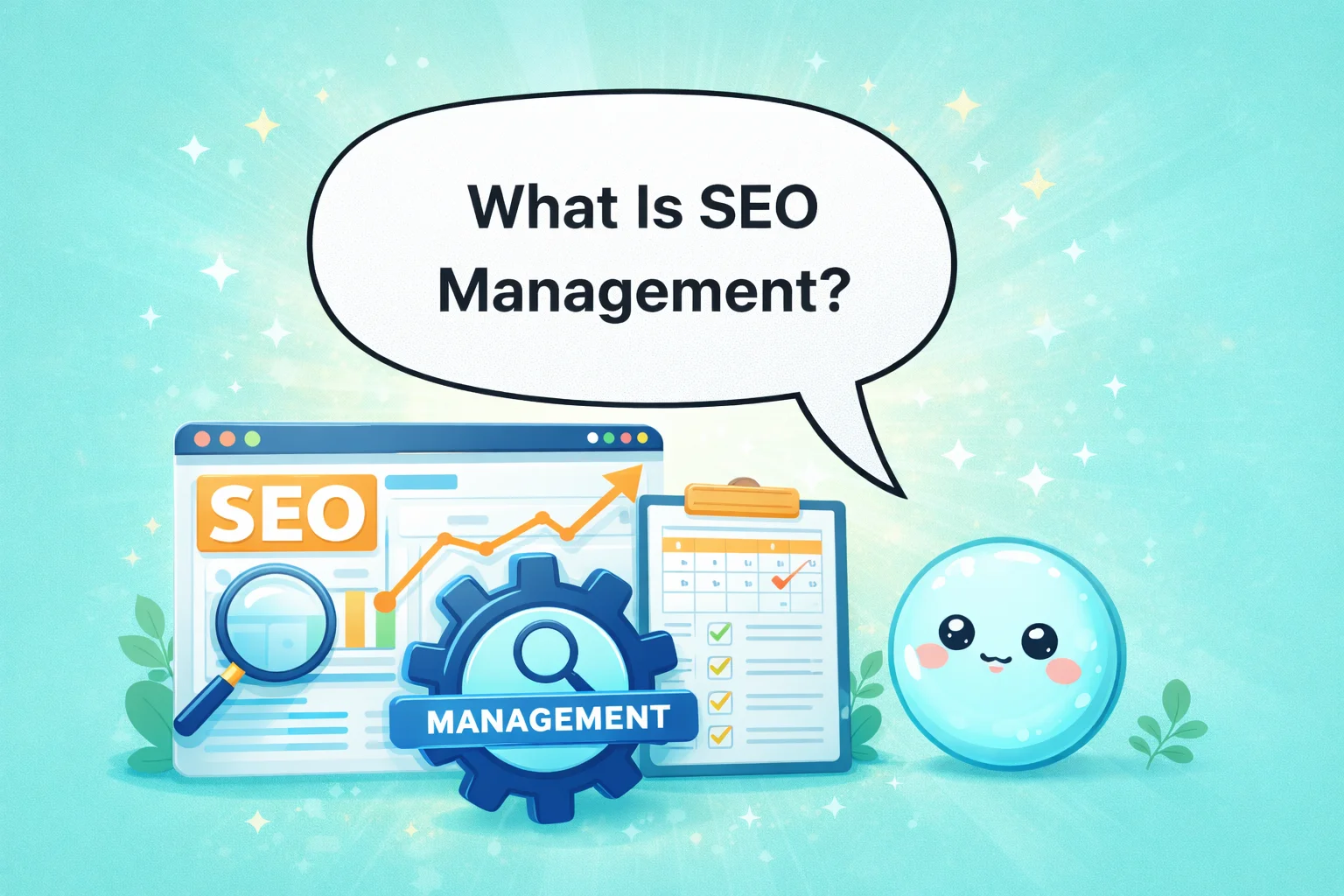
What Is SEO Management?
SEO management is an ongoing process of directing your SEO strategy to achieve specific goals—usually increasing organic traffic, improving rankings, and driving revenue.
Many people confuse “SEO” with “SEO management.” Here is how I explain the difference to my clients:
- SEO (Implementation): This is the act of fixing a broken link, writing a meta description, or speeding up a specific page. It is a task.
- SEO Management (Strategy & Oversight): This is the continuous loop of analyzing data, prioritizing those tasks, executing them, and measuring the results to see what worked.
SEO management fits into your wider marketing work as the foundation of your organic growth. While paid ads stop bringing in traffic the moment you stop paying, managed SEO builds an asset that grows over time.
Who Handles This Work?
I’ve worked with teams of all sizes, and I see SEO management handled in three main ways:
- Website Owners & Solopreneurs: You wear every hat. You likely use tools like Google Search Console to check your performance weekly.
- In-House Marketers: You might have a marketing manager who dedicates 20% of their week to SEO, focusing on content updates and basic technical health.
- Agencies & Consultants: Larger brands often hire outside help to handle the heavy lifting of link building and technical audits.
Regardless of who does the work, the goal remains the same: turning search engines into a reliable source of customers.
Why SEO Management Matters for Website Growth
I often get asked, “Rahul, can’t I just write good content and wait?”
In 2015, maybe. In 2025 and 2026, the answer is a hard no. With AI Overviews dominating the top of search results and competition higher than ever, “posting and praying” is not a strategy.
Effective management directly supports better rankings. When I review a site that has stagnant traffic, I usually find that they haven’t updated their “best” content in two years. By managing that content—refreshing it, adding new data, checking search intent—we can often double the traffic to that page in a few weeks.
Connecting Rankings to Revenue
Ranking #1 is vanity. Ranking #1 for a term that brings in paying customers is sanity. Management means focusing on the latter.
For small companies and personal sites, steady optimization supports business goals by reducing reliance on paid ads. I have seen small businesses cut their ad spend by 50% simply because they started ranking organically for the terms they were previously bidding on.
The long-term value here is undeniable. When you manage your SEO, you are building equity in your domain. Short-term promotions offer a spike; SEO management offers a slope—upwards and to the right.
Core Areas Covered in SEO Management
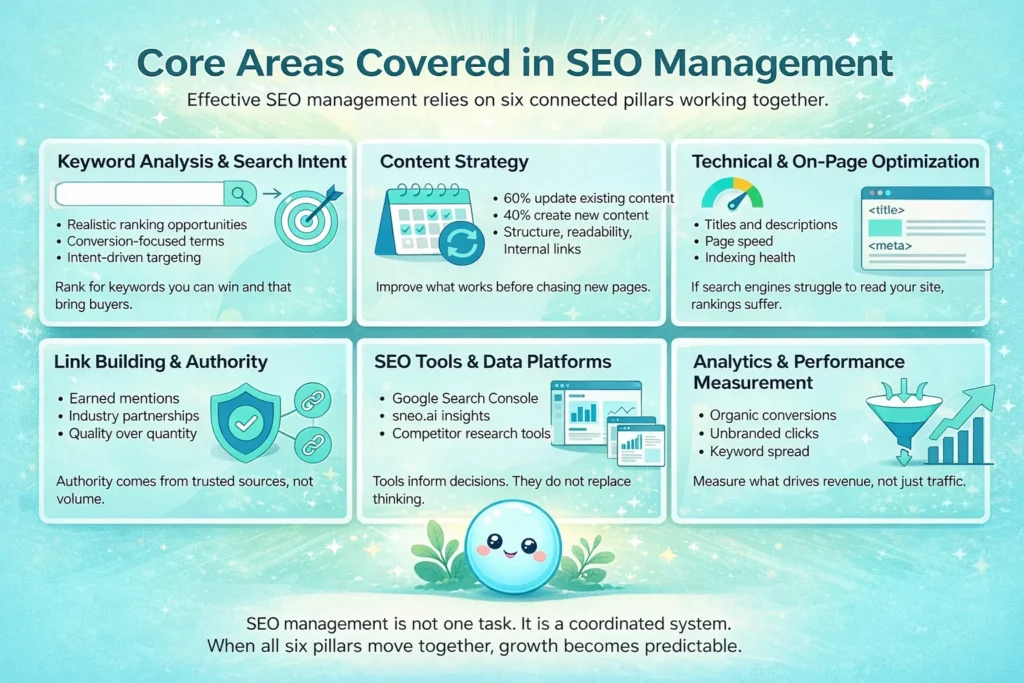
When I log into a new client’s Google Search Console or connect a user’s site to sneo.ai, I look at six specific buckets. If you want to understand what SEO management is, you need to understand these pillars.
1) Keyword Analysis and Search Intent
Keyword research isn’t just about finding words with high search volume. It is about understanding intent.
I remember a client who wanted to rank for “best CRM.” They were a tiny startup. I told them, “If we target ‘best CRM,’ we will be fighting Salesforce and HubSpot with a slingshot.”
Instead, we looked for what people actually searched for when they were ready to buy from a smaller provider. We found terms like “simple CRM for freelance writers.” The volume was lower, but the intent was specific. We targeted those, and they started getting leads within a month.
In my workflow, I look for:
- Realistic Opportunities: Keywords where you actually have a chance to rank based on your current site authority.
- Conversion Potential: Does this keyword bring visitors who buy, or just visitors who read and leave?
2) Content Strategy for Search Performance
Content strategy is more than just a publishing calendar. In my experience, the biggest mistake site owners make is always creating new things while letting their existing assets rot.
I recommend a 60/40 split: spend 60% of your time updating and improving existing pages, and 40% creating new ones. Google loves fresh content, but it loves an authoritative, up-to-date resource even more.
When managing content, I look at:
- Structure: Are we using H2s and H3s correctly to help Google understand the page?
- Readability: Is this easy to skim on a mobile phone?
- Internal Linking: Are we passing authority from our strong pages to our new ones?
3) Technical and On-Page Optimization Techniques
This is the part that scares most people. I get it. Terms like “canonical tags” and “INP” (Interaction to Next Paint) sound intimidating.
But technical optimization is really just about making your site easy for Google to read. If Google looks at your site and sees a mess of broken code and slow loading times, it won’t rank you, no matter how good your writing is.
I focus on these basics:
- Page Titles & Meta Descriptions: These are your billboards in the search results. I check my clients’ click-through rates (CTR) weekly. If impressions are high but clicks are low, we rewrite these.
- Page Speed: In 2026, if your site takes more than 2.5 seconds to load, you are losing visitors. I check Core Web Vitals reports regularly to ensure we pass Google’s thresholds.
- Indexing: You would be shocked how many times I’ve seen a site owner accidentally block Google from reading their most important pages.
4) Link Building and Authority Signals
Link building has a bad reputation because of spammers, but it remains a crucial ranking factor. Think of a link from another website as a vote of confidence.
However, the definition of a “good link” has changed. I tell my clients to stop chasing thousands of low-quality directory links. Instead, focus on “earning” links.
For small businesses, this might mean:
- Getting featured in a local news article.
- Writing a guest post for a partner in your industry.
- Creating a piece of data or research that others want to cite.
5) SEO Tools and Data Platforms
You cannot manage what you do not measure. In my daily work, I use a stack of tools to keep track of performance.
- Google Search Console (GSC): This is non-negotiable. It is the only place to see exactly how Google views your site.
- sneo.ai: I built this to sit on top of GSC. Instead of digging through raw data tables, you can just ask, “Which pages dropped in traffic last week?” and get an instant answer.
- Competitor Tools: Platforms like Ahrefs or Semrush are great for seeing what the other guys are doing.
Tools should support your decisions, not replace your strategy. I see too many people blindly following “optimization scores” from tools without thinking about the actual human user.
6) Analytics Tracking and Performance Measurement
What metrics actually matter? If you are a publisher, maybe it’s “pageviews.” But for most businesses, I track:
- Organic Conversions: How many people came from Google and filled out a form or bought a product?
- Unbranded Clicks: Traffic from people searching for your services, not your company name.
- Keyword Spread: Are we ranking for more keywords this month than last month?
Using data is the only way to decide what to fix next. If I see a page that has high impressions but low time-on-page, I know the content isn’t matching what the user wants.
How SEO Management Fits into Broader Marketing Efforts
SEO does not exist in a vacuum. I’ve seen companies where the SEO team and the Social Media team never talk, and it’s a disaster.
Your SEO management should feed your other channels. For example, if I see a particular blog post is getting a ton of search traffic, I immediately tell the social team, “Hey, this topic is hot. Turn this into a LinkedIn carousel or a video.”
Conversely, paid ads can help SEO. If you are testing a new keyword, run Google Ads on it for a week. If it converts well, then invest the months of effort to rank for it organically. SEO is the long-term customer discovery engine that supports everything else.
Step-by-Step SEO Management Process
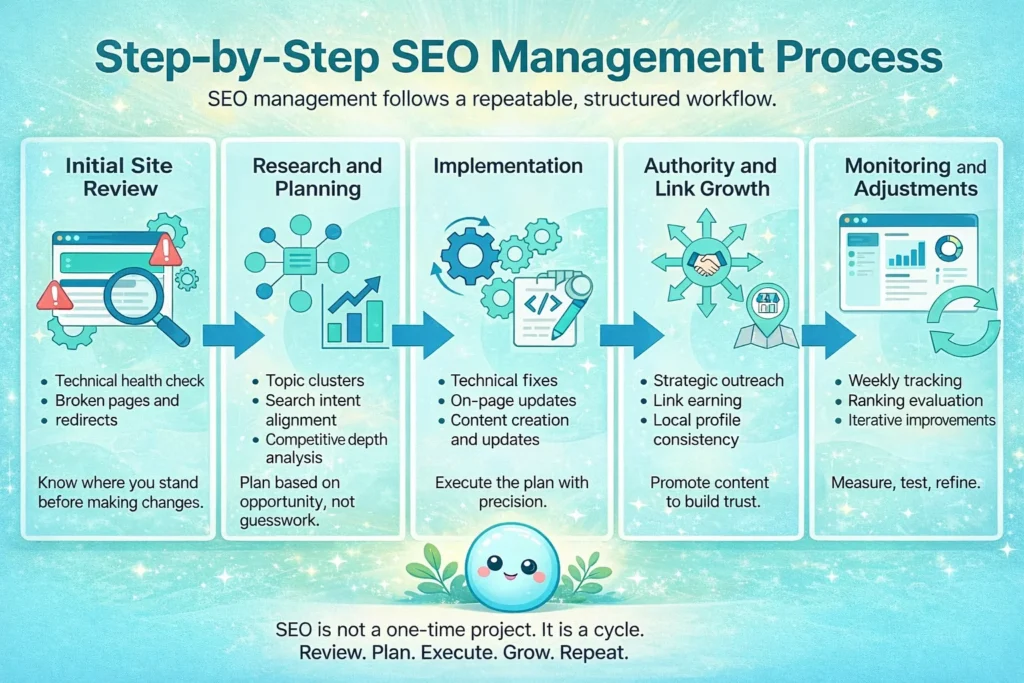
If you hired me to manage your site today, here is the exact process I would follow.
1) Initial Site Review
First, I need to know where we stand. I perform a technical health check. I crawl the site to look for 404 errors (broken pages), redirect chains, and missing security certificates. I check the backlink profile to make sure there is no “toxic” history from a previous owner who bought spammy links.
2) Research and Planning Phase
Next, we plan. I map out topics, not just keywords. Google understands concepts now. So rather than just targeting “dog food,” we plan a whole cluster of content: “best dog food for puppies,” “grain-free options,” “dog food allergies.”
I also look at competitors. If the top 3 results for your target keyword are all 3,000-word guides, writing a 500-word blog post isn’t going to cut it.
3) Implementation Phase
This is where the work happens.
- Technical Fixes: We clean up the code and improve speed.
- On-Page Optimization: We update titles, headers, and images.
- Content: We start writing the new articles and updating the old ones.
4) Authority and Link Growth Phase
Once the content is live, we need to get eyes on it. I might reach out to industry influencers or newsletters to share the new resource. For local businesses, I ensure their Google Business Profile is active and consistent.
5) Monitoring and Adjustments
This is the “management” part. I check analytics weekly. If a page isn’t ranking after 3 months, I ask why. Is the content too thin? Is the competition too strong? We test, we adjust, and we try again.
Common SEO Management Mistakes to Avoid
I have made plenty of mistakes in my career. Here are the ones I want you to avoid.
- Chasing High-Volume Vanity Keywords I once spent months trying to rank a client for a keyword with 100,000 monthly searches. We finally cracked page 1… and got zero sales. The intent was too broad. Focus on relevance, not just volume.
- Publishing Without Strategy “We need to blog 3 times a week.” Why? If you don’t have a reason for those posts, you are just adding noise. Quality beats frequency every time.
- Ignoring Technical Problems You can have the best content in the world, but if your site accidentally has a “noindex” tag on it (I have seen this happen!), you are invisible.
- Relying only on Tools Tools are great, but they lack context. A tool might tell you to “shorten your title,” but maybe your long title is what makes people click. Use your brain, not just the software.
In-House SEO Management vs Hiring an External Team
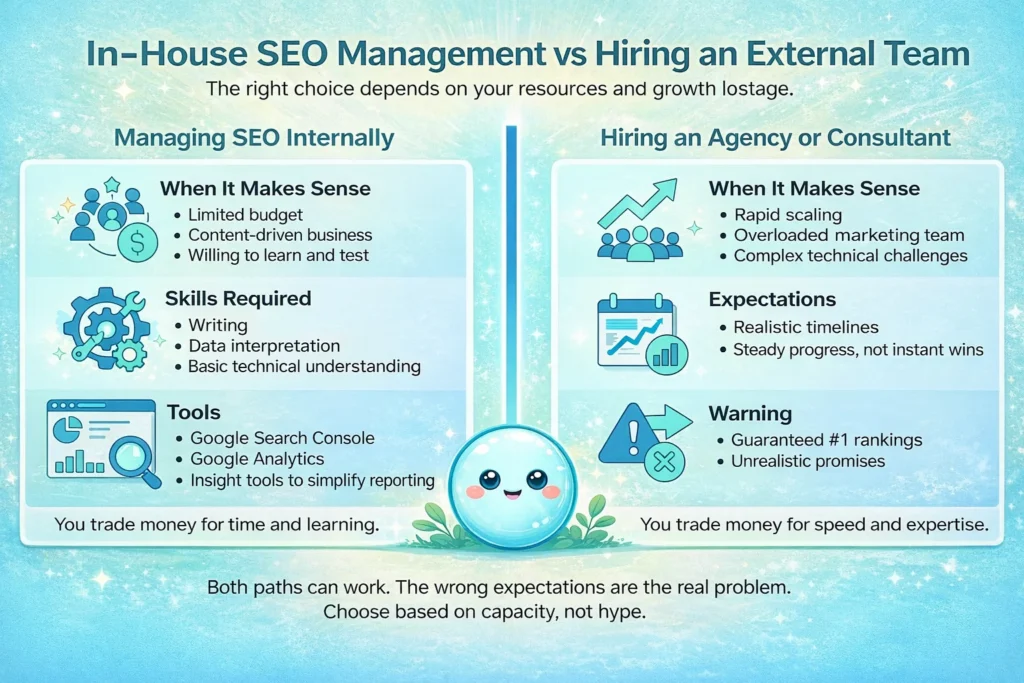
Should you do this yourself or pay someone like me? It depends on your resources.
Managing SEO Internally
When it makes sense: If you are a small business with a limited budget, or a publisher where content is your product. Skills required: You need to be a bit of a generalist—part writer, part data analyst, part developer. Tools: You can get by with Google Search Console, Google Analytics, and a tool like sneo.ai to help interpret the data without needing a dedicated analyst.
Working with an SEO Agency or Consultant
When it makes sense: When you are scaling fast and your marketing team is overwhelmed. Or, when you hit a technical ceiling you can’t break through. Timelines: A good agency will tell you that results take time. If someone promises you “#1 ranking in 30 days,” run away. That is a scam.
How Long It Takes to See Results from SEO Management
This is the hardest conversation I have with clients. “How long until I rank?”

According to data from Ahrefs and my own experience, a new page on a new website usually takes 3 to 6 months to start getting significant traction. For an established site, fixing technical errors can lead to a boost in 2 to 4 weeks.
Factors that affect speed:
- Competition: Are you a pizza shop in New York City or a specialized manufacturing consultant?
- History: Does your domain have a good track record with Google?
- Resources: Can you publish 10 high-quality articles a month, or just 1?
Patience and consistency are the only “secrets” here.
Conclusion
So, what is SEO management really? It is the commitment to showing up. It is the discipline of looking at your data, understanding what your audience wants, and making your website the best possible answer to their questions.
Structured, ongoing work beats a flashy launch every time. I’ve seen small websites outrank massive corporations simply because the small owner cared more. They updated their content, they fixed their broken links, and they listened to their data.
If you are feeling overwhelmed, start small. Connect your Google Search Console to sneo.ai and just ask one question: “What is my best opportunity to grow traffic this month?” Let me show you what your data is trying to tell you. You don’t need to be an expert to start; you just need to be willing to begin.
FAQ – What Is SEO Management
1. What is SEO management in simple terms?
It is the daily or weekly process of tracking your website’s search performance and making changes to improve it. Think of it like gardening: SEO is planting the seeds, but SEO management is the watering, weeding, and pruning that makes the garden grow.
2. Is SEO management only about keywords?
No. While keywords are the starting point, management involves technical health (site speed), content quality, user experience, and building authority through links. If you only focus on keywords, you are missing half the picture.
3. How is SEO management different from basic search engine optimization?
Basic optimization is often a project: “Optimize the website.” Management is a habit: “Grow the website.” What is SEO management if not the transition from a one-time fix to a long-term strategy?
4. Do small businesses really need SEO management?
Yes, absolutely. In fact, small businesses need it more. You likely can’t outspend large competitors on ads. SEO is the great equalizer. I’ve seen local bakeries outrank national chains because they managed their local SEO better.
5. What SEO tools are most useful for beginners?
Start with the free ones: Google Search Console and Google Analytics 4. They are the source of truth. For interpretation, an AI assistant like sneo.ai can help you understand that data without a steep learning curve. Later, you might add a keyword research tool.
6. How often should SEO performance be reviewed?
I recommend a quick check weekly (to catch technical errors or sudden drops) and a deep dive monthly. Monthly reviews allow you to see trends rather than reacting to normal daily fluctuations.
7. Can SEO management increase traffic without paid promotion?
Yes. That is the primary goal. By improving your rankings for relevant terms, you capture demand that already exists. I have clients who receive tens of thousands of visitors monthly and spend exactly $0 on ads.
8. Which optimization techniques usually bring the fastest early gains?
For new projects, targeting “low-hanging fruit” keywords (specific, lower competition) usually works fastest. For existing sites, fixing technical errors (like broken links) and updating old content often brings the quickest wins.