

I’ve analyzed hundreds of websites over the last few years, and I see the same pattern over and over: thousands of impressions sitting in search results, but click-through rates stuck at 1% or 2%. The answer to why this happens is always buried somewhere in the data—but I know from experience it feels like searching for a needle in a haystack.
When clients come to me, they are often overwhelmed. They have dashboards full of numbers, graphs pointing in every direction, and a single burning question: “Is my website actually doing well?”
Usually, they are looking at a single number provided by a tool and asking me, “what is SEO score and why is mine stuck at 65?”

Here is the short, plain explanation: An SEO score is a grading system used by analytics tools to rate the health of your website. It is a report card. But just like in school, a report card doesn’t tell the whole story of your intelligence—it just tells you how well you performed on specific tests.
In this guide, I am going to walk you through exactly how these scores are calculated, what affects them, and how I use them to drive real growth for my clients. We aren’t just going to look at vanity metrics. I want to show you how to use this data to actually get more traffic.
What is an SEO Score: Direct Answer
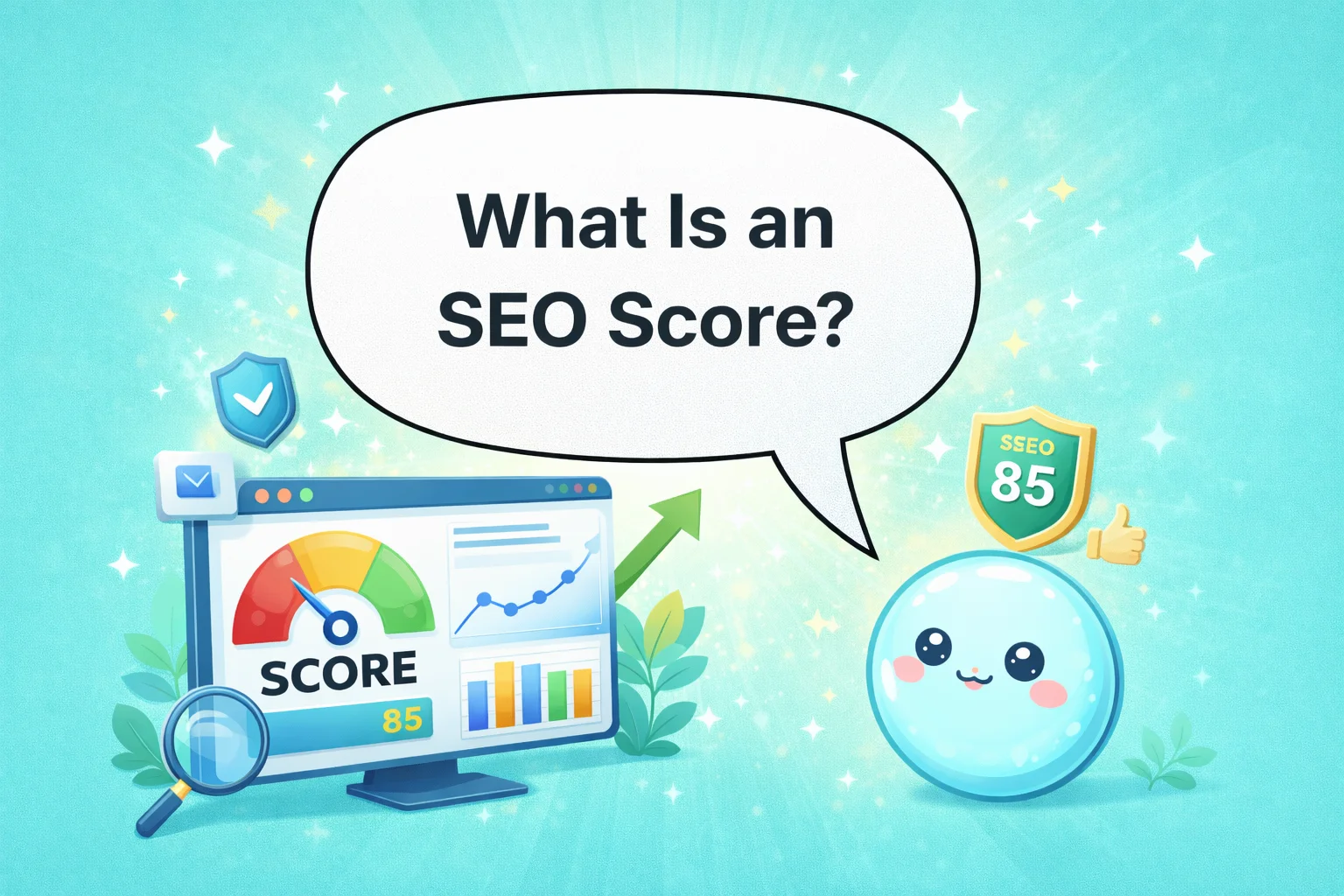
An SEO score is a numerical grade (0–100) measuring your website’s overall SEO health and adherence to best practices. It highlights issues like slow speeds or broken links but is not a direct ranking factor used by Google.
What is an SEO score? (simple definition for beginners)
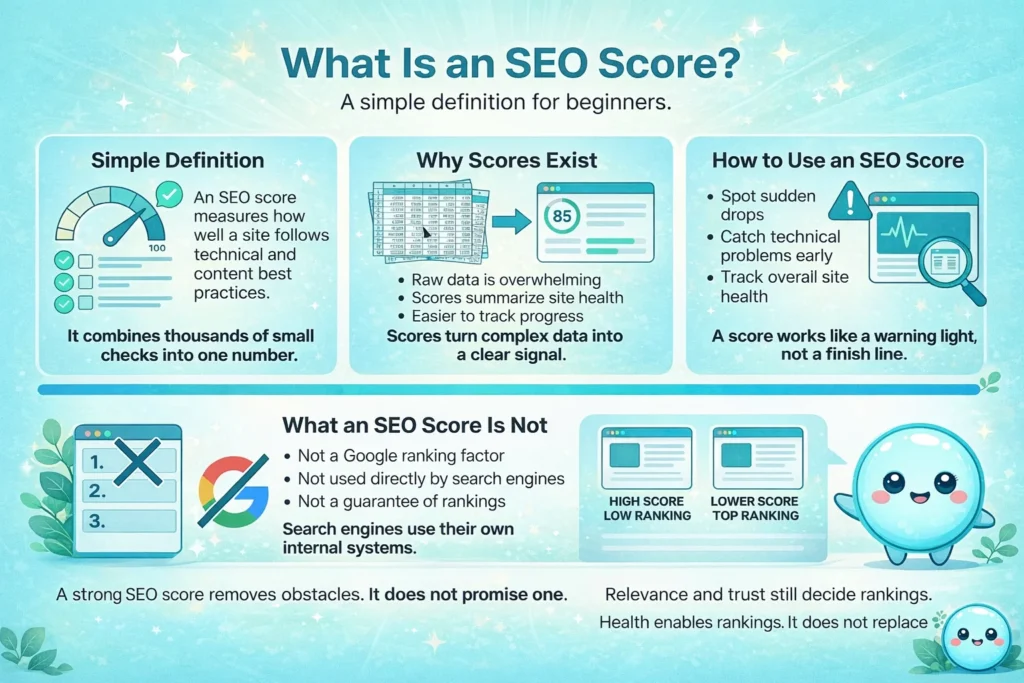
If you strip away the technical jargon, an SEO score is simply a measurement of how well your website follows technical and content best practices.
Think of it this way: Search engines like Google have a set of rules (often called “ranking factors”). These rules cover everything from how fast your page loads to whether your mobile view works correctly. An SEO score aggregates thousands of these tiny checks into a single number, usually between 0 and 100.
Why do we use a score instead of just showing the raw data? Because raw data is messy. If I handed you a spreadsheet with 40,000 rows of crawl data, you wouldn’t know where to start.
I use these scores as a high-level health monitor. If a client’s site drops from a score of 85 to 50 overnight, I don’t need to look at the raw logs to know something is broken. The score acts as an immediate alert system. It simplifies complex optimization metrics into a digestible format that allows website owners to track progress without needing a degree in data science.
What an SEO score is not
I need to be very clear about this because it is the most common misconception I encounter.
Your SEO score is not a Google ranking factor.
Google does not look at your score in Moz, Semrush, Ahrefs, or even the Health Score inside sneo.ai and say, “Oh, Rahul has a 98/100, let’s put him at number one.” That is not how it works. As Google’s John Mueller has confirmed multiple times, Google uses its own internal algorithms. The score you see in third-party tools is just an estimate of how well you are satisfying those algorithms based on known best practices.
I have seen websites with a “perfect” score of 100 rank on page five. I have also seen websites with a messy score of 60 rank number one because their content was incredibly relevant and authoritative.
Do not confuse your SEO score with your real search positions. A high score means your site is healthy, accessible, and easy for search engines to read. It removes the technical roadblocks that stop you from ranking, but it does not guarantee the ranking itself.
How SEO scores are calculated (high-level view)
When you ask what an SEO score is really made of, you have to look under the hood of the tools generating them. While every tool has its own “secret sauce,” I can tell you that they all generally combine web analytics and site checks in a similar way.

Here is the typical breakdown I see:
Crawl Results
The tool sends a “bot” (a computer program similar to Google’s crawler) to visit every page on your site. It looks for immediate failures: Does the page load? Is it blocked? Is it a dead end?
Page Performance Data
In 2025, user experience is critical. Tools ingest data regarding how fast your site paints the first image, how stable the layout is, and how quickly it responds to a click.
Keyword Analysis
Some scores factor in how well your content matches specific target terms. They check if your primary keyword appears in the title, the headers, and the body text.
Technical Signals
This is the plumbing of your website. Are your canonical tags set? Is your sitemap valid? Is your SSL certificate active?
The final number is usually a weighted average. Critical errors (like a homepage that doesn’t load) pull the score down heavily, while minor warnings (like a missing image description) might only nudge it down a fraction of a point.
Core elements that usually affect your SEO score
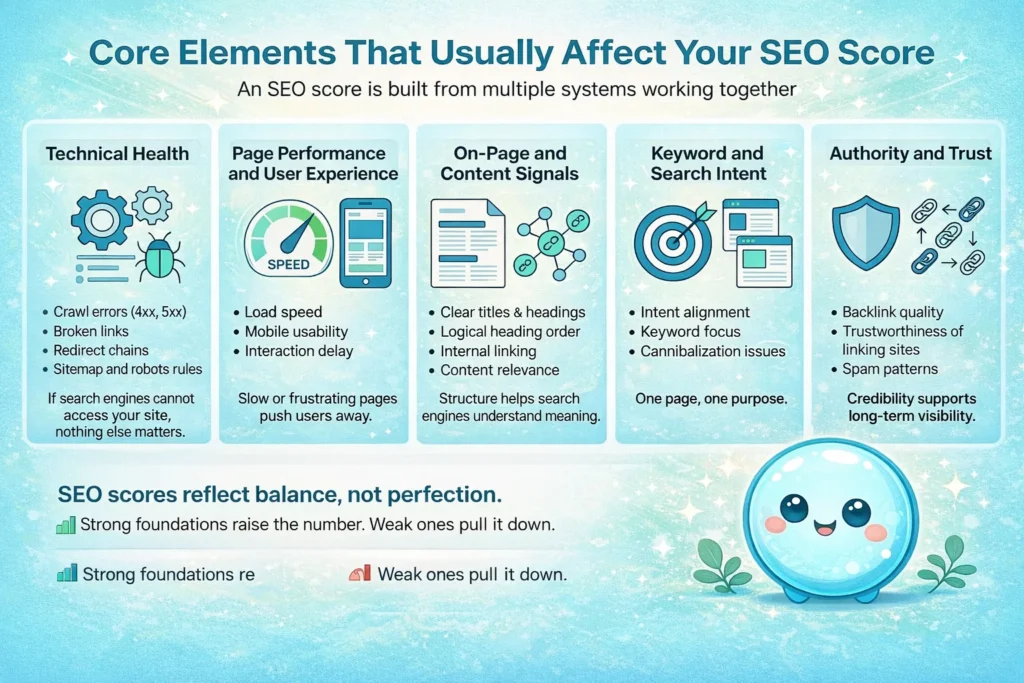
When I audit a site for a client, I don’t just look at the number. I look at the pillars that hold that number up. If you want to improve your score (and your site), these are the five areas you must focus on.
1) Technical health and site audit signals
This is the foundation. If this is broken, nothing else matters.
- Crawl Errors: If Google can’t access your page (4xx or 5xx errors), you can’t rank.
- Broken Links: These frustrate users and waste Google’s “crawl budget.”
- Redirect Issues: I often see “redirect chains” where Page A goes to Page B, which goes to Page C. This slows everything down.
- Sitemap and Robots: You need to explicitly tell search engines where to go and where not to go.
2) Page performance and user experience
Since the major updates in 2024 and 2025, Core Web Vitals have become non-negotiable.
- Loading Speed: How fast does the main content appear? Google research shows that as page load time goes from 1 to 3 seconds, bounce probability increases by 32%.
- Mobile Experience: I check this first. With mobile devices generating nearly 60% of global website traffic, if your text is too small or buttons are too close together, your score will tank.
- Interaction Delay: When a user clicks a menu, does it open instantly?
3) On-page and content signals
This is about how you structure your information.
- Titles and Headings: Are they descriptive? Do they follow a logical hierarchy (H1, then H2, then H3)?
- Internal Links: I always tell clients to think of their site as a spiderweb. Strong internal linking helps search engines understand the relationship between your pages.
- Content Relevance: Is the page actually about what the title says it is?
4) Keyword and search intent signals
It’s not just about stuffing keywords in. It’s about intent.
- Cannibalization: I frequently find clients competing with themselves—two pages trying to rank for the same term, which confuses search engines and lowers the score for both.
5) Authority and trust signals
While harder to measure directly in a “health” score, many tools try to estimate this.
- Backlinks: Who is linking to you? Are they trustworthy?
- Spam Signals: Do you have thousands of low-quality links that look suspicious?
How SEO scores connect to real website ranking
So, if the score isn’t a direct ranking factor, why do I pay attention to it?
Because SEO scores help you spot weaknesses that are ranking factors.
Think of it like a mechanic’s diagnostic tool. The tool doesn’t fix the car, and the tool doesn’t drive the car. But the tool tells the mechanic, “Hey, the spark plugs are misfiring.”

When I see a low SEO score, it points me to the problem. If the score is low because of slow load times, fixing that speed will help ranking. If the score is low because of broken links, fixing those will help the crawler index the site.
The score supports traffic enhancement efforts by giving us a prioritized list of things to fix. It removes the guesswork. However, manual review is still needed. A tool might give you a high score for a page that is technically perfect but contains boring, useless content. That is where human insight comes in.
SEO score vs other performance indicators
It is easy to get tunnel vision. I often have to remind website owners to look at the bigger picture.
SEO Score vs Organic Traffic Trends
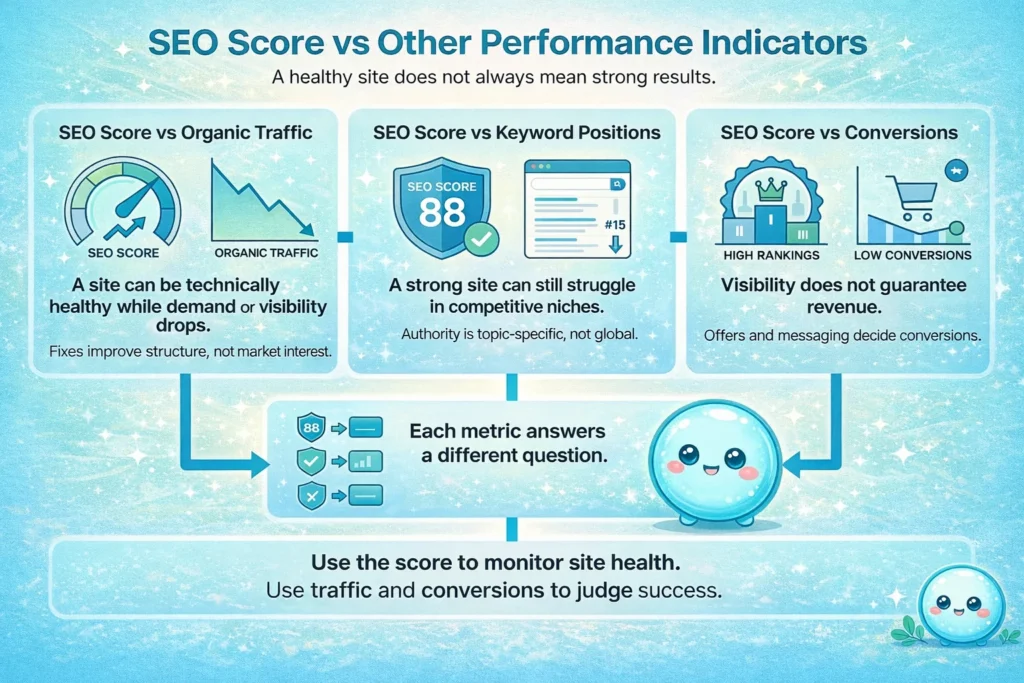
You can have a rising SEO score and falling traffic. This usually happens when you fix technical issues but lose market interest, or a competitor simply out-writes you. Traffic is the goal; the score is just a maintenance check.
SEO Score vs Keyword Positions
Your score is an aggregate. Your keyword position is specific. You might have a great overall site health score, but rank poorly for “best running shoes” because you lack authority in that specific niche.
SEO Score vs Conversions
This is the most painful one. You can have perfect SEO, great rankings, and zero sales if your product offer isn’t compelling.
I trust the score for technical health. I trust Google Search Console and analytics for performance.
Why SEO scores are useful in daily work
Despite the limitations, I use these scores every single day. Here is why.
Quick Prioritization: When I log in to manage a project, I don’t have time to manually check 500 pages. The score highlights the top 5 critical issues immediately.
Reporting: Explaining “canonical tags” to a business owner is hard. Showing them a graph that went from 60 to 80 is easy. It proves we are making progress.
Progress Tracking: SEO takes time. A score gives us an immediate feedback loop. We fixed the errors today, the score went up today, even if the traffic won’t follow for another month. It keeps the momentum going for search engine optimization projects.
Limitations of SEO scores you should know
You need to know where the blind spots are.
Tool Differences: A score of 80 on one tool might be a 50 on another. Their scoring models differ. Stick to one tool for consistency.
False Confidence: As I mentioned, a high score can make you lazy. You hit 100/100 and stop working, while your competitors are out there creating amazing new content.
Blind Spots: Most standard SEO scores cannot measure “Brand Demand.” They can’t tell you if people actually like your brand. They can’t measure how funny or engaging your writing is.
Understanding the Health Score in sneo AI
This brings me to why I built sneo.ai. I was frustrated that most SEO scores were just checking boxes (technical stuff) but ignoring the actual performance data from Google.
What the sneo AI Health Score represents
The sneo AI Health Score is different. It doesn’t just look at your code; it connects directly to your Google Search Console. It represents the overall vitality of your site by combining technical health with real user data.
It reflects the overall SEO condition. If your technical code is perfect, but your traffic is plummeting, a standard tool might still give you an ‘A’. The sneo AI Health Score will drop, alerting you that something is wrong with your visibility.
Main signals used inside the Health Score
We combine four distinct layers:
- CTR Changes and Visibility: Are people clicking? If impressions are high but clicks are low, that hurts your health score.
- Indexing Coverage: Is Google actually filing your pages away? We look at the “indexing queue.” Ahrefs found that over 90% of content gets no traffic from Google, often due to simple indexing failures.
- Technical Site Audit: The standard checks (broken links, 404s).
- Core Web Vitals: Real-world speed data.
How to read the Health Score panel
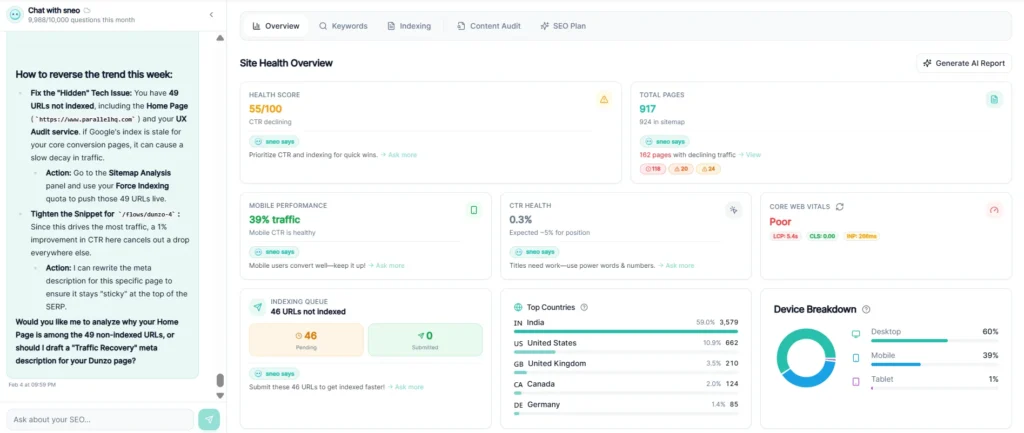
When you look at your dashboard in sneo.ai, you see a number (e.g., 55/100).
- Green: You are healthy. Focus on creating content.
- Yellow/Orange: Warning. Usually means a drop in CTR or a technical glitch.
- Red: Critical. You have likely been de-indexed or hit with a manual action.
We also show “Quick Action Hints.” Instead of a cryptic error code, I programmed it to say things like, “Fix these 3 titles to improve CTR.”
Why CTR and indexing are prioritized for quick wins
I prioritize these because they are the fastest way to get results.
- CTR: If you rank #5 and we improve your title, you get more traffic without needing to rank higher. According to Backlinko, the #1 result in Google gets 27.6% of all clicks, while position #10 gets only 2.4%. Moving up just one or two spots by improving your title can double your traffic.
- Indexing: If your page isn’t indexed, it doesn’t exist. Fixing indexing gaps is literally turning the lights on.
sneo.ai specifically flags “declining pages”—pages that used to do well but are slowly dying. Catching these early saves your traffic.
How the Health Score connects to real ranking factors
We weighted the Health Score to mirror Google’s priorities. Since Google prioritizes user experience (signals like CTR and bounce rate matter indirectly) and technical accessibility, our score moves in lockstep with those factors.
Practical workflow using sneo AI Health Score
Here is how I use it personally:
- Identify: I ask sneo.ai, “Why did my score drop this week?”
- Audit: It tells me, “Your CTR on the ‘Pricing’ page dropped 10%.”
- Check: I open the affected URL.
- Fix: I rewrite the meta description to be more catchy.
- Monitor: I watch the score (and traffic) recover over the next few days.
How to use an SEO score to improve your site step by step
Regardless of the tool you use, here is the process I recommend to improve your site.
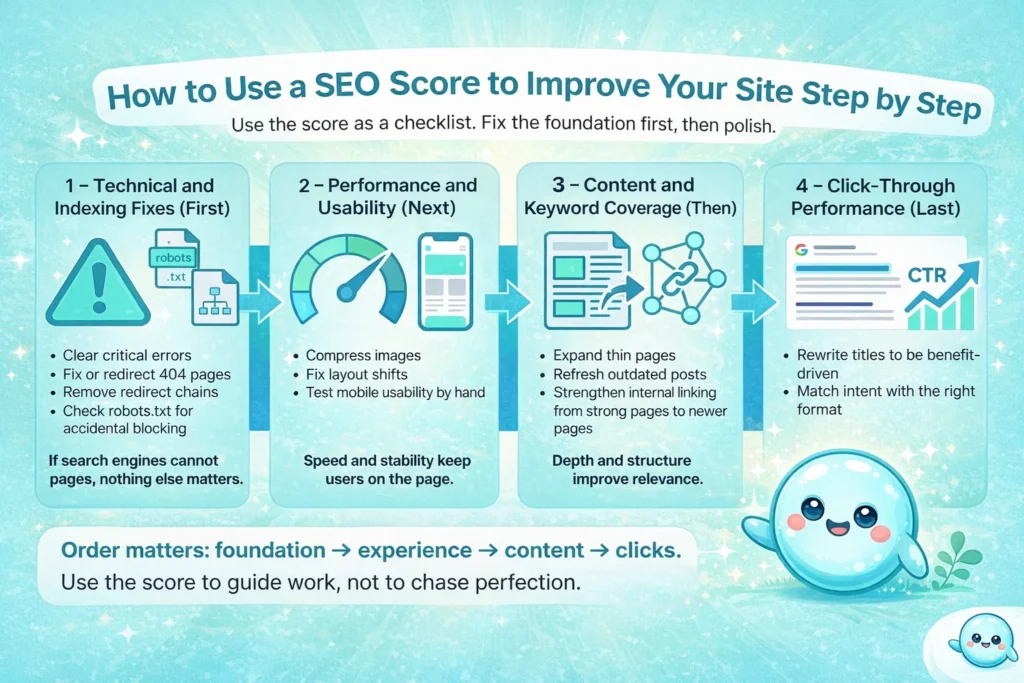
1) Start with technical and indexing fixes
Always clear the “Critical Errors” first.
- Fix broken pages (404s). Redirect them to relevant live pages.
- Clean up redirect chains.
- Check your robots.txt. I once saw a client accidentally block their whole site from Google. Fixing that one line restored their business.
2) Improve page performance and usability
Next, look at the speed.
- Compress your images. Large images are the #1 cause of slow pages.
- Check for layout shifts. Does the text jump around when an ad loads? Fix that.
- Test mobile usability. Pick up your phone and try to use your own site.
3) Strengthen content and keyword coverage
Now, look at the content.
- Identify pages with “Thin Content” warnings. Expand them with helpful details.
- Update outdated content. An article from 2021 needs a refresh for 2025.
- Improve internal linking. Link your high-authority pages to your new pages to pass that authority along.
4) Improve click-through performance
Finally, polish the presentation.
- Rewrite titles. Make them emotional or benefit-driven.
- Match search intent. If the user wants a calculator, don’t give them a 3,000-word essay. Give them a calculator.
Conclusion
So, what is an SEO score when it comes down to it? It is your compass. It is not the destination, but it keeps you from getting lost in the woods of data.
I’ve learned that SEO success isn’t about memorizing every algorithm update—it’s about asking the right questions. Every insight you gain, from understanding why traffic dropped to discovering untapped keyword opportunities, makes your site stronger. Your data has the answers.
My advice is to use the score responsibly. Let it guide your actions, but do not let it replace your brain. Use tools like sneo.ai to translate the confusion into plain English, and then take action.
I built sneo.ai to bridge the gap between having data and having insights. If you are tired of guessing, connect your Google Search Console and just ask me: “How do I improve my site today?” I’ll help you find the answer.
FAQ – What is an SEO score?
Q1. What is an SEO score in simple terms?
An SEO score is a single number (usually 0-100) that rates the overall health of your website based on technical performance, content quality, and user experience metrics. It acts like a report card for your site’s optimization.
Q2. Does Google use SEO scores to rank websites?
No. Google uses its own complex algorithms with hundreds of signals. The SEO scores you see in third-party tools are estimates designed to help you optimize, but they are not direct ranking factors used by Google.
Q3. Why do different tools show different SEO scores?
Each tool (like sneo.ai, Moz, or Semrush) has its own proprietary scoring model and data sources. One might prioritize backlinks while another prioritizes page speed, leading to different scores for the same website.
Q4. What is a good SEO score for a small business site?
In my experience, a score between 70 and 80 is a great baseline for a small business. You don’t need a perfect 100. Focus on being in the “healthy” green zone (usually 80+) for your most important pages.
Q5. Can a low SEO score still rank well?
Yes, it happens. A site with a low technical score (e.g., slow speed) can still rank if it has incredibly unique, high-authority content that no one else provides. However, a low score puts you at a disadvantage and makes ranking harder than it needs to be.
Q6. How long does it take for an SEO score to improve after fixes?
Technical fixes (like repairing broken links) can improve your score almost immediately once the tool re-crawls your site. Content changes and authority signals take longer to reflect, often weeks or months.
Q7. How is sneo AI Health Score different from a normal SEO score?
The sneo AI Health Score integrates directly with Google Search Console data. Unlike standard scores that look only at code, sneo AI factors in real performance metrics like Click-Through Rate (CTR) and indexing status, giving you a more realistic view of your site’s visibility.
Q8. Which parts of an SEO score have the biggest impact on traffic enhancement?
Indexing health is #1—if you aren’t indexed, you get zero traffic. After that, page performance (Core Web Vitals) and content relevance generally move the needle the most for traffic growth.
Q9. Should beginners focus only on SEO score?
No. Beginners should use the score as a guide to fix errors, but they must balance it with looking at real traffic and rankings. A balanced approach using rankings, traffic, and site health is the only way to grow sustainably.
Q10. Is SEO score useful for long-term search engine optimization planning?
Yes. It is excellent for tracking progress over time. It helps you spot risks early (like a sudden drop in technical health) before they destroy your rankings, making it a vital tool for long-term maintenance.