

I stare at Google Search Console data every single day. I’ve looked at thousands of graphs, analyzed millions of impressions, and helped hundreds of site owners make sense of their search performance. Yet, whether I’m talking to a small business owner in Ohio or a marketing director in London, the first question is almost always the same.
They point to a flat line on a graph and ask: “Rahul, why does SEO take so long?”

It is a fair question. In a world where you can launch a paid ad campaign and see traffic in twenty minutes, or post on social media and get likes in seconds, search engine optimization feels painfully slow. I’ve seen the frustration firsthand. You pour hours into writing a great guide, you fix your technical errors, and you wait. You check your analytics the next morning, and… nothing.
I used to explain this using complicated metaphors about gardening or investing. But after years in this industry, I prefer to give it to you straight. The delay isn’t a bug; it is a feature of how modern search engines protect their users.
When I look at the data from 2025 and heading into 2026, I see that Google has become stricter, not faster. Trust is harder to earn. Competition is fierce. But here is the good news: once you understand the mechanisms behind the delay, you stop worrying about the daily fluctuations and start seeing the real progress hidden in your data.
In this guide, I will walk you through exactly what is happening during those quiet weeks and months. We will look at how search engines actually grade your site, why “instant” results are usually a trap, and what a realistic timeline looks like for your specific situation.
Why Does SEO Take So Long: The Direct Answer
SEO takes time because search engines must verify your trust, authority, and content quality against billions of competitors. It is a protective measure to ensure users receive safe, accurate, and reliable results, not just the newest ones.
How search engines decide where your site appears
To understand the wait, you have to understand the goal of the search engine. I always tell my clients to think about Google not as a machine, but as a librarian who is terrified of recommending a bad book.
If you walk into a library and ask for a book on “heart health,” the librarian won’t just hand you the first book that arrived in the return bin five minutes ago. They want to give you a book that is accurate, written by an expert, and easy to read. If they suggest a bad book, you might not trust the librarian next time.
Search engines operate on this same principle of risk management.
The Algorithm’s Job
When you publish a page, algorithms assess it against billions of other pages. In 2026, these systems will be incredibly sophisticated. They aren’t just looking for keywords anymore. They are looking for “Satisfying Content.”
I have analyzed site hits from recent Google Core Updates, and the pattern is clear: the algorithm prioritizes user satisfaction over almost everything else. It asks:
- Does this page actually answer the query?
- Is this information unique, or is it just rephrased from Wikipedia?
- Does the site load quickly and work on mobile?
- Is the author credible?
Relevance vs. Trust
Relevance is easy. You can write a relevant article in an hour. Trust, however, is the hard part.
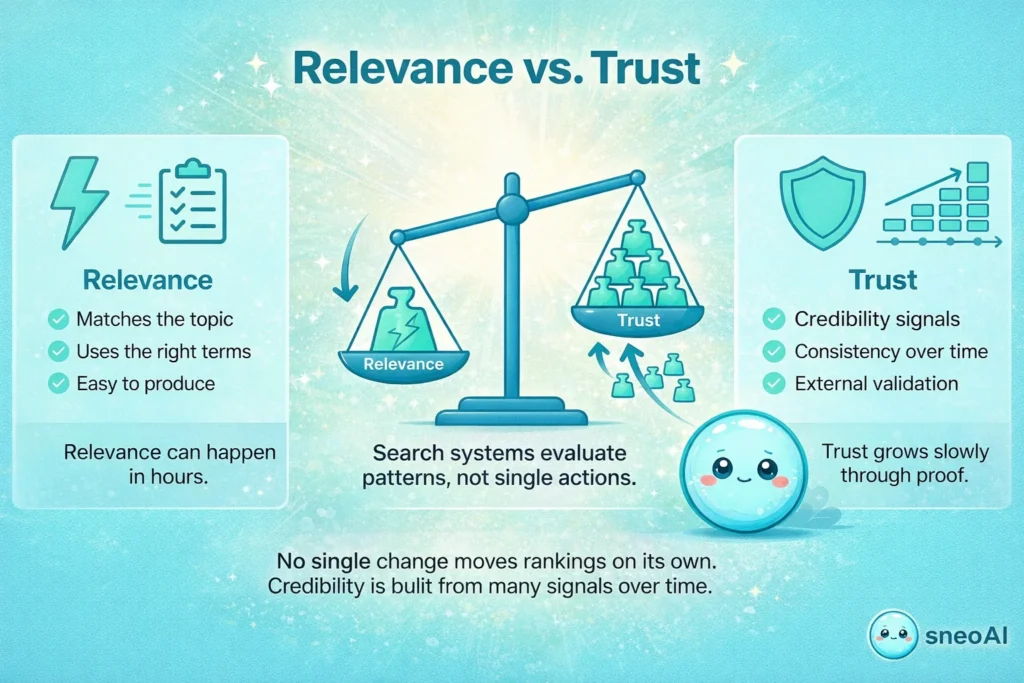
I frequently see new sites with excellent content that simply won’t rank. Why? Because the search engine doesn’t know if you are a legitimate business yet. You haven’t proven that you will be around in six months. You haven’t proven that other people trust you.
This evaluation process is the first barrier. No single change moves rankings on its own because the algorithm looks at the aggregate score of hundreds of factors. It is not checking a box; it is building a profile of your credibility. That profile takes data points to fill, and gathering those data points takes time.
The indexing process is not instant
One of the most common issues I find when users connect their site to sneo.ai is that they are worrying about ranking for a page that Google hasn’t even properly filed yet.
I remember a client last year who was panicking because his new product page wasn’t showing up for his brand name. He thought he had been penalized. I logged into his Search Console and checked the Page Indexing Report. The status was clear: “Discovered – currently not indexed.”
Google knew the page existed, but it hadn’t bothered to read it yet.
How Crawling Works
The web is expanding faster than Google can crawl it. Even with their massive resources, they cannot look at every page every day. They have a “crawl budget” for every site.
If you run a new site or a small blog, Google might only send a crawler (Googlebot) to your site once every few days, or even weeks. When you hit publish, you are essentially putting a flag up. The crawler has to see the flag, come over, download the page, render the code, and then analyze the text.

Why Delays Happen
I see three common technical reasons for indexing delays:
- Poor Internal Linking: If you publish a page but don’t link to it from your homepage or other important pages, the crawler has a hard time finding it. It is like building a house but forgetting to build a road leading to it.
- Server Performance: If your server is slow, Googlebot will slow down its crawling to avoid crashing your site.
- Quality Thresholds: If your site has a history of publishing “thin” or low-value content, Google will visit less often. They prioritize resources for sites they know publish high-value material.
This technical lag is the first practical answer to why does SEO take so long. You are waiting in a queue just to get your ticket stamped.
SEO depends on many ranking factors working together
I often use the analogy of a credit score. You can pay off one credit card today, but your score won’t jump 100 points tomorrow. Your credit score is a mix of payment history, credit age, usage, and mix of accounts. SEO is remarkably similar.
Progress is slow because you need multiple “buckets” of signals to fill up simultaneously.
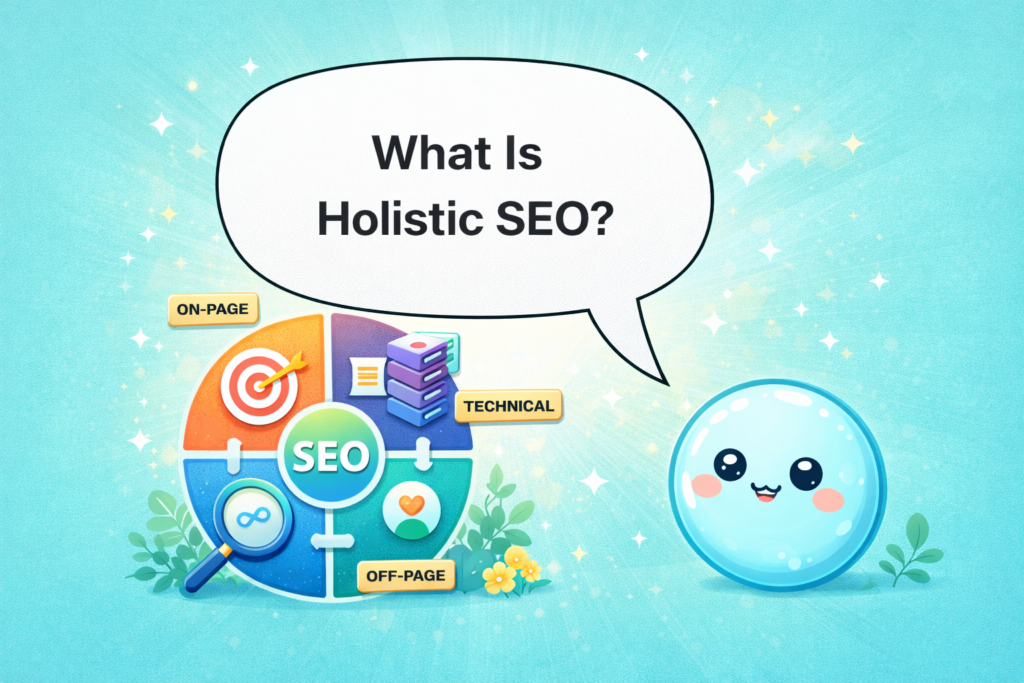
The Core Groups
- On-Page SEO: This is what you control directly—your words, your headings, your images.
- Off-Page SEO: This is your reputation—links from other sites, brand mentions, social shares.
- Technical SEO: This is your foundation—site speed, mobile usability, secure connections (HTTPS).
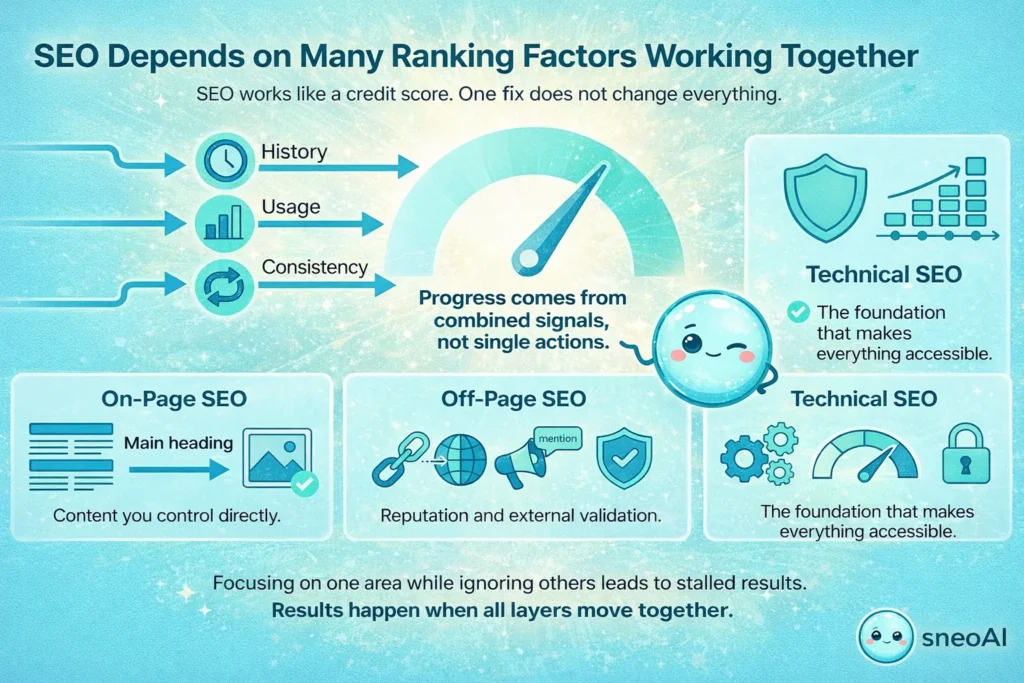
I have seen site owners obsess over one bucket while ignoring the others. I once worked with a business that had perfect technical SEO. Their site loaded in 0.5 seconds, the code was clean, and the structure was flawless. But they had zero backlinks and their content was generic. They waited six months and saw zero growth.
On the flip side, I’ve seen sites with great content but terrible technical issues (like blocking search engines via robots.txt) that also failed.
The “magic” only happens when all these layers align. You need the technical foundation to let Google see the content. You need the content to target the keywords. You need the off-page signals to prove the content is trustworthy. Getting all three spinning in the same direction is a complex operational challenge, not just a keyword problem.
Website authority and trust take time to build
If a stranger walked up to you on the street and gave you medical advice, you would ignore them. If a doctor you have known for ten years gave you the same advice, you would listen.
The advice is the same. The trust level is different.
In the eyes of a search engine, a new website is that stranger on the street.
What is “Authority”?
Authority isn’t just a metric from a third-party tool like Moz or Ahrefs. It is a concept of reliability. I look for specific signals in my clients’ data that indicate trust is building:
- Are people searching for the brand name specifically?
- Are reputable sites mentioning the brand?
- Is the user behavior consistent?
The “Sandbox” Effect
While Google has never officially confirmed a “sandbox” where new sites are held back, I have seen the data enough times to know the effect is real. According to Ahrefs data, only 5.7% of all newly published pages will rank in the Top 10 within a year.
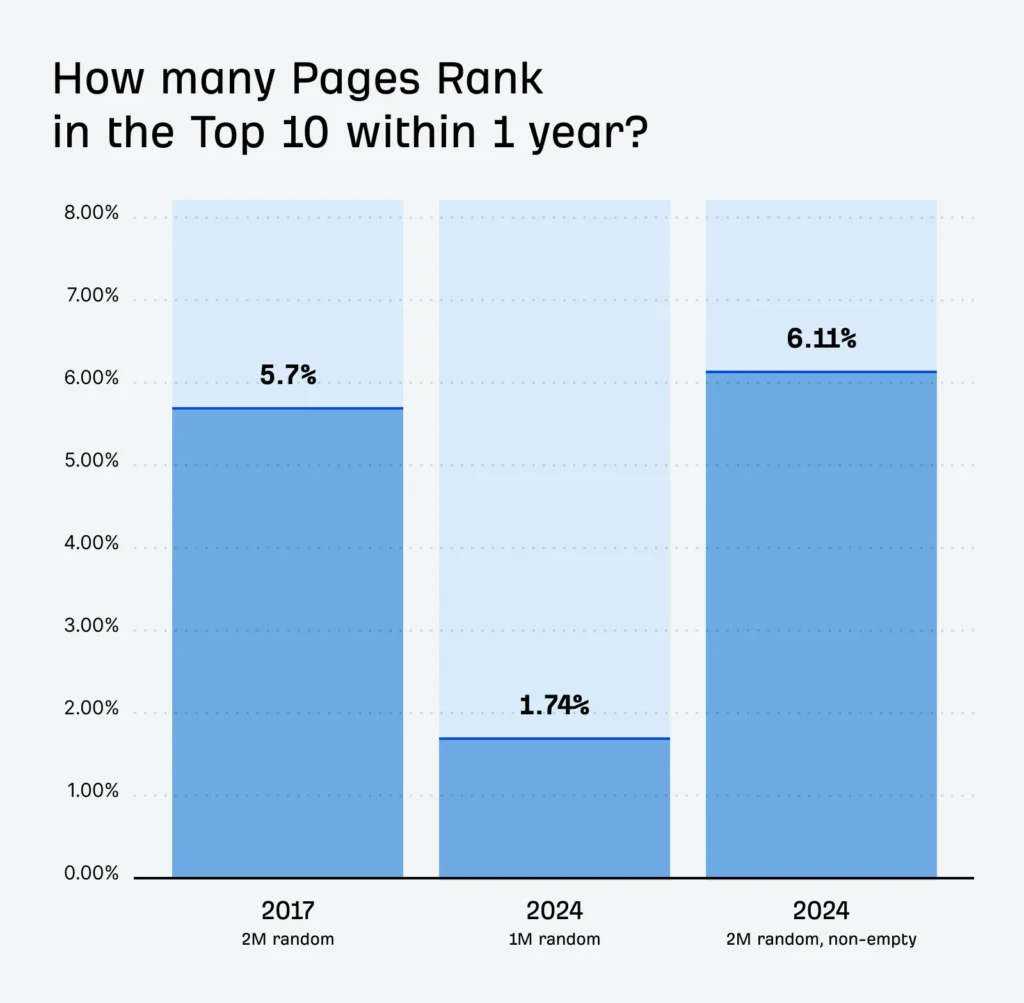
I believe this is a probation period. The algorithm is waiting to see if you are a spammer. Spammers churn and burn sites quickly. Legitimate businesses stick around. By simply existing, publishing consistently, and not breaking the rules for six months, you pass a silent test.
This trust-building phase is frustrating, but it is necessary. It protects users from fly-by-night scams. Unfortunately, it is also a major contributor to why SEO takes so long for startups and new projects.
Domain age plays a supporting role
I want to clarify a misunderstanding I hear often. People ask me, “Rahul, is my site failing because it’s new?”
The answer is yes and no.
Domain age itself—the simple number of years you have registered the URL—is not a magic ranking factor. You cannot just buy a domain, let it sit empty for ten years, and expect it to rank.
However, older domains usually perform better because they have had more time to accumulate the things that do matter: backlinks and content history. An older site is like a business that has been open on Main Street for twenty years. They have regulars. They have mentions in the local paper.
I recently analyzed a client’s competitor who was ranking #1 with a mediocre article. My client’s article was objectively better—more data, better graphics, more recent examples. But the competitor had been live since 2012. They had accumulated thousands of tiny signals of legitimacy over 14 years.
We couldn’t beat their history in a week. We had to beat them by being consistently better for a sustained period. We eventually overtook them, but it took eight months of consistent pressure.
Content quality is one of the biggest long-term drivers
In 2026, “content” means more than just text on a page. Google’s systems are looking for “Experience, Expertise, Authoritativeness, and Trustworthiness” or E-E-A-T.
I tell website owners: you cannot fake expertise.
Why Quality Takes Time
Producing truly high-quality content is slow. I can use an AI tool to generate 50 articles in an hour, and I can almost guarantee none of them will rank well for long. Why? because they lack original insight.
Google wants information gain—something new added to the conversation.
- Depth: You need to cover the topic fully, anticipating the user’s next questions.
- Originality: You need unique data, personal stories, or fresh angles.
- Clarity: You need to format it so it is easy to read on a phone.
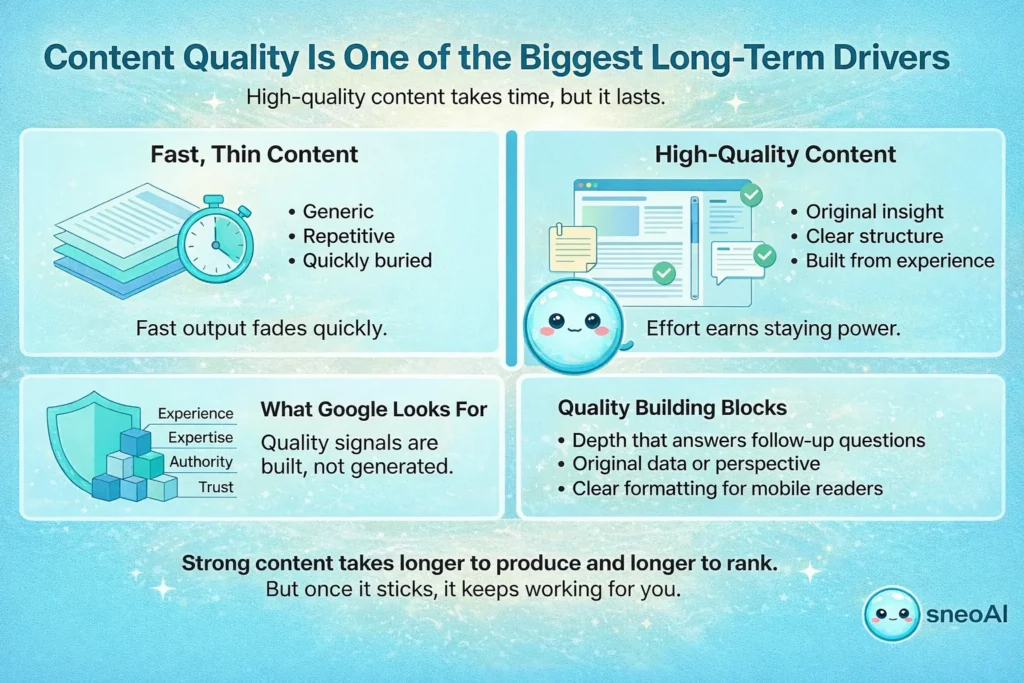
When I write content for my clients, I spend time researching. We verify facts. We add internal links. This production process slows down the publishing schedule, but it speeds up the ranking results in the long run.
Thin content might get indexed quickly, but it gets de-indexed or buried just as fast. High-quality content sticks. It earns passive links. It keeps users on the page. But because it takes effort to create, and because Google needs time to test user reactions to it, it adds to the timeline.
Content freshness matters more than many people expect
Here is a strategy I use constantly that surprises people: sometimes the fastest way to grow is to stop writing new posts and start fixing old ones.
Information decays. A guide to “Best SEO Tools” written in 2023 is useless in 2026. If you let your content rot, your rankings rot with it.
The Freshness Signal
Search engines want to serve current results. When you update a page, you are signaling that you are still active and that you care about accuracy.
However, this also contributes to the lag. If you have a massive site with 500 pages, and you only update one page a month, the overall “freshness score” of your site remains low. It takes time to cycle through your library and bring everything up to standard.
I often see a lag between the update and the reward. You might update a post today, Google recrawls it next week, re-evaluates the quality the week after, and adjusts the ranking a month later.
Understanding this cycle answers why SEO takes so long even when you are just maintaining an existing site. You are constantly fighting the natural decay of relevance.
Backlink building is slow by nature
If content is the engine, backlinks are the fuel. But unlike gas, you cannot just pull up to a pump and buy them (well, you can, but it will likely get you penalized). You have to earn them.
This is arguably the slowest part of the entire SEO process.
The Human Element
To get a legitimate backlink, a human being at another website has to:
- See your content.
- Read your content.
- Like it enough to edit their own page.
- Add a link to you.
Think about how much friction is in that process. People are busy. Editors have schedules.
I worked with a SaaS company that launched a fantastic industry report. We sent personalized emails to 200 journalists and bloggers. In the first week? Silence. In the second week, a few replies. It wasn’t until month three that the major links started appearing live on other sites.

Why? Because editorial calendars are planned weeks in advance. A journalist might love your study but not have a slot for it until next month.
The Danger of Shortcuts
Because this is slow, people try to cheat. They buy 500 links from a “link farm.” In the short term, their graph spikes. Two months later, Google’s spam brain catches it, and they crash to zero.
Building a “natural” link profile means growing slowly. A sudden spike in links looks suspicious. A slow, steady trickle looks like real popularity. We have to move at the speed of natural human behavior, not the speed of computers.
On-page SEO fixes do not deliver instant ranking changes
I built sneo.ai because I wanted people to be able to ask, “What is wrong with this page?” and get an instant answer. But getting the answer and fixing the problem doesn’t mean the result changes instantly.
Let’s say you realize your Title Tag is missing the main keyword. You log into WordPress, change the title, and hit update.
You might check Google five minutes later and see the old title.
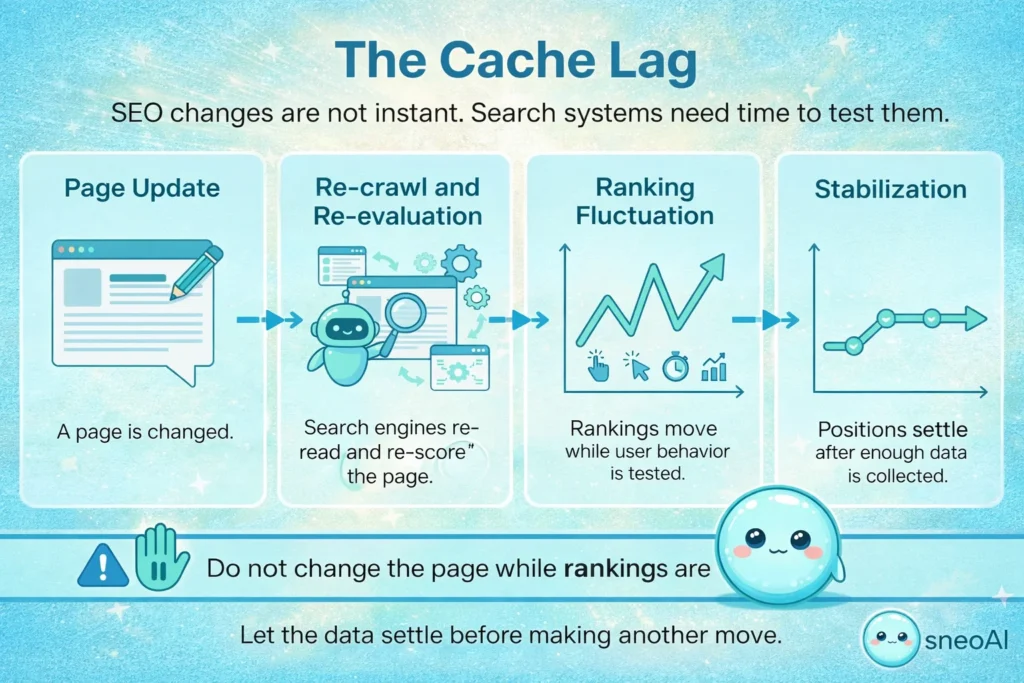
The Cache Lag
As I mentioned earlier, Google has to re-crawl the page to see the change. But even after they see the change, they have to re-calculate the page’s value.
Changing a keyword might make you more relevant for Query A, but less relevant for Query B. The algorithm has to test this. It might “dance” your ranking—putting you at position 5, then 15, then 8—to see how users react to the new title.
I always tell clients: Do not touch it while it is dancing.
This testing phase can last a few weeks. Users who tweak their on-page SEO every day are actually hurting themselves because they never let the data settle. This testing period is a core reason why SEO takes so long to show stable results from minor tweaks.
Off-page SEO grows at a different pace
While you are fixing title tags (on-page), your off-page reputation is moving at a glacial pace.
Off-page SEO includes things like brand mentions on forums, social media sentiment, and reviews. These signals are messy.
I analyze sentiment for brands, and it is clear that reputation has “momentum.” A big PR push today might result in more branded searches three months from now.
For example, I had a client appear on a popular podcast. The day the episode aired, traffic spiked slightly. But the real SEO benefit came four months later. Why? Because listeners slowly started searching for the brand, writing about it on their own blogs, and discussing it on Reddit. Google picked up on this rising tide of “Brand Authority” slowly.
You cannot force this momentum. You have to feed it and wait.
User engagement influences long-term performance
This is the factor that separates the winners from the losers in 2026. Google is watching what people do after they click.
- Bounce Rate (The bad kind): Someone clicks your result, hates it, and hits “Back” immediately to click the next result. This is called “Pogo-sticking.”
- Dwell Time: Someone clicks, stays for 4 minutes, and reads to the end.
The Feedback Loop
If you rank #1 but everyone hates your page, you won’t rank #1 for long. But Google needs a significant sample size to make this decision. They need hundreds or thousands of users to interact with your page to get statistically significant data.
If you are a small site getting 10 clicks a day, it might take months for Google to gather enough user data to say, “Hey, people really love this page, let’s move it up.”
I check this in my own accounts by looking at the difference between impressions and clicks. If clicks are low, or if rankings drop after a spike, it usually means the user engagement signals were poor. Fixing the content helps, but then you have to wait for a new set of users to generate new data.
Competitive niche pressure slows progress
If you are trying to rank for “best pizza in Tiny Town,” you might see results in two weeks. If you are trying to rank for “best credit card,” you might wait two years.
The timeline depends on who you are fighting.
I often have to set difficult expectations for clients in industries like finance, law, or health. You aren’t just fighting the algorithm; you are fighting competitors who have been doing SEO for a decade. They have millions of backlinks. They have teams of writers.
In these niches, the question of why does SEO take so long is answered by simple physics: you have a smaller engine, and you are starting ten miles behind the leader.
You have to displace them. And since they are likely maintaining their SEO, you have to run faster than them just to catch up. This is why I often advise smaller sites to target “long-tail” keywords—specific, niche questions—where the competition is weaker, so they can get traction faster.
Algorithm updates reset expectations
Just when you think you are winning, Google changes the rules.
Major core updates happen several times a year. In 2025 alone, we saw significant shifts in how AI-generated content was handled.
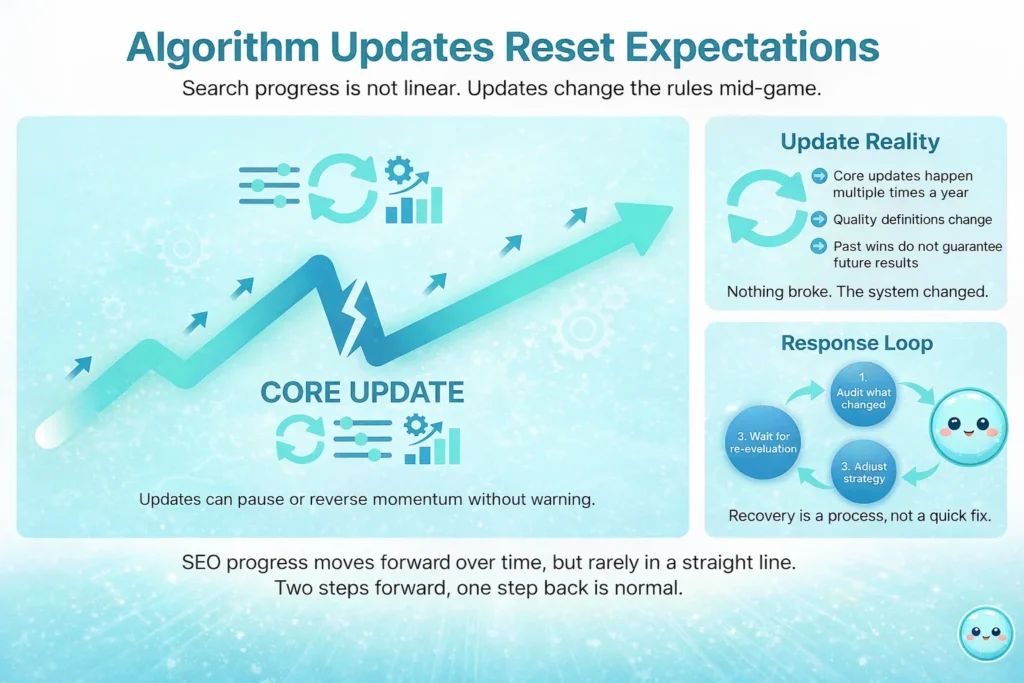
An update can pause your progress. I have seen sites climbing steadily for five months, only to get hit by an update that devalues their specific type of content. They didn’t do anything “wrong,” but the definition of “quality” shifted.
When this happens, you have to audit, adjust, and wait for the next refresh. It is two steps forward, one step back. This volatility is normal, but it drags out the overall timeline of growth.
A realistic SEO timeline for most sites
So, let’s get practical. Based on everything I see in the data, here is what you should actually expect.
Month 1: The “Ghost” Phase You are doing technical fixes, keyword research, and publishing content.
- Results: almost zero. You might see impressions in the Search Console, but very few clicks.
- Feeling: Frustration.
Month 2-3: The “Noticeable” Phase Google is indexing your pages properly. You start ranking for very specific, long-tail keywords (e.g., “blue running shoes for flat feet” instead of just “running shoes”).
- Results: Traffic trickles in. Maybe 10-50 visitors a day depending on the niche.
- Feeling: Hopeful but impatient.
Month 4-6: The “Growth” Phase This is where the magic starts. Your early content has aged enough to be trusted. You have earned a few backlinks. The “sandbox” effect lifts.
- Results: Traffic graphs start to curve upward. Leads or sales begin to happen consistently.
- Feeling: Validation.
Month 6-12: The “Compounding” Phase Your content library is large enough that one page supports another. Your authority allows you to rank for broader, more competitive terms.
- Results: SEO becomes your primary driver of traffic.
- Feeling: Success.
This timeline varies, but it is the average I see for a legitimate business putting in real effort.
What you can do to shorten the wait without cutting corners
You cannot skip the line, but you can definitely run faster.

When I analyze a site with sneo.ai, I look for the “unforced errors” that are slowing things down.
- Fix Technical Errors First: If Google can’t crawl your site, nothing else matters. Use a tool (like GSC or sneo.ai) to find 404 errors, broken redirects, or slow pages. Fixing these is like taking the parking brake off.
- Target Low-Hanging Fruit: Don’t write about the most competitive topic first. Write about the specific questions your customers ask you on the phone. These are easier to rank for and build early momentum.
- Interlink Aggressively: If you have one page that is doing well, link from it to your new pages. Pass that authority around.
- Update Content: As I mentioned, keep your existing pages fresh.
Consistency beats intensity. Publishing one great article a week for a year is infinitely better than publishing 50 articles in a week and then quitting.
Conclusion
So, let’s revisit the question: why does SEO take so long?
It takes time because you are building a reputation in a crowded room. You are proving to a skeptical algorithm that you are an expert, that you are trustworthy, and that you are here to stay.
I know it is hard to wait. I know it is tempting to look at the flat line in Google Search Console and give up. But I also know that the sites that win are the ones that endure the quiet months.
The delay is actually your protection. If rankings changed overnight, your business could disappear overnight. The slowness of SEO creates stability. Once you climb that hill and earn your spot, it is very hard for a competitor to knock you down quickly.
If you are feeling lost in the data, or if you just want to know if your arrow is pointing up or down, you don’t have to guess. I built sneo.ai to bridge the gap between “what is happening” and “what to do.” You can connect your Search Console and just ask me: “How are we doing?”
Keep publishing. Keep optimizing. The results are coming.
FAQ: Why Does SEO Take So Long?
1) What is the fastest way to see results from SEO?
The fastest wins usually come from “low-hanging fruit”—fixing technical errors that prevent indexing and optimizing existing content that is ranking on page 2 to push it to page 1. Technical fixes can show results in a few weeks, whereas new content typically takes months.
2) Does publishing more content make SEO faster?
Not necessarily. Publishing 100 low-quality pages will actually hurt you. It is better to publish 10 high-quality, deeply researched pages. Quality signals simply carry more weight than volume in 2026.
3) How long does backlink building usually take to affect rankings?
It is a slow process. First, you have to get the link live (which takes outreach time). Then, Google has to crawl the linking site. Then, the algorithm recalculates your trust score. You typically see the impact of a good link campaign 4 to 10 weeks after the links go live.
4) Is SEO slower for new websites?
Yes. New domains lack “Authority” and history. Google tends to place new sites in a probationary period (often called the sandbox) for 3 to 6 months to ensure they aren’t spam. Established sites with history can rank new content much faster—sometimes in hours.
5) Do algorithm updates delay progress?
They can. If an update rolls out and changes the weight of certain ranking factors, your site might drop or plateau while you adjust your strategy. However, updates are meant to surface better content, so if you focus on quality, they shouldn’t stop your long-term growth.
6) Can paid ads help SEO results happen faster?
Directly? No. Paying for Google Ads does not improve your organic ranking. However, ads can drive traffic, which increases brand awareness and might lead to people searching for your brand name or linking to your site—both of which do help SEO indirectly.
7) How often should I update my content for better results?
There is no fixed schedule, but I advise reviewing your most important pages every 3 to 6 months. If the information has changed (like a “Best of 2025” list becoming outdated), update it immediately. User intent and facts change, and your content needs to match that.
8) Why does my site rank well for some pages but not others?
Ranking is done on a page-by-page basis. One page might have great content and strong internal links, while another might be “thin” or buried deep in your site structure. You likely have higher authority for the topics you cover most frequently and best.
9) Is it normal for rankings to move up and down during SEO work?
Absolutely. This is called “volatility.” When you make changes, Google re-evaluates the page. It might test you at position 8, then 12, then 6. This bouncing is a sign that the algorithm is testing your relevance.
10) When should I expect stable results from SEO?
For most sites, you can expect to see consistent, reliable traffic growth between months 6 and 12. Before that, data will likely be noisy and fluctuate as you build authority.