

I have analyzed hundreds of websites over the last few years, and I see the same pattern repeat itself. A website owner looks at their dashboard and sees thousands of impressions in search results. It looks impressive on paper. But then, they look at the clicks, and the number is tiny. The click-through rate is stuck at 1% or 2%.
“Rahul,” they ask me, “Why is Google showing my site but nobody is visiting?”

The answer is almost always buried deep in their data, hidden behind technical errors or misunderstood search intent. But finding that answer feels like searching for a needle in a haystack. That is exactly why I built sneo.ai—to bridge the gap between having data and actually understanding it.
In 2026, search behavior has shifted. Users expect instant answers, and search engines like Google have evolved to prioritize helpfulness, speed, and genuine expertise (E-E-A-T) more than ever before. The rules have changed. If you are still operating on optimization tactics from three years ago, your traffic is likely suffering.
Before you spend another dollar on ads or write another blog post, you need to stop and assess your foundation. This is where understanding why SEO audit is important becomes the first step to real growth. You cannot build a skyscraper on a cracked foundation.
This guide is for the business owner who feels overwhelmed by analytics. It is for the marketer who needs to explain a traffic drop to their boss. And it is for anyone who wants to stop guessing and start growing.
Direct Answer: Why SEO Audit Is Important?
Understanding why SEO audit is important is critical because it exposes the invisible technical and content barriers blocking your growth. It transforms raw data into a prioritized repair plan, securing long-term search visibility and stability.
What Is an SEO Audit? A Simple Explanation
Let’s strip away the jargon. When I talk about an SEO audit, I am not talking about a quick scan from a free tool that just tells you your meta descriptions are too long.
Think of an SEO audit like a full medical checkup for your website. If you go to a doctor, they don’t just look at you and say, “You look fine.” They run blood work, check your heart rate, and review your history. An audit does the same for your site.
I look at three main pillars:
- Technical Health: Can search engines crawl and read your site?
- On-Page Elements: Is your content actually answering the questions users ask?
- Off-Page Authority: Does the rest of the web trust you?
Many people think an audit is just a list of errors. I view it differently. To me, an audit is a roadmap. It connects the health of your website directly to your search engine ranking. If Google cannot read your site because of a technical glitch, it does not matter how brilliant your content is—you will not rank.
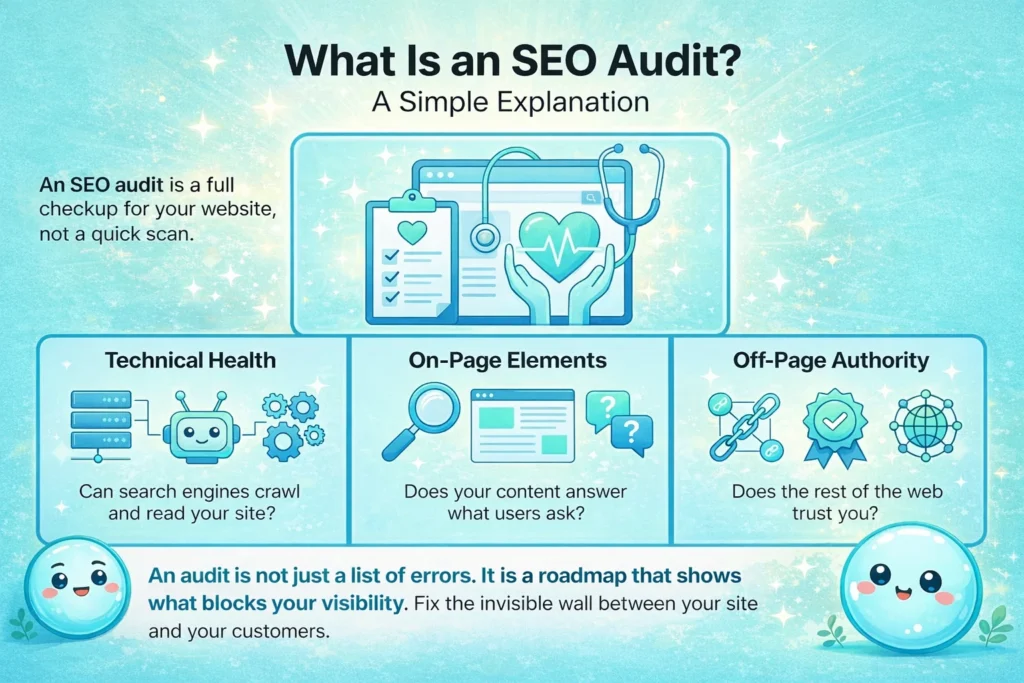
An audit reveals the invisible wall standing between you and your customers.
Why SEO Audit Is Important for Website Optimization
I often hear clients say, “My site looks great, so why isn’t it ranking?” This is a classic misconception. Human users see the visual design, but search engines see code.
When I run an analysis, I am looking for the hidden gaps in your optimization strategy. These are issues you typically cannot see with the naked eye. For example, I recently helped a client who had accidentally blocked Google from reading their most profitable product pages. Their site “looked” fine, but to Google, those pages did not exist.
Identifying what holds a site back is the primary reason why SEO audit is important for any business serious about growth. It allows us to move from guessing to knowing.
Instead of waking up and thinking, “I should probably write a blog post today,” an audit gives you raw data that we can turn into clear action steps. It might tell us, “Stop writing new posts. Fix the 40 broken links on your existing high-traffic pages first.” That distinction saves time and money. It makes sure that every ounce of effort you put into your website yields a return.
Impact of SEO Audits on Search Engine Ranking
Search engines evaluate websites using complex algorithms that change frequently. In 2025 and 2026 alone, we saw updates specifically targeting “unhelpful content” and giving more weight to first-hand experience. According to Google Search Central, content must demonstrate distinct expertise to survive these shifts.
If your site is not aligned with these standards, your visibility suffers. An audit is the tool I use to align a website with Google’s current expectations.

Visibility and Indexing
Ranking begins with indexing. If Google has not indexed your page, you are invisible. I have seen massive sites with thousands of pages where only 40% were actually indexed. The rest were wasting space. An audit helps us spot these indexing holes immediately.
Long-term Stability vs. Short-term Gains
Some “hacks” might boost traffic for a week, but they rarely last. I focus on long-term stability. By fixing the foundational issues found in an audit—like site architecture and page speed—we build a site that can weather algorithm updates. We move away from the volatility of “churn and burn” tactics and towards a stable, upward trend in rankings.
Finding and Fixing Technical Issues
Technical SEO scares a lot of people. I get it. It sounds like you need to be a developer to understand it. But you don’t. You just need to know where the problems usually hide. When I use sneo.ai to look at a site, here are the technical culprits I usually find.
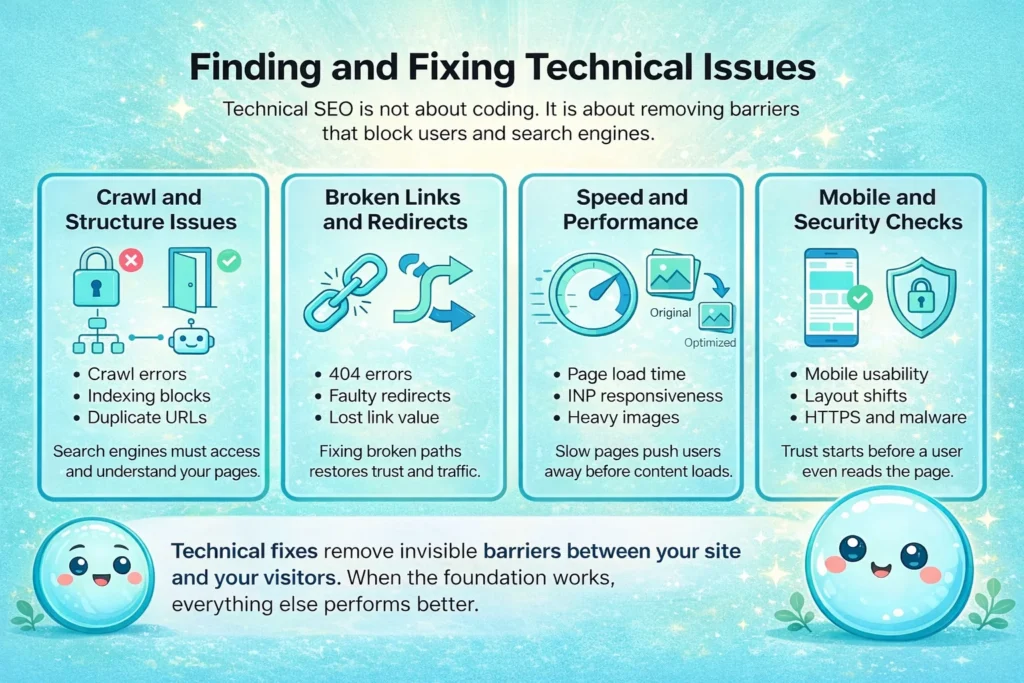
1) Common Technical Problems That Hurt Performance
- Crawl Errors and Indexing Blocks Imagine inviting someone to your house but locking the front door. That is what a crawl error does. I check your robots.txt file and your sitemap to ensure we are actually letting Google in.
- Broken Links and Faulty Redirects Nothing kills trust faster than a “404 Page Not Found” error. I once audited a site that had thousands of backlinks pointing to a page that no longer existed. We simply set up a 301 redirect to the new version of that page, and their traffic jumped 15% in two weeks.
- Duplicate URLs and Poor Site Structure If you have three pages that look identical to Google, it does not know which one to rank. They end up competing against each other (we call this cannibalization). I help site owners consolidate these pages to make one strong contender rather than three weak ones.
2) Site Speed and Performance Checks
In 2026, patience is non-existent. If your page takes more than 2.5 seconds to load, users leave. It is that simple.
Slow pages reduce traffic because people bounce before the site even loads. This signals to Google that your result was not helpful. Google data indicates that the probability of bounce increases 32% as page load time goes from 1 second to 3 seconds. I review metrics like Interaction to Next Paint (INP), which measures how quickly a page responds when a user clicks something.
High-ranking sites are fast. If an audit shows your images are huge and slowing you down, compressing them is an easy win that improves both rankings and conversion rates.
3) Mobile Responsiveness Review
We used to talk about “mobile-first.” Now, it is practically “mobile-only” for many industries. If your site is hard to use on a phone, you are losing customers. Statcounter data consistently shows mobile market share dominating desktop worldwide.

I look at touch targets—are buttons too close together? Is the text readable without pinching and zooming? Google penalizes sites that provide a poor mobile experience. I check specifically for layout shifts that happen when a page loads on a small screen, causing users to click the wrong button by mistake.
4) Security Vulnerabilities and Trust Signals
If your browser says “Not Secure” next to your URL, you have lost the user’s trust before they even read your headline.
HTTPS and Certificates I check that your SSL certificate is valid and that all page elements are loading securely.
Malware and Spam Sometimes sites get hacked without the owner knowing. An audit checks for injected spam links that could get your site blacklisted. Security is a ranking factor, but more importantly, it is a trust factor.
Keyword Analysis: Making Sure You Target the Right Searches
One of the biggest mistakes I see is business owners guessing what their customers type into Google. You might call your product a “portable hydration vessel,” but your customers are searching for a “water bottle.”
I use audits to match keyword intent with real user needs. I look at the queries bringing people to your site now (using Google Search Console data) and compare them to the content you have.
Are you ranking for terms that don’t bring sales? Are you missing out on obvious questions your competitors are answering?
This analysis helps us spot missed opportunities. I often find that a site is ranking on page 2 for a high-value term. With just a few tweaks to the content—identified by the audit—we can push that to page-1.
Content Quality Evaluation
Search engines want to serve the best possible answer. Period.
When I evaluate content, I look for “thin” pages—content with just a few sentences that adds no real value. I also look for outdated posts. If you have a guide to “Best Phones of 2021” still live and un-updated, it drags down your site’s perceived freshness.
We also look at E-E-A-T (Experience, Expertise, Authoritativeness, and Trustworthiness). Does your content demonstrate first-hand experience? This is a major differentiator in the age of AI-generated text. The Google Quality Rater Guidelines emphasize that personal experience is a vital component of trust.
Understanding the quality of your content is another reason why an SEO audit is important. It forces you to look at your articles objectively and ask, “Is this actually helpful?” If the answer is no, we either improve it or delete it.
Metadata Improvements That Drive Clicks
Your title tag and meta description are your advertisement in the search results. They don’t just help you rank; they convince humans to click.
I see so many common mistakes here:
- Duplicate title tags across the site.
- Descriptions that get cut off because they are too long.
- Titles that are boring and don’t promise value.
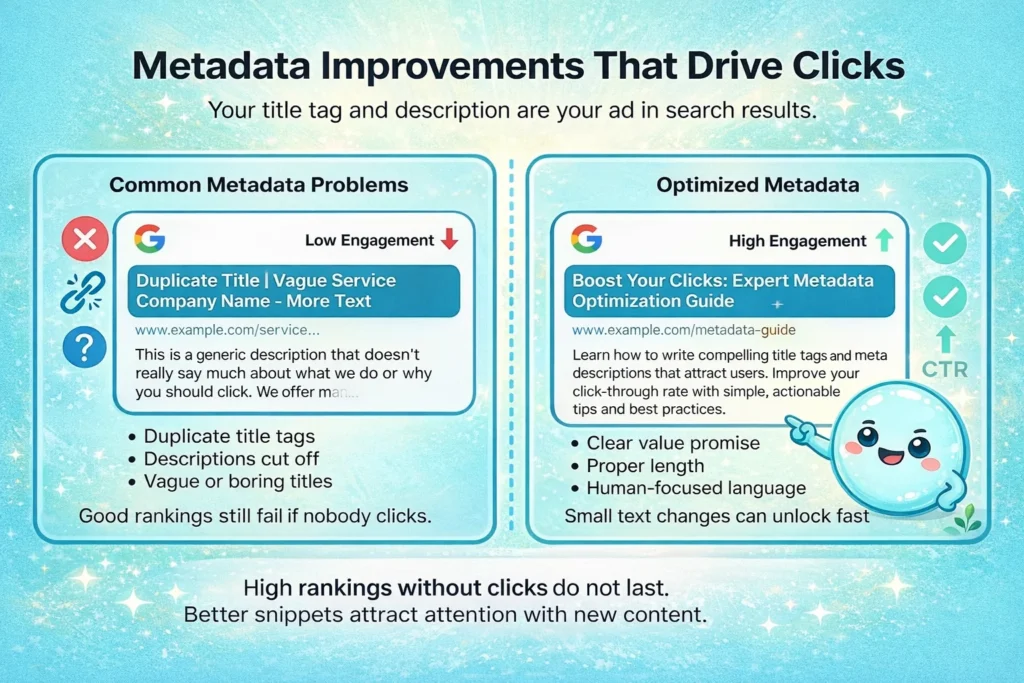
During an audit, I review CTR (Click-Through Rate) data. If a page ranks #3 but has a low CTR, the metadata is usually the problem. Rewriting these snippet texts is often the fastest way to get more traffic without creating any new content.
Backlink Profile Analysis
Links from other websites act as votes of confidence. However, not all votes are equal. Studies by Ahrefs have shown a clear correlation between the number of referring domains and search traffic.
I analyze your backlink profile to see who is linking to you. I am looking for “toxic” links—spammy sites that might be hurting your reputation by association. I also look for gaps. If your main competitor has links from 10 major industry news sites and you have none, that is a clear action item.
Authority is built over time, but an audit tells us if we are building a reputation or if we are being ignored.
User Experience Signals You Can’t Ignore
Google watches how people interact with your site. Do they click back to the search results immediately (pogo-sticking)? Do they spend time reading?
I analyze navigation clarity. If users cannot find what they want in three clicks, they leave. I also look at internal linking. Are you guiding visitors from one helpful article to the next?
User experience affects bounce rates and trust. If your text is a wall of grey blocks with no headings, people will not read it. An audit highlights these usability friction points so we can smooth them out.
Competitive Analysis: Learning From Others in Your Space
You do not exist in a vacuum. To win, you need to know who is ahead of you and why.
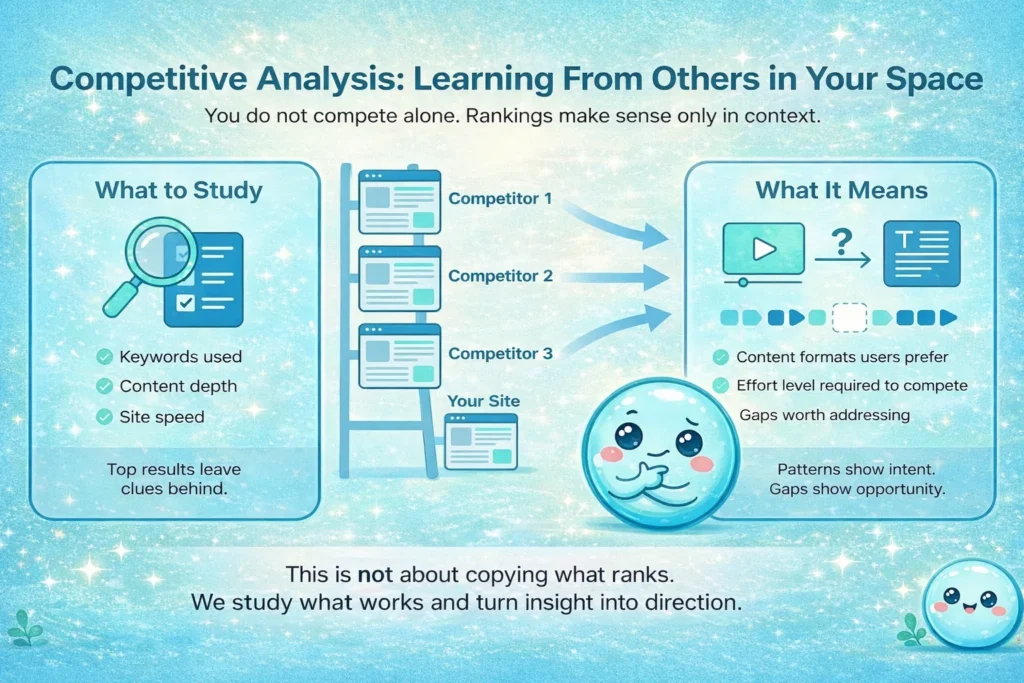
I include a competitive review in my process. I study the sites ranking above you.
- What keywords do they use?
- How long is their content?
- How fast is their site?
This is not about copying. It is about learning. If the top 3 results all feature video content and you only have text, that is a clear signal of what the user wants. Recognizing this gap is why an SEO audit is important for staying relevant in your specific niche. We turn their success into your strategy.
Using Analytics Insights to Measure What Matters
Data without context is just noise. I have worked with clients who stared at Google Analytics for hours and learned nothing.
An audit connects the dots. We look at traffic trends over the last 12 months. Are we growing or shrinking? We look at engagement metrics. Which pages keep people around?
I use these insights to guide decisions. If we see that “How-to” guides bring in 80% of your traffic but your product pages bring in 0%, we know we have a conversion problem, not a traffic problem.
SEO Audits and Conversion Rate Growth
This leads me to a crucial point: Traffic is vanity, sales are sanity.
I don’t just want more people on your site; I want the right people taking action. An SEO audit helps identify friction points that stop conversions. Maybe a popup is blocking the “Buy” button on mobile. Maybe your contact form is broken.
By aligning SEO fixes with business goals, we ensure that the traffic we generate actually impacts your bottom line.
How sneo AI Helps Simplify SEO Audits
I founded sneo.ai because I saw how painful this process was for most people. Traditional tools are expensive and spit out spreadsheets that look like alien code.
sneo.ai is different. It acts as a translation layer. You connect your Google Search Console, and instead of digging through charts, you just talk to me (well, the AI version of me).
You can ask plain questions like:
- “Why did my traffic drop last week?”
- “Which pages have the best chance of ranking higher?”
- “Are there any technical errors hurting me right now?”
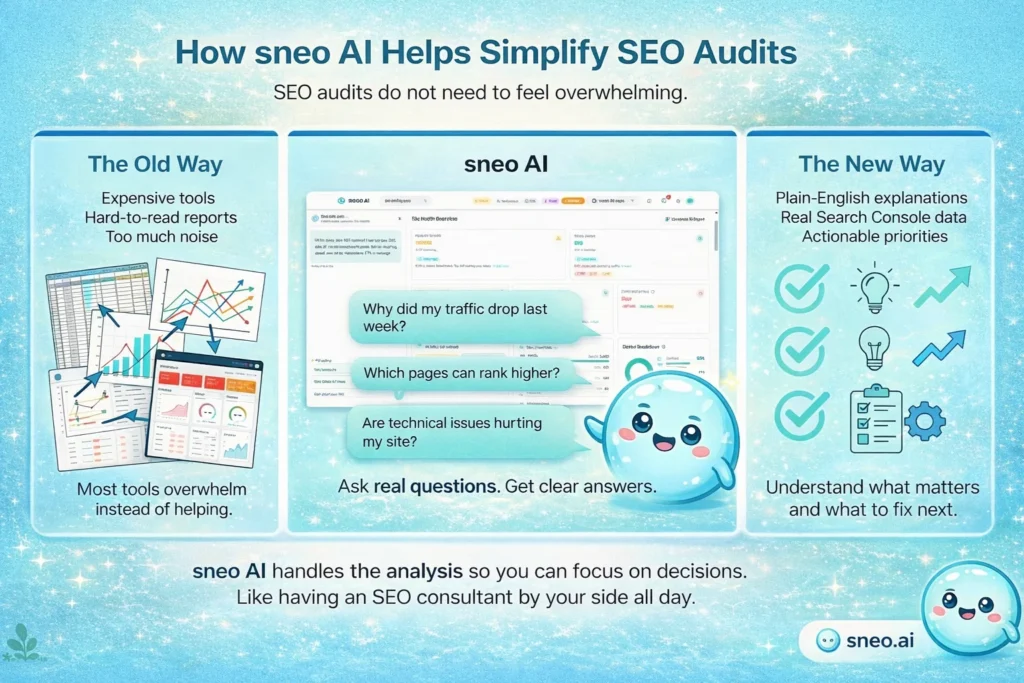
The system analyzes your real site data and gives you an answer in plain English. For beginners and small teams, this is a game-changer. It automates the heavy lifting of data analysis so you can focus on fixing the problems. It’s like having a consultant on your shoulder 24/7.
How Often Should You Run an SEO Audit?
I get asked this all the time: “Rahul, is this a one-time thing?”
No. The web changes too fast.
I recommend a quick checkup (which sneo.ai makes easy) every month to catch technical bugs or sudden drops. I recommend a full, deep-dive audit every quarter (every 3 months).
However, there are situations that demand an immediate review:
- After a website migration: If you moved your site, audit it immediately.
- After a sudden traffic drop: If you lose 20% of traffic overnight, something is broken.
- After a major Google algorithm update: To see if your site was impacted.
Keeping up with these changes is why an SEO audit is important for maintaining your position. If you stop watching, you will eventually start falling.
Conclusion
We have covered a lot of ground. We talked about technical errors, content quality, user experience, and competitors.
If you take one thing away from this guide, let it be this: An audit is not a finish line. It is a starting line. A PDF report full of errors does not help you. Fixing those errors helps you.
I want you to see an SEO audit as your biggest opportunity. Every error you find is a chance to get more traffic. Every gap you spot is a chance to beat a competitor.
Understanding why an SEO audit is important is the first step. The next step is taking action. Do not let the findings sit in a folder. Pick the top three issues, fix them, and watch your graph turn green.
Your data has the answers. You just need to look.
Frequently Asked Questions (FAQ)
1) What is the main goal of an SEO audit?
The main goal is to identify issues preventing your site from ranking and to spot opportunities for growth. It connects technical health, content quality, and user experience to give you a clear plan for improving your visibility. That clarity is exactly why an SEO audit is important for any business.
2) Can beginners run an SEO audit without expert help?
Yes, absolutely. While deep technical audits can be complex, tools like sneo.ai are built specifically for beginners. By connecting to Google Search Console, you can get high-level insights and identify major problems without needing to know how to code.
3) How long does it take to see results after an SEO audit?
It depends on the fixes. Technical fixes (like unblocking a page) can show results in a few days. Content and authority improvements usually take 3 to 6 months to gain traction. SEO is a marathon, not a sprint.
4) Are free SEO audit tools reliable?
They are good for surface-level checks. They can catch broken links or missing meta tags. However, they often lack context. They might tell you a page is “bad” because it is short, without realizing it is a contact page that should be short. For real strategy, you need data from Google Search Console, which is what we focus on at sneo.ai.
5) Does an SEO audit help small businesses compete?
Yes. In fact, it is your best weapon. Big companies move slowly. An audit helps you find the specific niche keywords and “easy wins” that big competitors ignore. It allows you to be smarter and faster. Knowing why SEO audit is important levels the playing field, giving you the data you need to outmaneuver larger budgets.