
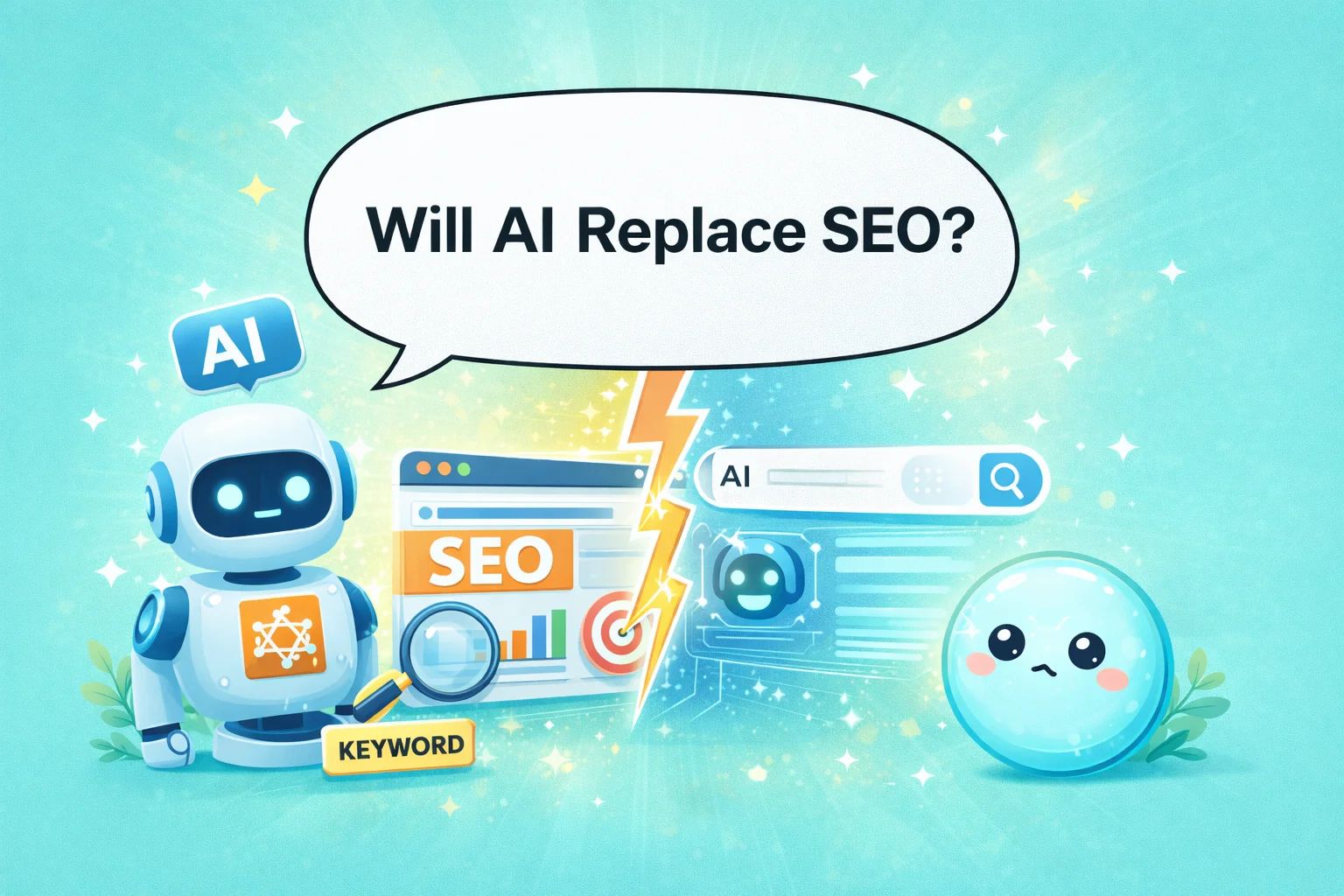

I receive the same panicked email weekly: “Rahul, is optimization dead? Will AI replace SEO entirely?”
I understand the anxiety. When you see tools like ChatGPT and Google’s AI Overviews rewriting the search results page, the ground feels unstable. We used to have clear rules for ranking. Now, machines generate content in seconds.
But here is what I tell every business owner: Panic is not a strategy. I have spent years analyzing traffic drops and algorithm shifts. This moment is not an extinction event; it is a mandatory update to our industry.
We must stop asking if robots will take our jobs and start asking how to work alongside them. The quick answer is this: will AI replace SEO? No. But it will replace the people who refuse to change.
Will AI Replace SEO: Quick Answer
No. While automation handles data processing and repetitive tasks, it lacks human judgment, trust, and strategic insight. The industry is shifting from execution to strategy, making human oversight more valuable than ever.
What SEO Actually Involves Today
To understand why a complete takeover by automation is unlikely, we first need to agree on what Search Engine Optimization actually is. When people ask if AI will replace SEO, they often think it is just “sprinkling keywords” into a blog post. If that were all I did, I would have been out of a job five years ago.
In practice, optimization is a massive discipline. It is part technical engineering, part creative writing, and part psychology.
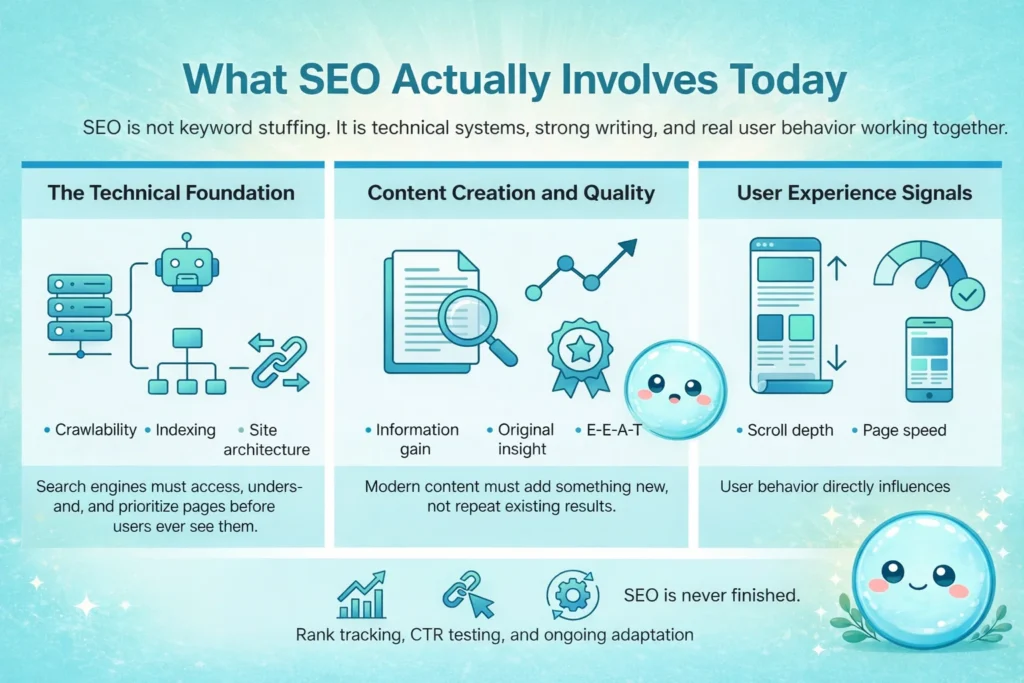
The Technical Foundation
Before a single person reads your content, a machine has to read it. I spend a significant amount of time dealing with technical foundations. This involves:
- Crawlability: Can the search engine bots actually access your pages? I have seen million-dollar sites tank because a developer accidentally blocked a specific directory in the robots.txt file. You can read more about how crawling works in Google’s official documentation.
- Indexing: Just because a bot crawls a page does not mean it stores it. Google is getting pickier. I constantly analyze the “Crawled – currently not indexed” report in Google Search Console to figure out why Google decided a page wasn’t worth its storage space.
- Site Architecture: How you structure your internal links tells search engines which pages matter most. It is like building a library; if you throw all the books in a pile, no one finds anything. You need shelves, sections, and logic.
Content Creation and Quality
This is the area everyone focuses on. Yes, we research what users are typing into search bars. But modern content work is about “Information Gain.” Google’s systems are now smart enough to ask, “Does this article add anything new, or is it just repeating the top 10 results?”
I often find myself telling clients that we cannot just publish a definition of a term anymore. We need to add original data, a unique perspective, or a case study. We have to demonstrate Experience, Expertise, Authoritativeness, and Trustworthiness (E-E-A-T), which is central to Google’s helpful content system.
The User Experience (UX) Signal
Search engines look closely at how users behave once they land on your site. Do they click back immediately? Do they scroll? Do they visit another page?
I treat UX as a core metric. If your site loads slowly (Core Web Vitals), or if an annoying popup covers the text on mobile, you lose rankings. It does not matter how good your keywords are if the user hates being there.
Rank Tracking and Adaptation
The job is never “done.” We track positions, sure, but we also track visibility. We look at click-through rates (CTR). According to data from Backlinko, the #1 result in Google gets 27.6% of all clicks. A page might rank #1, but if the title is boring and nobody clicks, that ranking will eventually drop. I constantly test new titles and meta descriptions to see what gets a human being to take action.
Why does this matter? Because while machines are great at processing data, they struggle with the “why.” They can see a traffic drop, but they often cannot tell you if it was because of a server error, a bad news cycle for your brand, or a seasonal dip. That requires context.
How Artificial Intelligence Is Used in SEO Right Now
Let’s be honest: we are already using heavy automation. I am not sitting here with an abacus and a ledger. I use sophisticated tools every single day. The question of AI replacing SEO often ignores the fact that we have been using machine learning in search for a decade.
Here is where the technology is currently doing the heavy lifting in my workflow:
1) Keyword Discovery and Clustering
In the old days, I would download a list of 5,000 keywords and manually sort them into Excel tabs. It took days. Now, I feed that list into a tool, and it groups them by “intent” in minutes.
It tells me, “Rahul, these 50 keywords are all basically asking the same question, so just write one page for them.” This pattern recognition is superior to human sorting because it identifies semantic relationships I might miss.
2) Content Drafts and Outlines
Generative text tools are excellent at overcoming “blank page syndrome.” HubSpot’s State of Marketing Report notes that a significant percentage of marketers use automation for content ideation. I use them to generate outlines. I might ask, “What are the common sub-topics covered in the top-ranking articles for ‘best running shoes’?”

The software scans the top results and gives me a list: durability, price, arch support, breathability. It ensures I don’t miss the basics. However—and this is critical—I never let it write the final draft unchecked. It tends to hallucinate facts or write in a very bland, repetitive style that bores readers.
3) Pattern Detection in Traffic
This is where automation shines. When you have a website with 10,000 pages, you cannot check every single one daily.
I use automated systems to set up alerts. If traffic to a specific category drops by more than 15% week-over-week, I get a ping. It acts as a smoke detector. It doesn’t put out the fire, but it tells me where the smoke is so I can grab the hose.
4) Reporting and Data Visualization
We used to spend the first week of every month just building reports. Now, live dashboards pull data from Google Search Console and Analytics automatically. This allows me to spend that week analyzing the data rather than copy-pasting it.
5) Where Automation Struggles
Despite these wins, the technology hits a wall when it comes to strategy. It can tell me “Traffic is down,” but it rarely tells me, “Traffic is down because your competitor launched a better product and their brand recognition is skyrocketing on TikTok.”
It lacks the ability to connect dots outside of its own dataset. It cannot read the room. It doesn’t know your business goals changed last Tuesday during a board meeting.
Why Artificial Intelligence Will Not Fully Replace SEO
If these tools are so powerful, why am I confident in my job security? And more importantly, why should you be confident that you still need a human strategy?
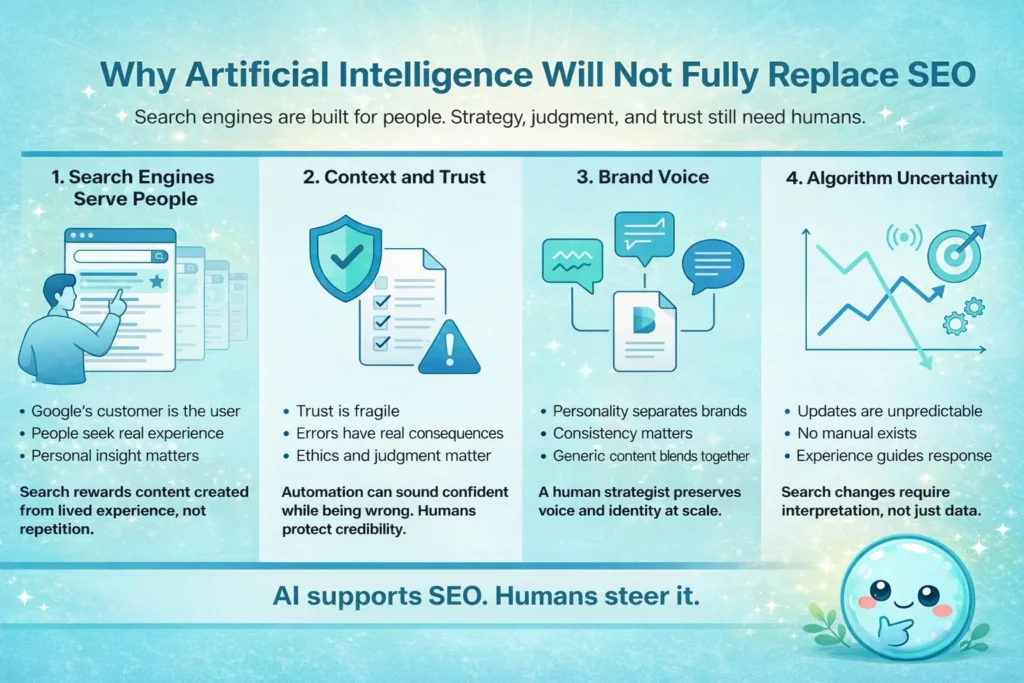
It comes down to the fundamental nature of search engines and humans.
1) Search Engines Serve People, Not Machines
At the end of the day, Google’s customer is the human searcher. If Google serves up 10 automated articles that all sound the same, users get frustrated. They stop trusting Google. We are already seeing this. Users are adding “reddit” to their searches because they crave human opinions.
Google knows this. That is why they are doubling down on “hidden gems” and content that demonstrates personal experience. They want to know that a real person actually wore the shoes, visited the hotel, or used the software. A machine can scrape specs, but it cannot tell you how the shoe felt after mile 20.
2) Context and Trust Signals
Trust is the currency of the web in 2026. A large language model can sound confident while being completely wrong.
I worked with a medical client recently. An automated tool suggested content claiming a certain supplement cured a specific ailment. If we had published that, the site would have been penalized (or worse, sued). A human editor knows the legal and ethical boundaries. A human knows that “trust” takes years to build and seconds to lose.
3) Brand Voice and Differentiation
If everyone uses the same tools to write content, everything sounds the same. It becomes “gray goo.”
Your brand voice is what separates you. Are you funny? Seriously? Sarcastic? Empathetic? Current generation tools struggle to maintain a consistent, unique voice across hundreds of pages without sounding forced. As a human strategist, I ensure that every piece of content sounds like you, not like a generic encyclopedia.
4) Algorithm Updates Are Unpredictable
Google changes its ranking systems thousands of times a year. Major core updates happen every few months. These updates often defy logic. Sometimes they prioritize speed; other times they prioritize content depth.
When an update hits, there is no manual. You have to look at the winners and losers and hypothesize what changed. This requires intuition and experience. A machine trained on data from 2023 cannot predict or react to a core update in 2026 until after the damage is done.
Real-World Example
I had a client whose traffic was flatlined. The automated audit tools said everything was fine—technical health was 100%, keywords were optimized.
But when I looked at the pages, I realized the tone was all wrong. They were selling luxury watches but speaking like a discount warehouse. The “data” was fine, but the “vibe” was off. We rewrote the copy to sound more exclusive and premium. Rankings didn’t change much, but sales doubled. No software could have flagged “lack of prestige” as an error.
The question of AI replacing SEO misses this nuance. It assumes SEO is a math problem. It’s not. It’s a sociology problem.
How SEO Roles Are Changing, Not Disappearing
While I am arguing that the industry isn’t dying, I cannot pretend it stays the same. The daily life of an SEO professional in 2026 looks very different from 2020. We are shifting from “doers” to “architects.” People asking will AI replace SEO usually don’t see this shift in responsibilities.
Tasks That Are Shrinking
- Basic Content Writing: Writing 500-word definitions is gone. Machines do that.
- Meta Tag Generation: I don’t manually write title tags anymore unless they are for critical pages. Automation handles the bulk work.
- Basic Code Checks: Finding broken links is fully automated.
Tasks That Are Growing in Value
- Strategy and Planning: Deciding what to write about and who to target is more important than ever. We spend more time on competitive analysis and market positioning.
- Content Quality Control: Editors are the new kings. Taking a raw draft and adding expert quotes, original data, and personality is a massive part of the workflow.
- Search Intent Analysis: Understanding exactly what a user wants when they type a query. Are they looking to buy, or just looking for a picture?
- Experience-Focused Improvements: We spend more time working with developers to improve page speed and layout. We spend time analyzing heatmaps to see where users get stuck.
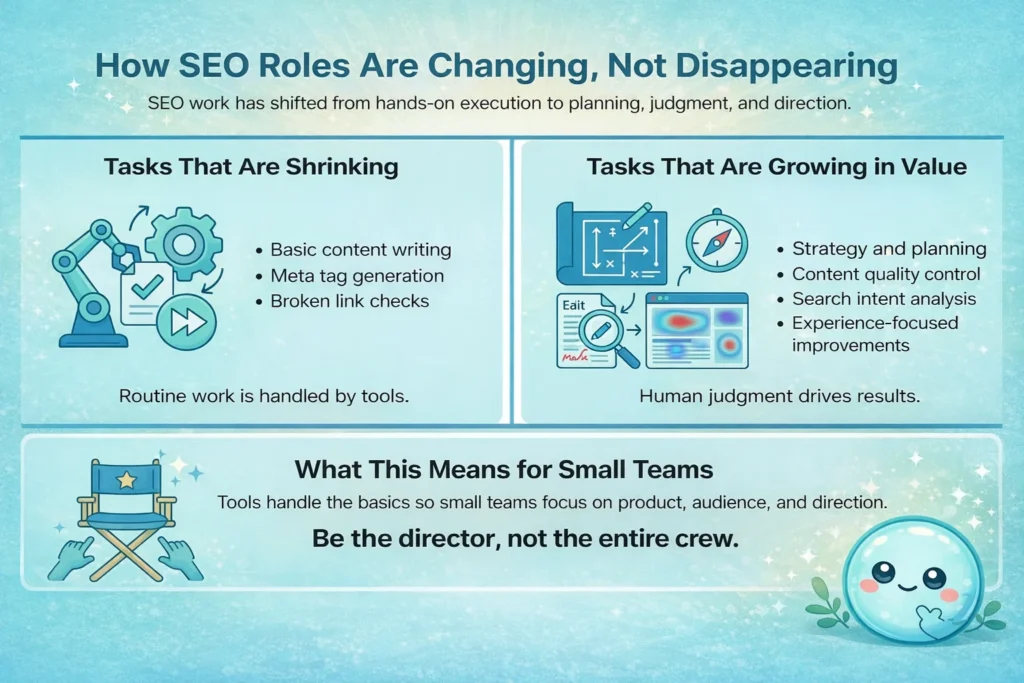
What This Means for Small Teams
If you are a solo site owner or a small team, this is actually good news. You don’t need to hire a massive agency to do the grunt work anymore. You can use tools to handle the basics, which frees you up to focus on what you know best: your product and your customers.
You become the director of the movie, rather than the person holding the boom mic, the camera, and the script all at once.
Artificial Intelligence as an Assistant, Not a Replacement
I like to think of these new tools as an “Iron Man suit.” Tony Stark is smart without the suit, but with it, he can fly. But—and this is critical—Tony is still piloting. If he takes a nap, the suit just hovers.
The most successful website owners I work with use automation to save time without losing control. They turn raw data into clear actions, but they make the final call.

The Problem with “Autopilot”
I’ve seen what happens when people try to put their SEO on full autopilot. One business owner I know connected a tool that auto-generated blog posts based on trending news.
At first, traffic spiked. Then, the tool published a story about a “breaking” event that turned out to be a hoax. Google’s algorithms picked up on the inaccuracy and the low-quality signals. The site lost 60% of its traffic in a week.
The mistake was trusting the machine to have judgment. Machines have processing power; humans have judgment.
Combining Speed with Wisdom
Here is the right way to do it:
- Use software to gather data: “Find me all keywords where I rank on page 2.”
- Use human insight to prioritize: “Of these 50 keywords, these 5 are high-margin products. Let’s fix those first.”
- Use software to draft: “Create an outline for this topic.”
- Use human expertise to refine: “Add a paragraph about our specific warranty and a photo of a customer using it.”
This hybrid approach is where the magic happens. It is efficient, but it stays safe and effective.
How sneo.ai Fits Into This New SEO Workflow
This brings me to why I built sneo.ai.
I spent years consulting, and I saw the same problem over and over. Business owners would open Google Search Console, stare at the “Performance” tab, see a bunch of jagged lines, and close the tab. They had the data, but they didn’t have the answers.
I realized there was a gap. We didn’t need another tool to give us more charts. We needed a tool that could explain the charts we already had.
What sneo.ai Actually Does
sneo.ai connects directly to your Google Search Console with a chat interface. It acts as a translation layer between the raw database and you.
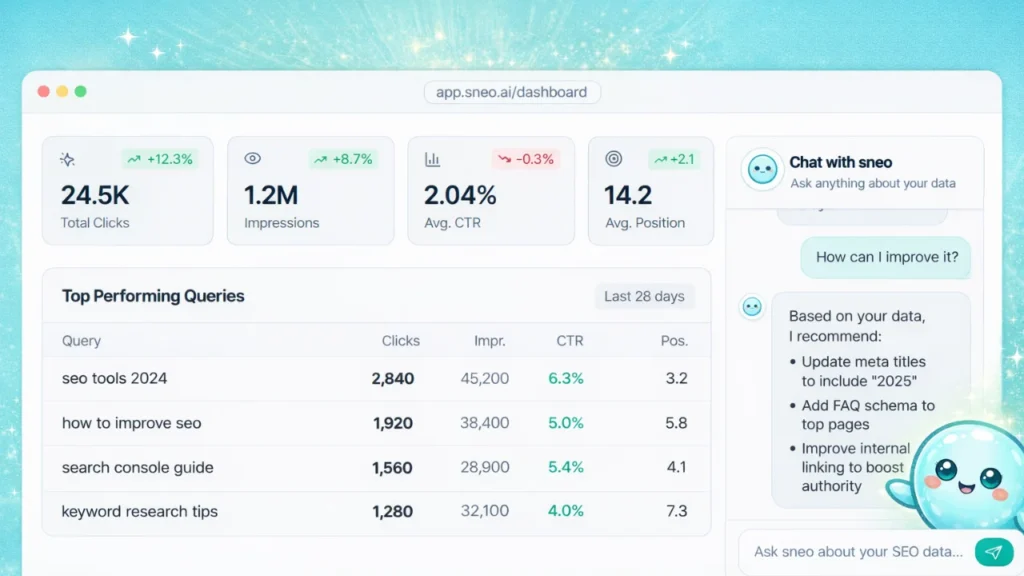
You can ask it direct questions in plain English, just like you would ask me over a cup of coffee:
- “Why did my traffic drop last week?”
- “Which pages are close to ranking on page 1?”
- “What keywords are bringing in the most impressions but no clicks?”
From Confusion to Clear Answers
When you ask these questions, sneo.ai analyzes your specific data and gives you a practical answer.
Instead of saying “CTR is down 2%,” it says: “Your traffic dropped because your top blog post on ‘Summer Trends’ lost its ranking for three main keywords. This might be seasonal. I recommend updating the article with fall trends.”
See the difference? One is a number; the other is a plan.
Who Benefits Most?
I built this specifically for:
- Website Owners: Who wear ten hats and need answers in 30 seconds, not 30 minutes.
- Small Business Teams: Who want to improve their search presence but don’t have the budget for a full-time agency.
- Marketers: Who manage multiple sites and need a quick way to spot fires before they burn down the house.
It is your 24/7 analyst. It handles the “pattern detection” part of the job instantly, so you can focus on the “strategy” and “business” parts. It ensures you never have to ask if AI will replace SEO, because you are using the technology to master it.
What Website Owners Should Focus on Going Forward
So, looking at 2026 and beyond, where should you put your energy? If you want to survive the changes in search, here is my advice.
1. Build Content That Solves Real Problems
Stop writing for robots. If your page exists only to catch a keyword, it is vulnerable. Build pages that answer questions so well that the user doesn’t need to click back to Google. Use video, use custom images, use your own data.
2. Focus on “Brand”
In a world of generic automated content, a strong brand is your defense. If people search for your company by name, no algorithm update can take that away from you. Be active on social media, build an email list, and create a community. Make sure people know who you are.
3. Track What Matters
Don’t obsess over vanity metrics like “total impressions.” Focus on “clicks” and “conversions.” Use tools like sneo.ai to cut through the noise. If traffic is down but sales are up, you are winning.
4. Stay Flexible
The only constant in search is change. The format of the search results page will look different in six months. Don’t get married to one specific tactic. Be ready to pivot.
5. Use Automation Wisely
Don’t fear the tools, but don’t blindly trust them either. Use them to speed up your research and reporting, but always keep your hands on the wheel.
Conclusion
The anxiety around AI replacing SEO is natural. We are living through a major technological shift. But history shows us that whenever technology automates a task, the value of human creativity and strategy goes up, not down.
Calculators didn’t replace mathematicians; they allowed mathematicians to solve harder problems. Photoshop didn’t replace artists; it gave them a new canvas.
Search Engine Optimization is not dying. It is shedding its skin. It is becoming less about manipulating code and keywords, and more about building genuine authority and delivering great user experiences.
The future of search belongs to those who can combine the speed of machines with the empathy and insight of a human. It belongs to the website owners who stop worrying about the robots and start focusing on their customers.
I have seen businesses thrive in this new environment by using data to make smarter decisions. Your data has the answers. You just need to ask the right questions. But will AI replace SEO completely? Not as long as humans are the ones doing the searching.
FAQ Section
1) Will artificial intelligence take over SEO jobs?
It will replace the repetitive, low-value tasks like basic keyword sorting and generic content writing. However, it will not replace the roles requiring strategy, creative direction, and high-level decision-making. The job description will change from “technician” to “strategist.”
2) Is SEO automation safe to use?
It is safe if you use it as an assistant, not a pilot. Using it to analyze data or generate outlines is great. Using it to auto-publish thousands of pages without review is dangerous and can lead to penalties from Google. Caution is necessary whenever content is going live to the public.
3) Can artificial intelligence write content that ranks well?
It can write content that ranks, but usually not for competitive terms. Google’s systems are trained to reward “Information Gain” and unique human experience. Purely automated content often lacks the depth, nuance, and trust signals required to hold a top position for long. It requires human editing and oversight.
4) How do algorithm updates affect automated SEO tools?
Tools react after the fact. When Google updates its algorithm, the tool’s programming is based on yesterday’s rules. A human SEO can look at the market, read the sentiment, and predict where things are going. Tools are reactive; humans can be proactive.
5) Is SEO still worth learning for beginners?
Absolutely. The fundamentals—understanding how users search and how the web is structured—are valuable for any business. While you might not need to learn the gritty technical details that tools can now handle, understanding the strategy of search is a massive competitive advantage. Tools like sneo.ai can help shorten the learning curve by explaining the data to you as you go.