
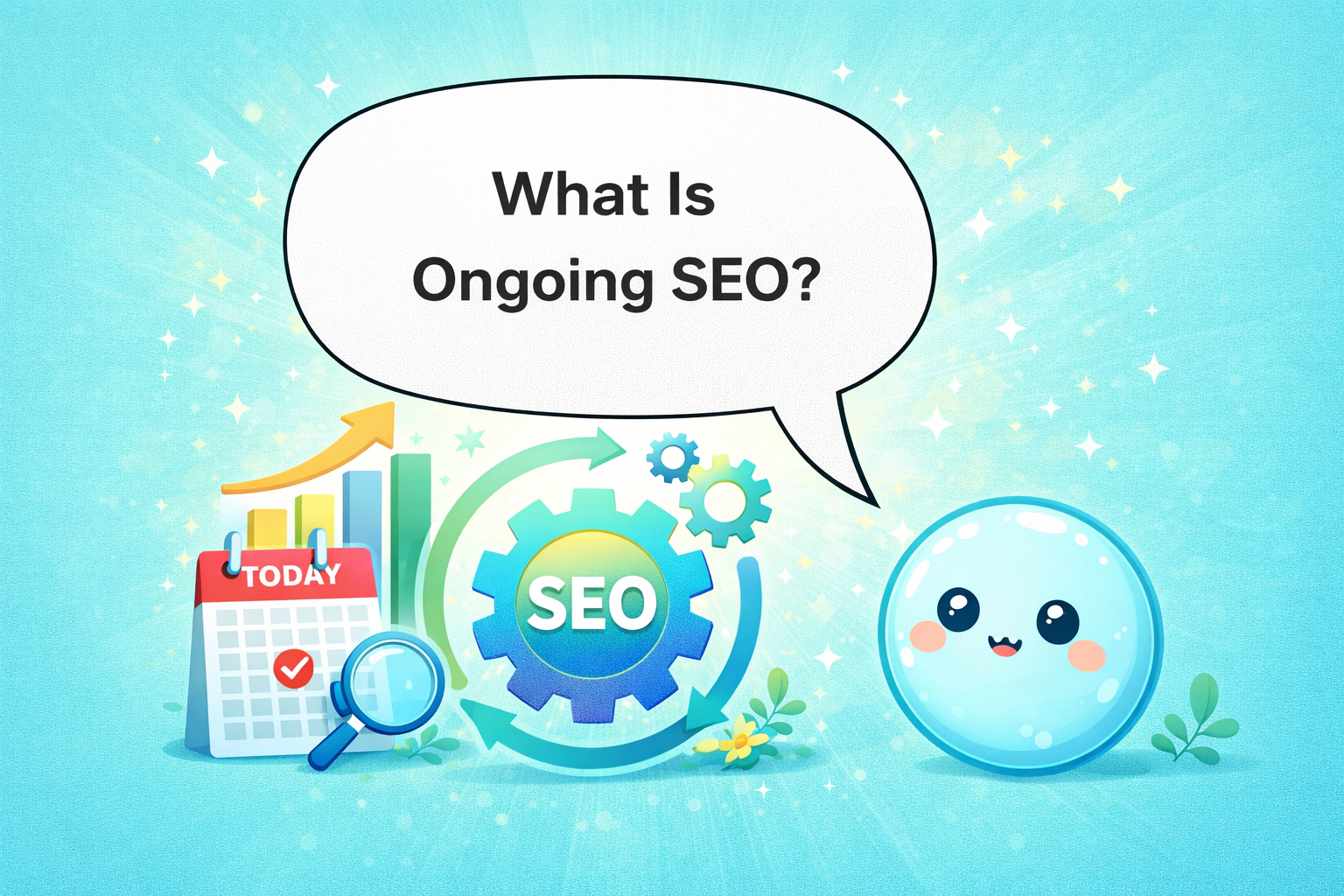

Simply put, what is ongoing SEO is the practice of continuously working to improve, maintain, and protect a website’s organic search rankings—month after month, not just once. Unlike a one-time website launch or a single content campaign, ongoing SEO is a living process that adapts to Google’s algorithm changes, shifting competitor strategies, and evolving user behavior.
Think of it like keeping a car on the road. You don’t service it once and expect it to run forever. You change the oil, rotate the tyres, check the brakes. SEO is exactly the same.
Ongoing SEO is the sustained, month-by-month practice of optimizing a website’s content, technical health, and link profile to maintain and grow organic search visibility over time—adapting continuously to algorithm changes, competitor activity, and user intent shifts.
Google runs thousands of algorithm updates every year. According to Google’s own documentation, its systems are constantly evaluating pages for relevance, quality, and authority. A page that ranks well today may slip tomorrow—not because you did anything wrong, but because the landscape changed around you.
Why Continuous SEO Is Non-Negotiable in 2025–2026
I remember a client—a mid-sized e-commerce store—who told me confidently: ‘We already did SEO last year.’ Within eight months, their organic traffic had dropped 38% after a Google core update. The problem wasn’t a penalty. It was stagnation.
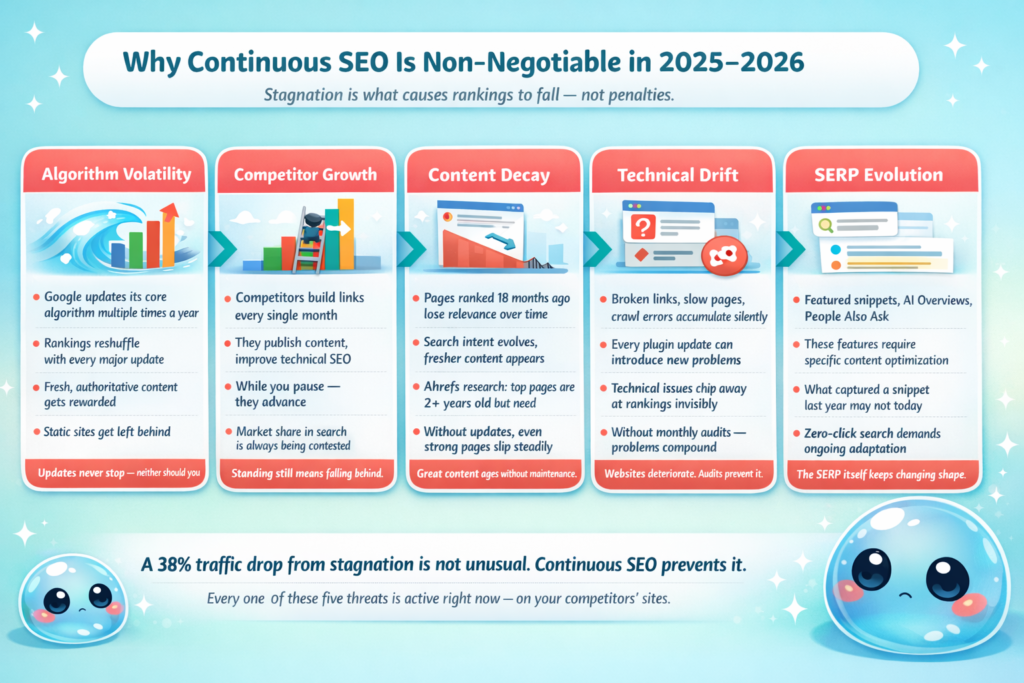
Here’s what continuous SEO protects you from:
- Algorithm volatility: Google updates its core algorithm multiple times a year, reshuffling rankings and rewarding fresh, authoritative content.
- Competitor growth: Your rivals are actively building links, publishing content, and improving their technical SEO—every month.
- Content decay: Pages that ranked well 18 months ago often lose relevance as search intent evolves and fresher content appears.
- Technical drift: Websites accumulate broken links, slow pages, and crawl errors over time—silently hurting your search visibility.
- Zero-click search and SERP evolution: Featured snippets, AI Overviews, and People Also Ask boxes require ongoing optimization to capture.
Ahrefs’ research on content decay shows that the average top-ranking page is over 2 years old—but without regular updates, those pages slip down steadily. I’ve seen this firsthand: a client’s pillar content that ranked number 1 for 18 months started losing ground the moment they stopped updating it.
This is exactly why what is ongoing SEO has become the foundational question for any serious website owner. It’s not optional—it’s the cost of staying visible.
The Core Recurring SEO Tasks: What Happens Every Month
When I onboard a client for an SEO retainer, I always walk them through exactly what we’ll be doing every single month. Here’s what genuine monthly SEO services actually involve:
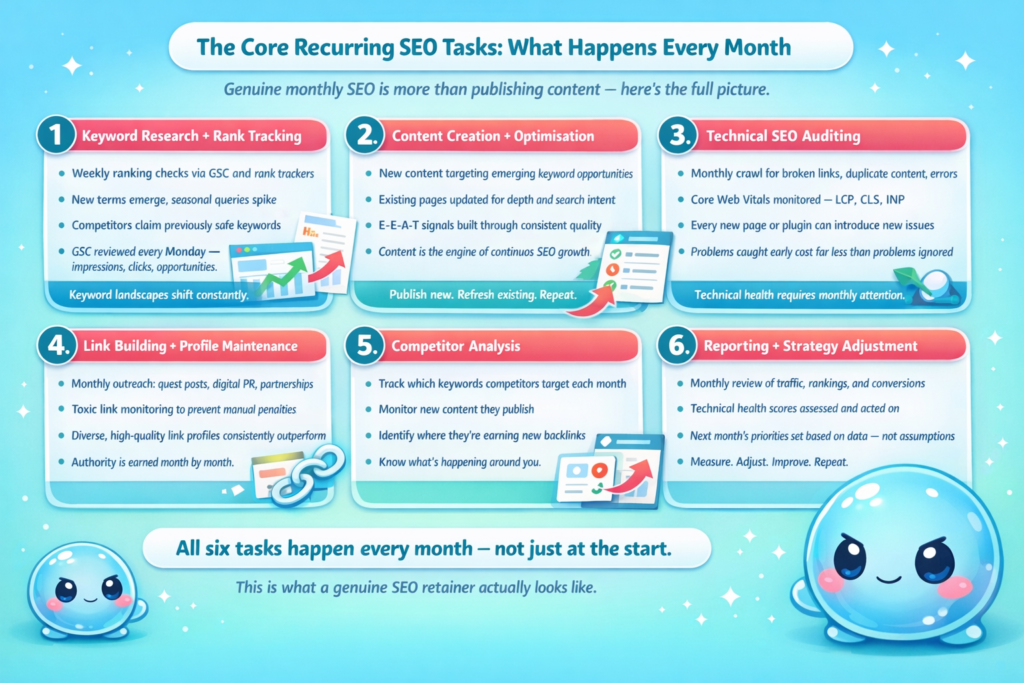
1. Keyword Research and Rank Tracking
I check keyword rankings weekly using Google Search Console and third-party rank trackers. Search trends shift—new terms emerge, seasonal queries spike, and competitor pages claim keywords I’ve been targeting. Staying on top of keyword research means constantly refreshing the list of opportunities.
Google Search Console is my first stop every Monday morning. I check which queries are gaining or losing impressions and clicks, and I use that data to prioritise which pages need attention this month.
2. Content Creation and Optimisation
Fresh, high-quality content is the engine of continuous SEO. Every month, I’m either publishing new pieces targeting emerging keywords or updating existing pages to improve depth, accuracy, and alignment with current search intent. Google’s Search Quality Evaluator Guidelines make clear that Expertise, Authoritativeness, and Trustworthiness (E-E-A-T) are core signals—and those signals are built through consistent, quality content over time.
3. Technical SEO Auditing
Every month, I run a technical audit to catch crawl errors, broken internal links, duplicate content, slow-loading pages, and Core Web Vitals issues. These problems accumulate silently and chip away at rankings if left unchecked.
I especially watch Core Web Vitals—Google’s page experience signals. A drop in Largest Contentful Paint (LCP) or an increase in Cumulative Layout Shift (CLS) can directly impact rankings, and these metrics fluctuate with every new page added or plugin installed.
4. Link Building and Link Profile Maintenance
Building high-quality backlinks is a monthly discipline, not a one-time push. I focus on earning links from authoritative, relevant sources through digital PR, guest publishing, and content partnerships. At the same time, I monitor the link profile for toxic links that could trigger a manual penalty.
Moz’s research on domain authority consistently shows that sites with diverse, high-quality link profiles outperform those with static or spammy backlinks. Monthly link building is how you build that profile systematically.
5. Competitor Analysis
I track what competitors are doing every month—which keywords they’re targeting, what content they’re publishing, and where they’re earning new links. This isn’t copying; it’s intelligent market intelligence that informs where to focus energy.
6. Reporting and Strategy Adjustment
Every month, I review performance data and adjust the strategy. SEO without measurement is guesswork. I look at organic traffic trends, keyword movement, conversion rates from organic search, and technical health scores—then reprioritise the next month’s work accordingly.
The single biggest mistake I see businesses make is treating SEO as a project with a completion date. Organic search is a competitive, algorithm-driven environment that never stops changing—and neither should your SEO effort.
SEO Retainer vs. One-Time SEO: Understanding the Difference
I get asked this constantly: ‘Can’t I just do SEO once and move on?’ Here’s how I explain the difference to every new client:
| Factor | One-Time SEO | Ongoing SEO / SEO Retainer |
|---|---|---|
| Duration | Days to weeks | Month after month |
| Adaptability | Fixed scope, no adjustments | Adapts to algorithm changes and competitors |
| Content output | Initial batch only | Regular publishing and updates |
| Link building | One-time push | Consistent, growing profile |
| Technical monitoring | Snapshot at project start | Continuous monitoring and fixes |
| Results timeline | Short-term lift, then decline | Compounding growth over time |
| Best for | New site launches or audits | Established sites wanting sustained growth |
An SEO retainer is the formal arrangement that makes ongoing SEO sustainable. It gives me—and my clients—the structure to plan months ahead, build momentum, and make strategic decisions based on cumulative data rather than one-off snapshots.
How sneo.ai Makes Ongoing SEO Manageable for Everyone
I built sneo.ai because I watched too many business owners either pay thousands for SEO retainers they barely understood, or give up on continuous SEO entirely because it felt overwhelming. Neither outcome is acceptable.
sneo.ai is an AI-powered SEO assistant connected directly to your Google Search Console. Instead of staring at dashboards full of numbers you’re not sure how to interpret, you simply ask a question in plain English: ‘Why did my traffic drop last month?’ or ‘Which pages have the most potential to move up in rankings?’
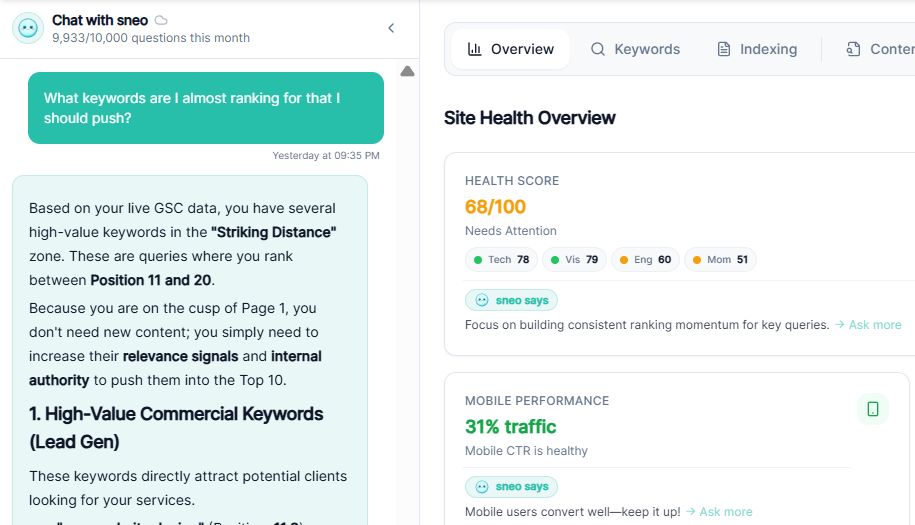
Just last month, a client came to me confused about a sudden drop in impressions. Instead of spending an hour digging through Search Console manually, I connected her data to sneo.ai and asked a single question. The answer came back instantly: a group of her top-performing pages had been de-indexed after a plugin update had accidentally added a noindex tag. We fixed it in 20 minutes.
Here’s what sneo.ai makes easier for recurring SEO tasks:
- Instant diagnosis: Ask why traffic dropped, which keywords slipped, or which pages underperform—and get a clear, data-backed answer.
- Opportunity spotting: sneo.ai surfaces pages with high impressions but low click-through rates—prime candidates for title tag and meta description optimisation.
- Progress tracking: Monitor keyword and page performance over time without needing to build custom dashboards.
- Plain-English reporting: Understand your SEO performance without needing to be a data scientist.
I think of sneo.ai as ‘your Google Search Console data, decoded.’ It doesn’t replace the strategic thinking and content work that SEO maintenance requires—but it eliminates the friction of understanding what’s happening and what to do next.
How Long Does Ongoing SEO Take to Show Results?
This is the honest question I get from almost every new client, and I always give the same honest answer: expect meaningful results in 3–6 months, with compounding growth from 6–12 months onward.
Search engine optimization is not a paid advertising channel—you can’t flip a switch and see immediate results. But the flip side is equally important: the results you earn through what is ongoing SEO are far more durable than paid traffic. A page that earns its way to position 1 through consistent effort and quality doesn’t disappear the moment you stop paying per click.
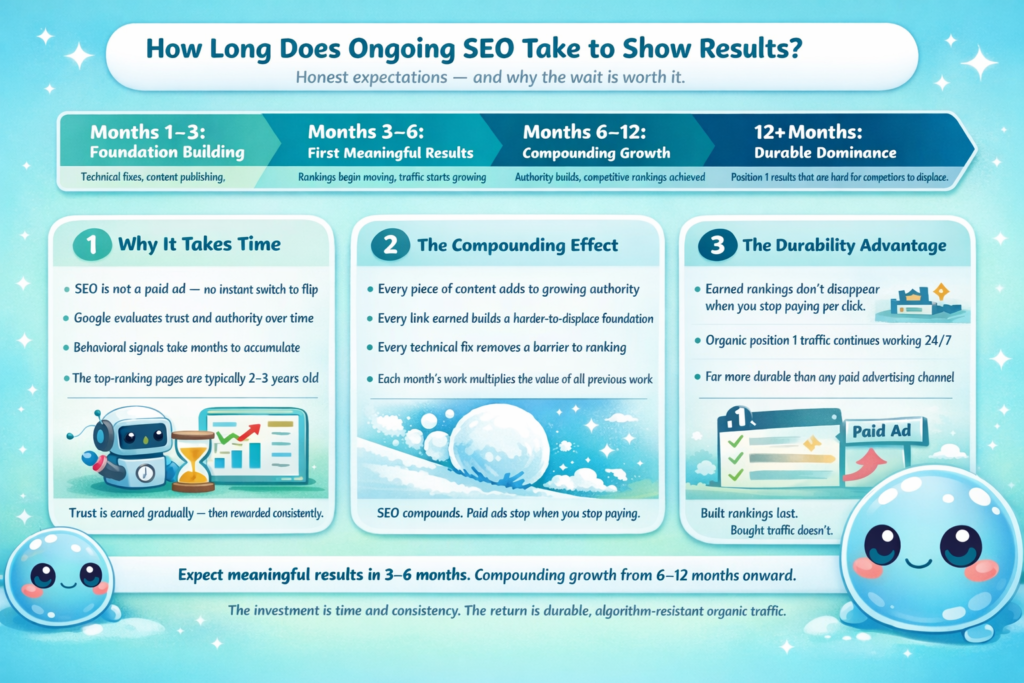
Search Engine Journal’s analysis of SEO timelines confirms that the majority of top-ranking pages are 2–3 years old—but they get there through consistent, sustained work. That’s continuous SEO in action.
The compounding effect is real. Every piece of content you publish, every link you earn, and every technical issue you fix adds to a growing foundation of authority and relevance that gets harder for competitors to displace over time.
What to Look for in Monthly SEO Services
If you’re evaluating monthly SEO services from an agency or consultant, here’s what I look for—and what I’d tell any business owner to insist on:
- Transparent reporting: You should receive a clear monthly report showing keyword rankings, traffic trends, technical health, and work completed.
- Defined deliverables: Know exactly what work is being done each month—content pieces, links built, technical fixes, and so on.
- Google Search Console access: Any legitimate SEO provider works directly with your Search Console data.
- Strategic adjustment: Monthly strategy reviews that adapt to what the data is showing, not a rigid playbook executed on autopilot.
- Clear communication: Regular check-ins where the SEO provider explains what they’ve done and why.
- No guarantees of position 1: Anyone who guarantees specific rankings is either naive or dishonest. Reputable providers commit to best-practice work and measurable progress.
I’ve seen businesses waste significant budget on agencies that delivered monthly PDF reports full of vanity metrics—clicks from branded searches, impressions for irrelevant queries—while the real organic traffic flatlined. Always look behind the headline numbers.
Frequently Asked Questions About Ongoing SEO
1) How is ongoing SEO different from a one-time SEO audit?
A one-time SEO audit is a diagnostic snapshot—it identifies problems at a specific moment in time. Ongoing SEO is the sustained work of fixing those problems, adapting to new ones, building authority, and responding to algorithm changes month after month. An audit is the starting point; what is ongoing SEO is the marathon that follows.
2) How much do monthly SEO services typically cost?
Monthly SEO services vary widely depending on the scope of work and the authority of your site. Small business retainers can start from a few hundred dollars per month for basic recurring SEO tasks, while competitive industries with aggressive link-building programs can run to several thousand dollars monthly. The key is understanding exactly what’s included—not just the headline price.
3) Can I do ongoing SEO myself without hiring an agency?
Absolutely—especially with the right tools. If you’re willing to invest time in learning keyword research, content creation, and basic technical SEO, you can manage much of it yourself. Tools like sneo.ai make it far easier to understand your Google Search Console data and identify what needs attention each month, even without a technical SEO background.
4) What happens if I stop doing SEO for a few months?
In my experience, most sites start to see ranking declines within 3–6 months of stopping active SEO work—sooner in competitive niches. Competitors continue building links and publishing content, algorithm updates shift the landscape, and content freshness signals fade. It’s rarely catastrophic overnight, but the slide is real and reversible only with renewed effort.
5) How does sneo.ai support ongoing SEO?
sneo.ai connects directly to your Google Search Console and gives you an AI assistant you can ask anything about your site’s SEO performance. Instead of manually digging through data to understand what’s happening, you get clear, actionable answers—making the SEO maintenance process faster and more accessible for business owners at any skill level.
Start Your Ongoing SEO Journey Today
I’ve spent years helping website owners understand that what is ongoing SEO isn’t a complicated concept—it’s simply the commitment to staying competitive in a search landscape that never stands still. The businesses I’ve worked with that treat SEO as a continuous investment consistently outgrow the ones that treat it as a checkbox.
You don’t need to become a data scientist to make this work. You don’t need to understand every algorithm update the moment it drops. What you need is a system: regular attention, clear data, and the willingness to adapt.
Start by connecting your Google Search Console to sneo.ai and asking me one question about your site’s performance. Let’s see what your data is telling you—and build your continuous SEO strategy from there.